When You're the Caregiver for Your Own Spouse
Sep 04, 2026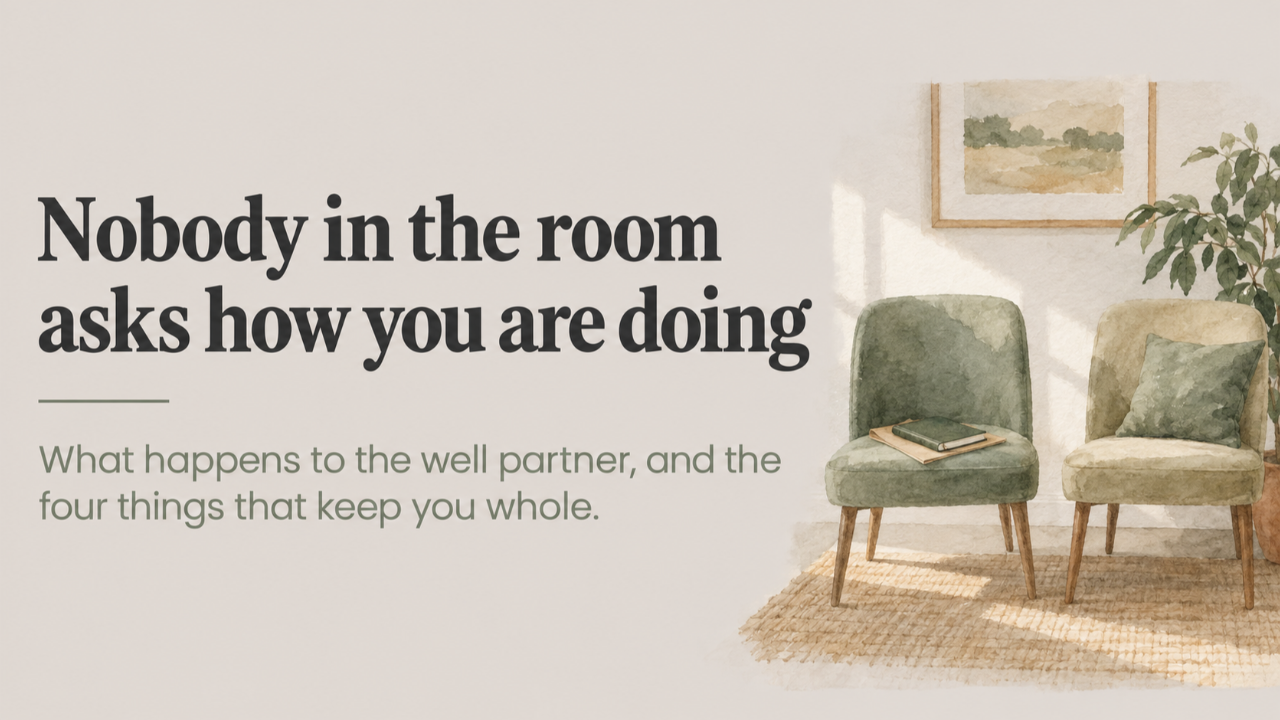
There is a moment I see that almost nobody writes about.
The patient is talking. The specialist is talking. Scans, cycles, counts, side effects, next steps. And off to the side, in the second chair, is the husband or the wife. They are holding the folder. They have the notebook. They are the one who wrote down the question everybody else forgot to ask.
Nobody in the room asks them how they are doing.
Because when your spouse is the one who is sick, there is an unspoken rule you absorb almost immediately. My job is to be steady. My feelings can wait. This is not my crisis.
I understand that instinct. I have felt it. But I want to say something plainly, right at the start, because it is the entire reason I am writing this.
You are not support staff in your spouse's illness. You are a person inside it.
The role nobody applies for
You did not train for this. There was no orientation. One day you were a husband or a wife, and then there was a phone call, and now you are also a pharmacist, a scheduler, a driver, a nurse, an insurance negotiator, a translator of words like adjuvant and ejection fraction, and the person who has to decide whether that new symptom at 11 p.m. means call the doctor or wait until morning.
You are also, still, the person who loves them.
If it helps to know you are not unusual, the numbers are staggering. The 2025 Caregiving in the US report from AARP and the National Alliance for Caregiving found that 63 million Americans, nearly one in four adults, provided ongoing care for an adult or a child with a complex medical condition or disability in the past year. That is an increase of about 20 million people since 2015. Roughly 44 percent described their caregiving as high intensity, and more than half were performing medical or nursing tasks that used to happen only in hospitals.
But spousal caregiving is its own particular thing, and I think it deserves to be named as such.
An adult child caring for a parent goes home at some point. A hired aide finishes a shift. A spouse does not. You live inside the illness. You sleep next to it. The person you would normally go to when something frightening happens is the frightening thing that is happening. And the relationship itself quietly changes underneath you, from partner and partner into something that can start to feel like patient and staff.
That is the part that tends to hurt the most, and it is almost never the part people talk about out loud.
What actually harms caregivers, and what does not
There is a famous study that gets quoted at caregivers constantly, usually in a way that scares them.
In 1999, Schulz and Beach published findings from the Caregiver Health Effects Study in JAMA. Older spousal caregivers who reported mental or emotional strain had a 63 percent higher risk of dying within four years compared with spouses of people without disability. That number has been repeated in a thousand articles and pamphlets ever since.
Here is the part that almost never gets repeated with it.
In 2015, Roth, Fredman and Haley published a reappraisal in The Gerontologist looking at several large population based studies. Caregivers as a whole, compared with carefully matched people who were not caregivers, did not show higher mortality. Several of those studies actually found lower mortality among caregivers. Many caregivers report real benefit from the role. The researchers argued that the public picture of caregiving has become unnecessarily dire.
The danger is not caring for someone you love. The danger is strain.
Caregiving while depleted, isolated, sleepless, unsupported, and quietly convinced that your own needs no longer count. That is the exposure. Not the love. Not the devotion. Not the showing up.
How to tell if you are already there
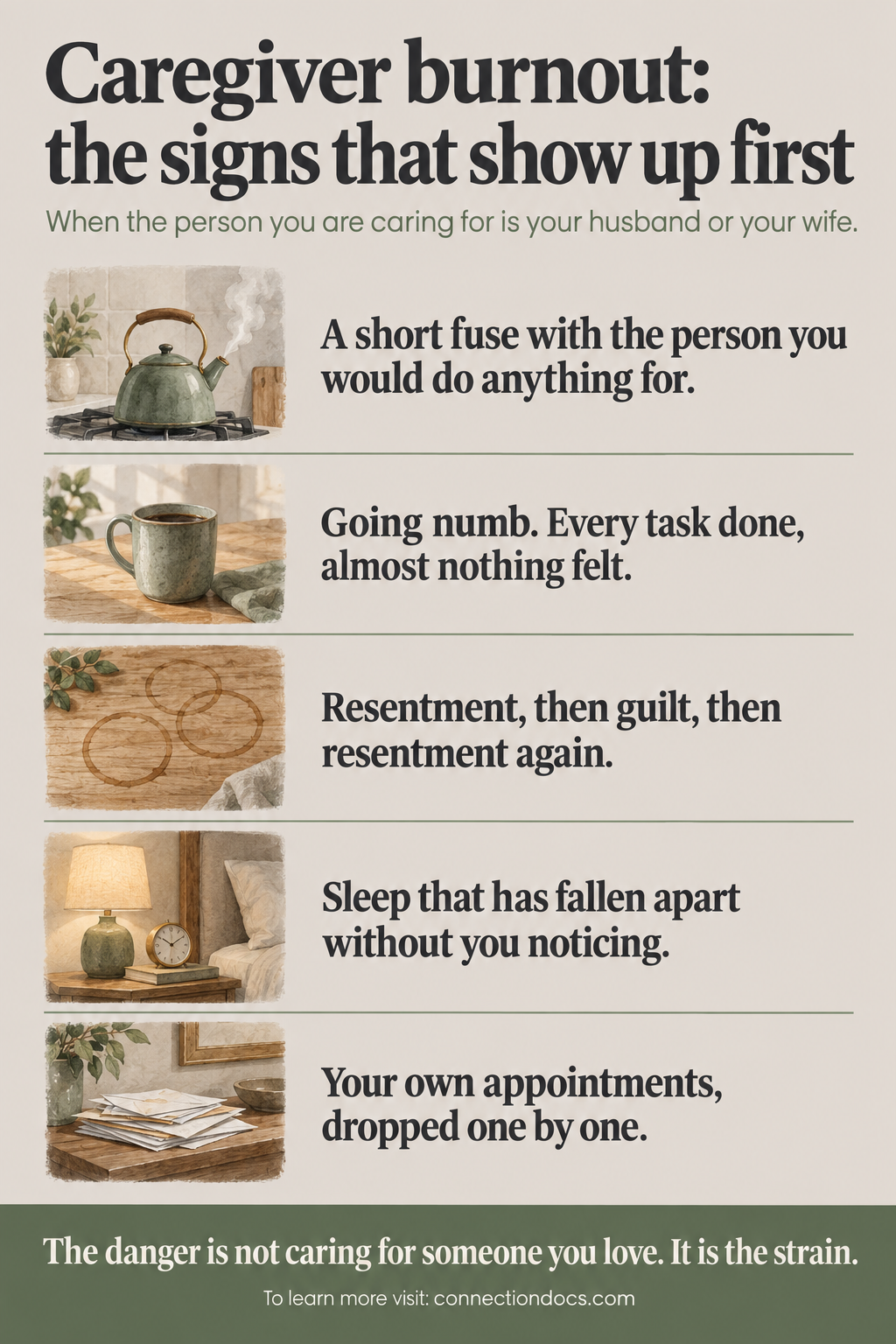
Caregiver burnout and compassion fatigue rarely arrive with an announcement. They arrive quietly, and they usually show up first in how you feel about the person you are caring for. That is what makes them so disorienting.
Some of the signs I watch for:
- A short fuse with the very person you would do anything for.
- Going numb, where you can still perform every task but you have stopped feeling much of anything.
- Dread on the drive home.
- Resentment, immediately followed by guilt, on a loop.
- Sleep that has quietly fallen apart. In one study of hospice family caregivers, roughly half met criteria for insomnia, and caregivers with insomnia rated their own physical health dramatically worse. In the REGARDS study, new caregivers took significantly longer to fall asleep than matched people who were not caregiving.
- Letting your own care go. Your mammogram, your colonoscopy, your blood pressure refill, the mole you have been meaning to have looked at.
That last one is the one I would most like to intercept. Because the thing your spouse needs most is not a caregiver who sacrificed everything. It is a caregiver who is still here in two years.
Whenever we sit with spousal caregivers, we keep coming back to the same four places. Fun, Food, Fitness, Family. They sound almost too simple. They are not. They are the four structures that hold a human being up, and when someone is drowning in caregiving, all four tend to collapse at the same time.
Fun: the part of you that is not a caregiver
Fun is your connection with yourself. It is the things you like to do, for no reason other than that you like them. It is the friends who knew you before any of this.
It is almost always the first thing to go, and it goes without a decision. Nobody sits down and announces that they are giving up the guitar, or the fishing, or the Thursday night group, or the garden. It just erodes. There is a chemo appointment on Thursday. Then there is a scan. Then there is the week you were too tired. And then a year has passed and you cannot remember the last time you did something that was purely yours.
Fun is not a reward you collect after the caregiving is finished. There is no finished. Illness does not have a graduation date, and if you are waiting for one before you allow yourself to be a person again, you may wait a very long time.
Protect one thing. Just one. Not a whole reclaimed identity, one thing.
Twenty minutes with the guitar. The Saturday morning walk with the friend who does not ask about lab values. The book club. The woodshop. The long shower with the door closed. The friend you text something ridiculous to at 10 p.m.
Ask yourself honestly: what did I used to do that made me feel like me?
Then ask the harder question: what is the smallest possible version of that, and could it happen this week?
Not because you deserve a break, though you do. Because a person who has completely disappeared into a role has nothing left to bring back to the person they love.
Food: fuel on the days when cooking is the last thing you want to do
I want to be careful here, because caregivers get lectured about nutrition more than almost anyone, usually by people who are not currently running two households worth of medical logistics.
So let me say the thing I actually believe. There is no single perfect diet. There is no plan that works for every body, every schedule, every culture, every set of preferences. Your job is not to find the optimal diet. Your job is to find the one you can actually keep on a Tuesday when the infusion ran three hours long.
What tends to happen instead is this. You eat the cafeteria sandwich. You eat standing at the counter at 9 p.m. You eat the food you made for your spouse, or you skip it entirely and have a fourth cup of coffee, and then you wonder why your mood has flattened and your sleep is worse and your body hurts.
A few things that hold up under real conditions:
- Anchor each meal around protein and something that grew. That is it. That single rule survives chaos better than any meal plan.
- Keep a short list of five meals you can make half asleep, and keep those ingredients in the house permanently.
- Treat hydration as medical. Caregiver headaches and caregiver fatigue are sometimes just dehydration wearing a costume.
- Be honest about the evening drink. Alcohol is an excellent short term anesthetic and a terrible long term one, and it wrecks the sleep you cannot afford to lose.
- Let people feed you. When friends ask what they can do, food is the single most useful, least awkward thing they can give. Say yes. Ask for a specific night.
And please do not add nutritional perfectionism to the pile of things you are failing at. You are not failing. You are carrying an enormous load. Eat in a way that keeps you upright, and let the rest go.
Fitness: functional, outdoors, and honest about the time you have
When I say fitness, I do not mean a program. I mean functional capacity. Can you get your spouse into the car. Can you get up off the floor. Can you carry the groceries and the walker and the bag in one trip. Can you get through the day without your back giving out.
Steps. Strength. Sunlight. That is the whole prescription.
The research here is encouraging, and also honest about its limits. A 24 week aerobic exercise trial in family caregivers, analyzed in the Annals of Behavioral Medicine, found reductions in perceived caregiver burden and depressive symptoms along with an improved sense of mastery. Systematic reviews of exercise programs for caregivers of older adults with chronic disease have generally found reduced burden and stress, though not every trial has been positive. Exercise is not a cure for a hard situation. It is, reliably, one of the few levers that gives you back energy instead of costing you energy.
What that looks like in a caregiving week:
- Ten minutes, twice a day, beats sixty minutes once a week that never happens.
- Walk the hospital corridor or the parking lot during infusion instead of sitting in the waiting room chair.
- Two sessions a week of something that loads your muscles. Bands, dumbbells, a few bodyweight movements in the living room. Lifting is what preserves your ability to physically care for another adult.
- Get outside every single day, even briefly. Daylight early in the day does more for your sleep than almost anything you can buy.
- If your spouse is able, walk together. It is exercise and it is time together that is not about the illness.
Family: letting the circle around you become real
If Fun is your relationship with yourself, Family is everybody else. Children, siblings, the neighbors, the church group, the friends who have become family. These are the people who want to help and have no idea how.
Caregiving isolates people with remarkable efficiency. And isolation is not a soft problem. The 2023 Surgeon General's advisory on loneliness described social disconnection as carrying a mortality risk comparable to smoking up to 15 cigarettes a day, with elevated risk of heart disease, stroke, dementia, depression and premature death.
So here is the practical work.
First, convert vague offers into specific jobs. When someone says let me know if you need anything, they mean it, but they cannot read your mind and they are afraid of intruding. Keep a running list on the refrigerator. Thursday pickup. Lawn. Pharmacy run. Sit with him for two hours Saturday so I can go to my own appointment. People are far more willing than you think. They just need an assignment.
Second, take respite seriously, and take it early. Respite care means planned, temporary relief, from a few hours to a few weeks, at home, at an adult day program, or in a facility. The National Institute on Aging points caregivers to the ARCH National Respite Locator. Your local Area Agency on Aging, reachable through the Eldercare Locator, can tell you what is funded in your area. If your spouse is a veteran, the VA Caregiver Support Line is a real and underused resource. ARCH makes a point I wish more people heard: respite works best when you use it before you are exhausted, not after.
Third, find other people who are in it. Caregiver support groups, in person or online, do something no amount of sympathy from the uninitiated can do. They let you say the ugly thing out loud and hear somebody answer, yes, me too.
And fourth, the one I care about most.
Stay married inside the caregiving.
There is a line of research on what is called communal coping, measured partly through what researchers call we-talk, the use of first person plural language. Couples who talk about the illness as something that is happening to us rather than to you tend to show better psychological well being, better relationship quality, and in some studies better illness outcomes. Notably, the partner's we-talk often predicts the patient's outcomes more strongly than the patient's own.
I do not think that is a communication trick. I think it is a reflection of something deeper, which is whether the two of you are still a we.
So protect something that has nothing to do with the disease. A show you watch together. Sunday breakfast. Holding hands with the television off. Ten minutes where nobody mentions a symptom. You are still partners. You were partners long before any of this arrived, and you will be partners regardless of how it goes.
A word about the guilt
Almost every spousal caregiver I have sat with eventually says some version of the same sentence, usually quietly, usually looking at the floor.
Sometimes I just want my life back.
I never do. Resentment is not the opposite of love. It is what love feels like when it has been running without rest for a very long time. Grief, exhaustion, tenderness, anger and devotion can all occupy the same chest at the same time. They routinely do.
You are allowed to want your life back and love your spouse completely. Both are true. Neither cancels the other.
If that guilt is running your days, please say it out loud to someone. A therapist, a chaplain, a caregiver group, a friend who can hear it without flinching. Guilt that stays private tends to grow. Guilt that gets spoken tends to shrink.
The question I ask the person in the second chair
When the appointment winds down and everyone is gathering their coats, I sometimes turn to the spouse and ask one question.
Who is taking care of you?
Most of the time there is a pause. Sometimes their eyes fill. Almost always the answer is some version of nobody, or I am fine, or we are focused on him right now.
So let me ask you the same thing, along with the follow ups I usually add.
- Who is taking care of you?
- When did you last do something purely because you enjoy it?
- When is your next appointment for your own health?
- Who could take one shift this month so you could sleep, or leave, or breathe?
- What part of your marriage is still just your marriage?
You do not have to fix all of it. Pick one. One walk, one meal you did not cook, one friend, one afternoon of respite, one honest conversation with the person you love about how you are actually doing.
The most loving thing you can do for your sick spouse is to refuse to disappear.
Stay a whole person. Keep your friendships, your body, your appetite, your curiosity, your sense of humor, your own doctor's appointments. Not instead of caring for them. So that you can keep caring for them, and so that whatever comes, you are still someone when the season changes.
You matter in this story. Not as a helper. As one of the two people it is happening to.
If this is sitting heavy tonight
If you are reading this at 2 a.m. after finally getting them settled, and you do not know where to start, you do not have to figure it out alone.
This is exactly the kind of conversation we have with people every week. Not a sales call, not a treatment plan. A conversation about what you are carrying, what actually matters to you, and what a more livable version of the next six months could look like for both of you.
If that would help, you are welcome to book a connection call with us at https://www.connectiondocs.com/connection-call. Whenever you are ready. No pressure, no agenda.
And in the meantime, whatever else today holds, please eat something real, step outside for a few minutes, and text one person who loves you.
You are not alone in that second chair.
References and resources
AARP and National Alliance for Caregiving. Caregiving in the US 2025. https://www.aarp.org/pri/topics/ltss/family-caregiving/caregiving-in-the-us-2025/
Schulz R, Beach SR. Caregiving as a risk factor for mortality: the Caregiver Health Effects Study. JAMA, 1999. https://pubmed.ncbi.nlm.nih.gov/10605972/
Roth DL, Fredman L, Haley WE. Informal caregiving and its impact on health: a reappraisal from population-based studies. The Gerontologist, 2015. https://academic.oup.com/gerontologist/article/55/2/309/656865
Hives BA, et al. The effects of aerobic exercise on psychological functioning in family caregivers. Annals of Behavioral Medicine, 2021. https://doi.org/10.1093/abm/kaaa031
Effects of physical activity on depressive symptoms in older caregivers: the IMPACCT randomized controlled trial, 2024. https://pubmed.ncbi.nlm.nih.gov/38279894/
Sleep quality in family caregivers and matched non-caregiving controls: the REGARDS study. https://www.ncbi.nlm.nih.gov/pmc/articles/PMC8681506/
Poor sleep among hospice family caregivers and caregiver health. https://www.ncbi.nlm.nih.gov/pmc/articles/PMC9766695/
US Surgeon General. Our Epidemic of Loneliness and Isolation, 2023. https://www.hhs.gov/surgeongeneral/reports-and-publications/connection/index.html
National Institute on Aging. What Is Respite Care? https://www.nia.nih.gov/health/caregiving/what-respite-care
ARCH National Respite Network, caregiver resources and National Respite Locator. https://archrespite.org/caregiver-resources/
Eldercare Locator, to find your Area Agency on Aging. https://eldercare.acl.gov/
VA Caregiver Support Program, 1-855-260-3274. https://www.caregiver.va.gov/
Family Caregiver Alliance, caregiver education and support. https://www.caregiver.org/
Falconier MK, Kuhn R. Dyadic coping in couples facing chronic physical illness: a systematic review. Frontiers in Psychology, 2021. https://www.frontiersin.org/journals/psychology/articles/10.3389/fpsyg.2021.722740/full
A communal coping intervention for couples managing chronic illness. https://pmc.ncbi.nlm.nih.gov/articles/PMC11361721/
This article is for general education and is not a substitute for individual medical advice from your own clinicians.