What Therapeutic Self-Care Actually Looks Like
Sep 07, 2026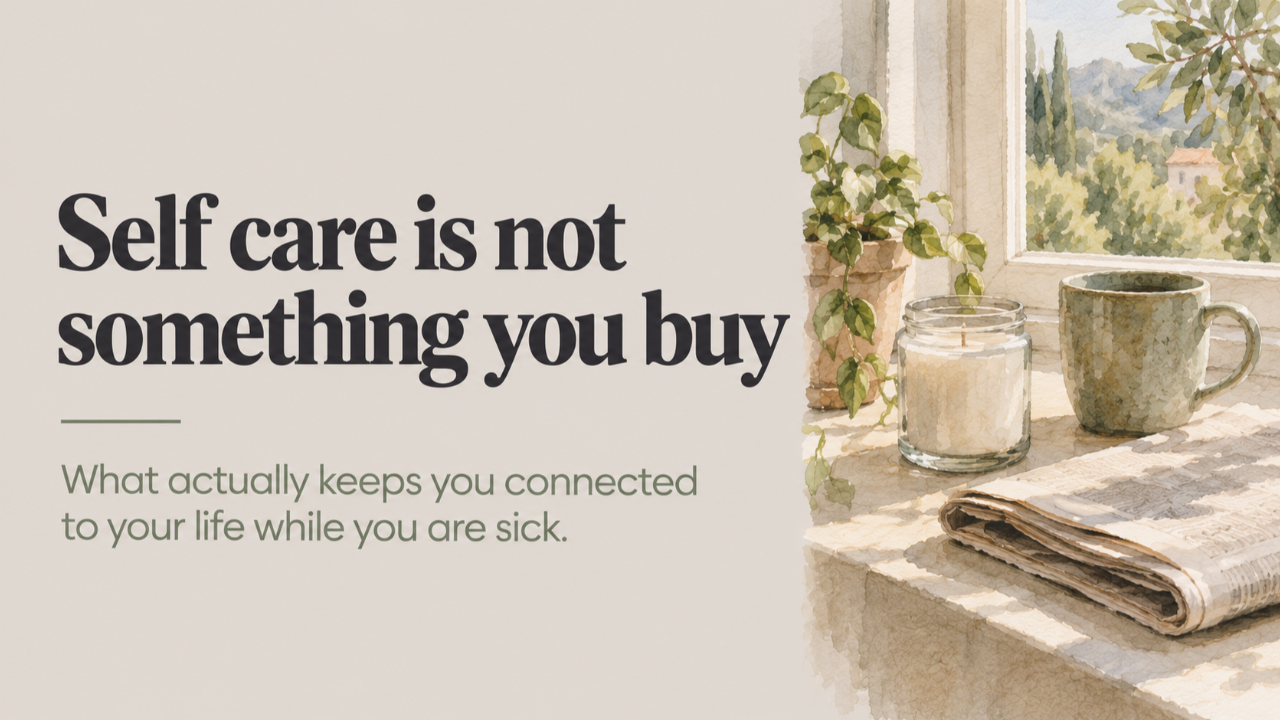
A woman I saw not long after her diagnosis told me that her oncologist had encouraged her to focus on self-care. She nodded in the appointment the way most of us nod when we do not want to seem difficult. Then she went home and bought a candle.
A few weeks later she said, with real frustration in her voice, "I lit the candle. I still feel like I am disappearing."
She was not doing self-care wrong. She had simply been handed a word that has been quietly emptied of meaning. Somewhere along the way, self-care stopped describing how a person stays whole and started describing what a person buys. Bath products. Face masks. A weekend away that you spend answering email.
None of that is bad. It is just not therapeutic.
Therapeutic means healing. Restoring. Something that changes the way your body and your life actually function, not something that changes how your evening looks in a photograph. When we talk with people about therapeutic self-care, we are talking about the practices that keep you connected to your own life while you are living through something hard.
What self-care actually means
The World Health Organization uses a working definition that is worth reading slowly. Self-care is the ability of individuals, families and communities to promote health, prevent disease, maintain health, and cope with illness and disability with or without the support of a health worker.
Notice what is in that definition. Ability. Families. Communities. Coping with illness. Notice what is not in it. Nothing about products. Nothing about indulgence. Nothing about earning a reward after a hard week.
Self-care, in the clinical sense, is the ongoing work of participating in your own health. It includes taking the medication. It also includes sleeping, eating, moving, laughing, and letting people near you. In chronic illness, researchers describe it as a process rather than an event, which matches what we see in practice. The people who do well over years are rarely the ones who executed a perfect plan. They are the ones who kept returning to a handful of things that mattered.
Why this gets so much harder after a diagnosis
When something threatens your health, your attention narrows. That narrowing is not a character flaw, it is biology doing its job. Appointments, scans, medications, side effects, insurance calls, and uncertainty begin to fill the calendar. Slowly, almost without anyone noticing, your days start to revolve around managing what is wrong.
And then a strange thing happens. The parts of life that made it worth protecting in the first place get postponed.
There is a second pattern we see often. Many of the people who sit across from us are the most responsible people in their families. The caregivers. The providers. The peacemakers. The ones who learned early that their own needs could wait. When we ask what they want, there is frequently a long pause. Not because they have no answer, but because nobody has asked in a very long time.
So before any specific practice, therapeutic self-care begins with a permission that most people are still waiting for. You are allowed to matter in your own life while you are sick. You are allowed to matter in your own life while you are well.
The four doors back into your life
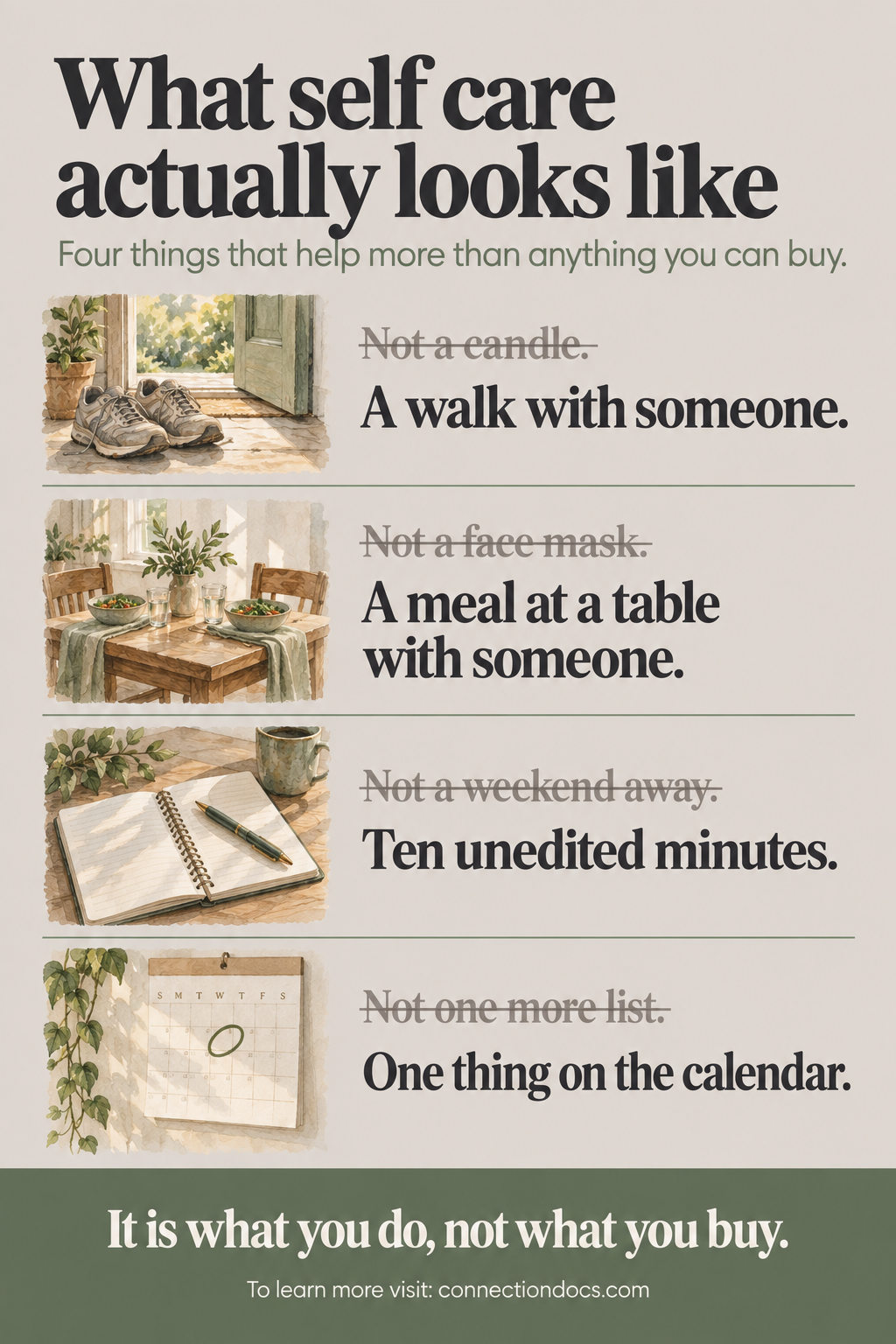
We organize this work around four areas. We call them the Four F's: Fun, Food, Fitness, and Family. They are not a program and they are not a ranking. Think of them as four doors into the same room. Most people find that one door opens more easily than the others, and once they walk through it, the rest become less intimidating.
Fun: the type of self-care almost everyone skips
Fun is the one people apologize for. It sounds unserious next to chemotherapy or an A1C. It is not.
In this framework, fun means your connection with yourself. The things you like. The things you are curious about. The music, the garden, the woodshop, the novel you keep meaning to start, the friends who make you laugh so hard you forget to check your phone. It is the answer to a question we ask often: what makes you glad to be alive?
There is more science behind that question than people expect. A cohort study of 6,985 adults over the age of 50, published in JAMA Network Open, found that a stronger sense of life purpose was significantly associated with lower all-cause mortality. The authors made a point we keep coming back to. Life purpose is a modifiable risk factor. It can change. It can be rebuilt.
Emotional self-care lives here too. Naming what you feel, out loud, to someone safe. Journaling for ten minutes without editing yourself. Saying no to the visit that will cost you three days of energy. These are not luxuries, they are maintenance.
A few places to start:
- Write down everything that makes you glad to be alive. Big, small, silly, serious. Look for the themes.
- Finish this sentence honestly: "If only ________, then I could finally ________." Then ask what would happen if you stopped waiting.
- Put one of those things on the calendar this week. Not someday. This week.
Food: there is no one perfect diet
This is where people expect us to hand them a list of forbidden foods, and where we usually disappoint them.
The American Cancer Society's 2022 guideline for cancer survivors is unusually direct about this. It states that many dietary patterns can fit within its recommendations, including a Mediterranean pattern, a vegetarian or mostly plant-based pattern, the DASH eating plan, and the US Dietary Guidelines. In other words, the respected guidelines do not agree on a single winning diet, because the evidence does not support one.
What they do agree on is the shape of the plate. Plenty of vegetables in a range of colors. Whole fruits. Fiber-rich legumes. Whole grains. Limited highly processed foods, processed meats, and added sugars. Limited alcohol, and for cancer risk specifically, less is better than some.
Inside that shape, you have room to be a person. Some people thrive on beans and rice. Some cannot tolerate legumes. Some need more protein because they are losing muscle. Some are managing diabetes, kidney disease, or a gut that has been through radiation. The right diet is the one that fits your biology, your budget, your culture, and your kitchen, and that you can still be eating in a year.
During active treatment, the rules shift again. Taste changes, nausea, mouth sores, and appetite loss are real, and the goal moves from optimizing to maintaining. Getting enough calories and enough protein to protect muscle is often the win. This is exactly the moment to ask for an oncology dietitian. Most cancer centers have one, and most people never get referred.
One last thing about food. Food is also connection. Who you eat with changes the meal as much as what is on the plate. A shared dinner at a kitchen table does something that a perfectly macro-balanced smoothie eaten alone in the car does not.
Fitness: functional first, aesthetic never
When we say fitness, we are not talking about a physique. We are talking about function. Can you carry the groceries? Can you get off the floor without help? Can you walk to the mailbox and back without needing to sit down? Can you get through an infusion day and still make dinner?
The evidence here is some of the strongest in all of survivorship care. The American College of Sports Medicine's international roundtable, which reviewed thousands of randomized trials, opens with the plainest possible instruction: avoid inactivity. Its general prescription is roughly 30 minutes of moderate aerobic activity three times per week, plus resistance training at least twice a week. Those doses have been studied specifically for cancer-related fatigue, anxiety, depression, physical function, and quality of life.
Walking counts more than people think. A meta-analysis of 15 international cohorts including 47,471 adults, published in The Lancet Public Health, found that mortality risk fell steadily as daily steps increased, leveling off around 6,000 to 8,000 steps per day for adults 60 and older and around 8,000 to 10,000 steps for adults under 60. Compared with the least active group, the more active groups had roughly 40 to 53 percent lower risk of death. There was no magic in 10,000. There was a great deal of benefit in moving from very little to a bit more.
So start where your body is today, not where it was two years ago.
- If you are in treatment, ask your oncology team what is safe right now, especially with low blood counts, bone metastases, neuropathy, or a port.
- Add steps to something you already do. Park farther out. Walk the first ten minutes of a phone call.
- Keep resistance simple. Sit to stand from a chair. A set of light dumbbells. Two short sessions a week beats one ambitious session a month.
- Go outside if you can. Daylight, fresh air, and a change of scenery are part of the dose.
Family: the people who hold the other end of the rope
Fun is mostly about your relationship with yourself. Family is about the people around you, and we mean that broadly. Spouses, children, siblings, the friend who has known you since ninth grade, the neighbor who brings in your trash cans. Family is whoever shows up.
This is not soft. It may be the hardest-edged data in this entire article.
A meta-analysis of 148 studies following 308,849 people found that individuals with stronger social relationships had a 50 percent greater likelihood of survival, an effect the authors compared with well-established risk factors such as smoking. In cancer specifically, a meta-analysis of 87 studies found that high perceived social support was associated with a 25 percent lower relative risk of mortality, a larger social network with 20 percent, and being married with 12 percent. In 2025, the World Health Organization's Commission on Social Connection reported that roughly one in six people worldwide are affected by loneliness, and that social disconnection is linked to an estimated 871,000 deaths each year.
If a pill produced those numbers, everyone would be on it.
And yet connection is the thing that quietly collapses after a diagnosis. People stop calling because they do not know what to say. You stop answering because you are exhausted or because you cannot bear the pity in their voices. Six months later you are surrounded by people who love you and you feel completely alone.
A few things that help:
- Give people a job. "Can you drive me on the 14th?" is easier to answer than "Let me know if you need anything."
- Name your three. Who are the three people you would actually call at 2 a.m.? If you cannot name three, that is useful information, not a verdict.
- Let someone see you on a bad day. Being cared for is a skill, and most caregivers have never practiced it.
- Consider a support group or a peer matched program. Sitting with people who do not need the situation explained to them is its own kind of rest.
There is a boundary piece here too, especially for the caregivers reading this. You can love someone deeply without carrying their emotions for them. When your spouse is frightened, or your adult child is angry about your prognosis, you can stay present without making their distress your emergency. Staying anchored to yourself does not make you less loving. In our experience it makes you more useful, because you can finally hear what the other person is actually asking for.
What therapeutic self-care is not
It is not a cure. Nothing in this article will make a tumor disappear, and anyone who tells you otherwise is selling something. Diet, movement, purpose, and connection influence how you live and, in some cases, how long. They do not replace oncology.
It is not a verdict on your past. One of the most damaging ideas in the wellness world is that illness is the bill for a life poorly lived. Decades ago, when researchers began noticing that many patients had spent years suppressing their own needs, some readers turned that observation into blame. That was never the finding, and it is not ours. You did not think your way into this, and you will not think your way out of it.
It is not another performance. If your self-care plan has become one more list you are failing at, the plan is wrong, not you. We are not aiming for perfection here. We are aiming for noticing a little sooner, and returning a little faster.
If you are reading this to stay well
Everything above applies to you too, with one advantage. You get to build these habits before anything forces you to.
The same four doors reduce risk of the diseases most likely to shorten your life. Movement and body composition, dietary pattern, alcohol, and social connection all show up repeatedly in prevention guidance. Just as importantly, the version of you who has friends, a purpose, a body that works, and a kitchen that feeds you is the version who will handle a hard diagnosis best, should one ever come.
The best time to build a life you are not ready to leave is while nothing is threatening it.
One small step
Insight rarely changes a life. Action does, and not massive action. Small action.
So do not make a list of twenty changes. Choose one.
One phone call. One walk. One meal at a table with another human being. One appointment with a dietitian. One class. One honest conversation. One thing you have been postponing that would make this week feel more like your own.
Write it down. Then decide when you will do it.
Because the goal was never a perfect routine. The goal is a life you are still glad to be living in.
A quiet invitation
If you are newly diagnosed, or caring for someone who is, or simply tired of doing all of this alone, we would be glad to talk with you. No agenda, no pressure, just a conversation about where you are and what might help next.
You can book a connection call with us here: https://www.connectiondocs.com/connection-call
With warmth,
Dr. Alona and Dr. Matt
References and further reading
- World Health Organization, working definition and guideline on self-care interventions for health and well-being: https://www.ncbi.nlm.nih.gov/books/NBK582346/
- Alimujiang A, et al. Association Between Life Purpose and Mortality Among US Adults Older Than 50 Years. JAMA Network Open, 2019: https://pmc.ncbi.nlm.nih.gov/articles/PMC6632139/
- Rock CL, et al. American Cancer Society Nutrition and Physical Activity Guideline for Cancer Survivors. CA: A Cancer Journal for Clinicians, 2022: https://acsjournals.onlinelibrary.wiley.com/doi/10.3322/caac.21719
- American Cancer Society, patient summary of the survivor nutrition and physical activity guideline: https://acsjournals.onlinelibrary.wiley.com/doi/full/10.3322/caac.21721
- American Cancer Society, physical activity when you have cancer: https://www.cancer.org/cancer/survivorship/be-healthy-after-treatment/physical-activity-and-the-cancer-patient.html
- Campbell KL, et al. Exercise Guidelines for Cancer Survivors, ACSM International Multidisciplinary Roundtable, summary coverage: https://bcmj.org/news/new-international-exercise-guidelines-cancer-survivors
- Paluch AE, et al. Daily steps and all-cause mortality: a meta-analysis of 15 international cohorts. The Lancet Public Health, 2022: https://pubmed.ncbi.nlm.nih.gov/35247352/
- Holt-Lunstad J, Smith TB, Layton JB. Social Relationships and Mortality Risk: A Meta-analytic Review. PLoS Medicine, 2010: https://journals.plos.org/plosmedicine/article?id=10.1371/journal.pmed.1000316
- Pinquart M, Duberstein PR. Associations of social networks with cancer mortality: a meta-analysis. Critical Reviews in Oncology/Hematology, 2010: https://pubmed.ncbi.nlm.nih.gov/19604706/
- World Health Organization. Social connection linked to improved health and reduced risk of early death, Commission on Social Connection, 2025: https://www.who.int/news/item/30-06-2025-social-connection-linked-to-improved-heath-and-reduced-risk-of-early-death
This article is for general education and is not a substitute for individual medical advice. Please talk with your own care team before making changes to your treatment, diet, or exercise routine.