What "Self-Healing" Really Means
Sep 18, 2026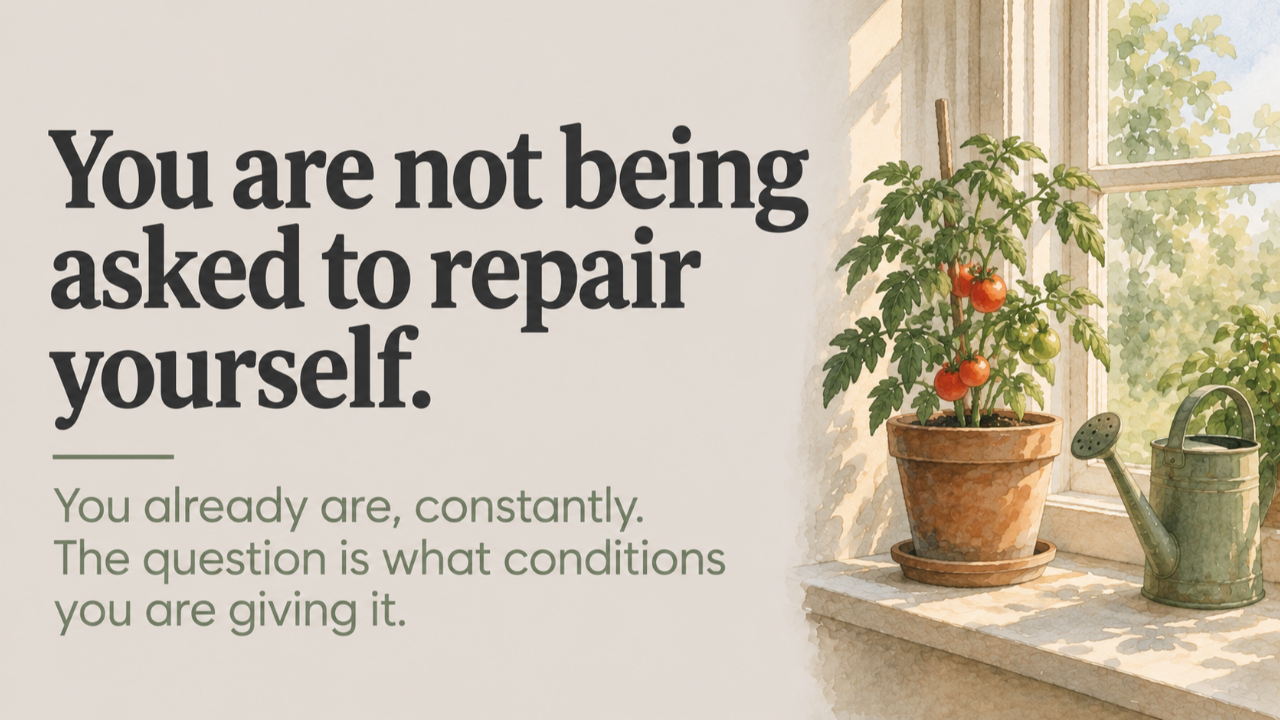
I want to start with two conversations.
The first was with a woman who had been diagnosed with breast cancer six days earlier. She sat down, unfolded a printout she had been carrying in her purse, and asked me almost apologetically, "Is it true that the body can heal itself?" She wanted permission to hope.
The second was with a man whose brother had died of colon cancer the year before. He asked me nearly the same question, but his voice was completely different. He was not hopeful. He was furious. Someone had told his brother that if he had believed harder, eaten cleaner, and released his resentments, he would still be alive. His brother died believing he had failed at something.
Same idea. Two entirely different places to be standing.
That is the trouble with the phrase self healing. Used one way, it hands a person their agency back. Used another way, it quietly hands them a life sentence of blame. So before we talk about what to do, I want to be very precise about what the phrase actually means, and what it does not.
First, what self-healing is not
It does not mean you caused this
More than fifty years ago, the psychologist Lawrence LeShan began asking people with cancer a set of questions almost nobody was asking them: What gave your life meaning before this? What did you give up? What made you feel most alive? He noticed something real. Many of the people in front of him were profoundly responsible people, caregivers and providers and peacemakers, who had spent decades attending to everyone else and had lost contact with their own passions.
What LeShan never said, and what he was careful to never say, is that this caused their cancer. That leap has done a staggering amount of damage. It has left people lying awake at 3 a.m. auditing their own personalities for the flaw that grew a tumor.
The data does not support that, and it never has. Cancer and chronic illness arise from a tangle of genetics, age, exposures, infections, random replication errors, and yes, some modifiable risk factors. American Cancer Society researchers estimate that roughly 40 percent of cancer cases in U.S. adults over 30 are attributable to modifiable risk factors such as smoking, excess body weight, alcohol, and physical inactivity. That is a large and hopeful number if you are trying to prevent illness. It is also, read honestly, an admission that the majority of cases are not explained by anything a person did or failed to do.
You are allowed to change your life going forward without accepting the premise that your old life is what put you here.
It is not a substitute for treatment
I have watched people decline surgery that would have cured them because someone online promised that the body heals itself if you just get out of its way. I want to say this plainly and then move on: chemotherapy, radiation, surgery, immunotherapy, insulin, dialysis, and the rest of modern medicine are not the opposite of self healing. They are, at their best, tools that clear the obstruction so your own repair systems can get back to work. A surgeon does not heal an incision. A surgeon approximates the edges. Your body does the rest.
So what is self-healing, actually?
Here is the version I believe in, and it is not mystical at all. It is biology, and it is running right now, while you read this.
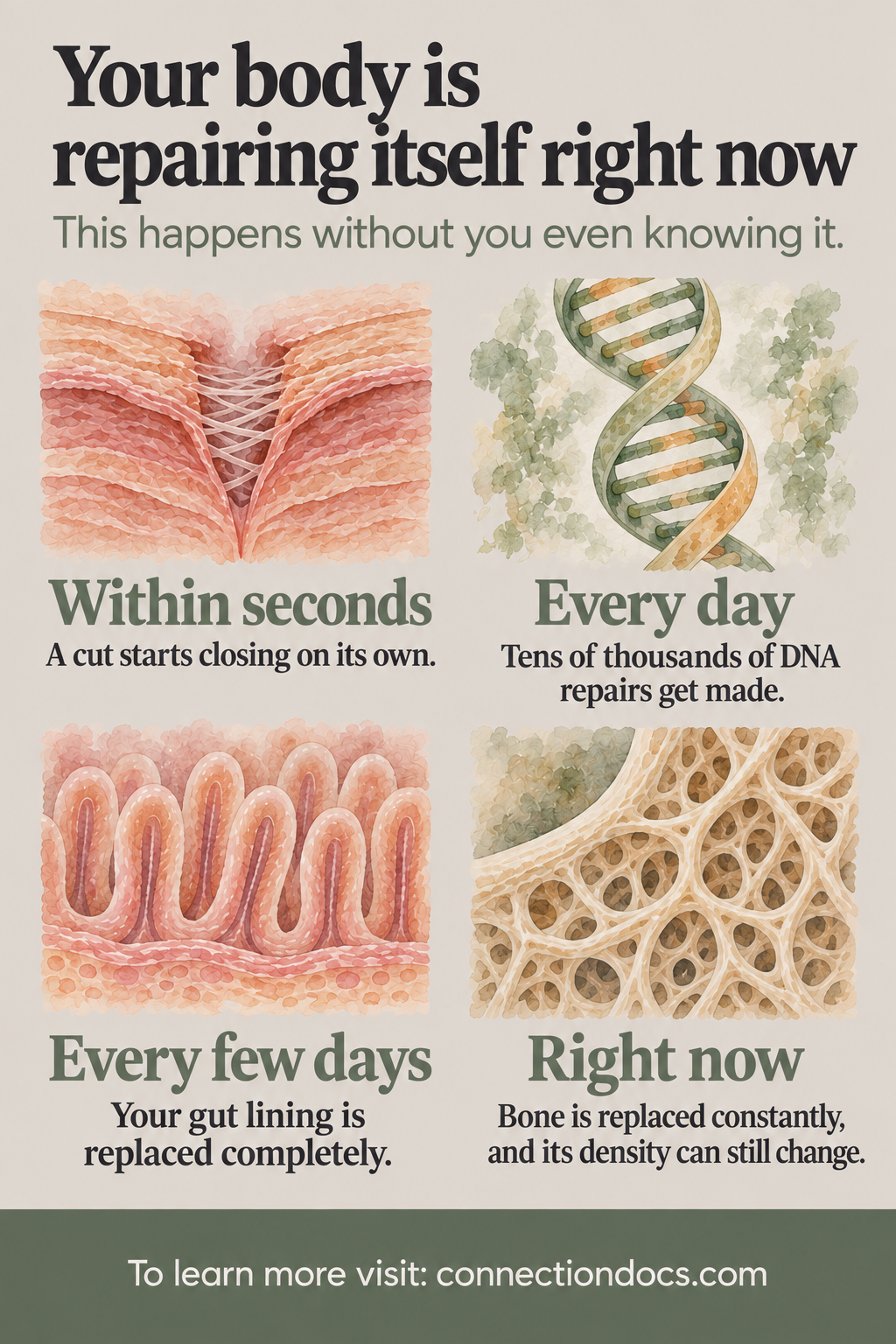
Every single day, the DNA in your cells takes tens of thousands of hits from ordinary metabolism, ultraviolet light, and environmental exposures. Every single day, dedicated repair enzymes find and fix the overwhelming majority of that damage. The discovery of how those systems work earned the 2015 Nobel Prize in Chemistry.
Meanwhile your immune system is patrolling for abnormal cells. Your cells are running autophagy, the housekeeping process that dismantles and recycles damaged internal parts, which earned the 2016 Nobel Prize in Physiology or Medicine. Your bone is continuously being broken down and rebuilt. The lining of your gut replaces itself roughly every few days. Cut your finger and a coordinated cascade of clotting, inflammation, new tissue, and remodeling begins within seconds, without you deciding anything.
You are not being asked to heal yourself. You already are healing yourself, constantly, whether or not you believe in it. The honest question is much smaller and much more useful:
What conditions am I giving that system to work in?
Healing is not a thing you do. It is a set of conditions you create.
I think about it the way I think about a garden. Nobody grows a tomato. You cannot will a tomato into existence, you cannot hustle it, and you cannot shame it into ripening faster. What you can do is put it in the sun, water it, feed the soil, and pull the weeds that are stealing from it. Then the plant does what plants do.
Your body is the same. You do not manufacture healing. You create conditions. And after years of sitting with people through the hardest decisions of their lives, we keep coming back to four of them. We call them the Four F’s: Fun, Food, Fitness, and Family.
None of them are exotic. That is the point. The conditions that support recovery after a diagnosis are almost identical to the conditions that lower your risk of ever getting one.
Fun: the connection you have with yourself
I put this first on purpose, because it is the one people apologize for.
When something threatens your life, your attention narrows hard. Appointments, scans, side effects, portal messages, insurance calls. Life becomes a logistics problem. And slowly, almost imperceptibly, your existence reorganizes itself around avoiding death rather than around being alive.
Fun is the antidote, and I do not mean it frivolously. Fun is your connection with yourself: the things you like, the things you are curious about, the things that make you lose track of an afternoon. The friend you laugh differently with. The guitar in the closet. The garden. The ridiculous television show. The trip you keep postponing until things settle down.
This is not sentimental. In a study of nearly 7,000 U.S. adults over 50 in the Health and Retirement Study, a stronger sense of purpose in life was associated with significantly lower all-cause mortality. Purpose is not a personality trait you either have or lack. It is downstream of what you actually do with your hours.
A few questions worth sitting with, especially if nobody has asked you them in a while:
- What did I love doing before all of this started?
- What am I curious about right now, even a little?
- Who do I laugh the hardest with, and when did I last see them?
- What am I moving toward, not just what am I trying to avoid?
If the list feels blank, that is information, not failure. Start absurdly small. One hour a week that belongs to you and has no medical purpose whatsoever.
Food: there is no one perfect diet, and that is good news
Nothing generates more noise after a diagnosis than food. Someone will tell you sugar feeds cancer. Someone will hand you a juicing protocol. Someone will insist on carnivore, or raw vegan, or a supplement stack that costs more than your mortgage.
Here is what the evidence actually supports. In the DIETFITS trial, 609 adults were randomized to a healthy low-fat diet or a healthy low-carbohydrate diet for twelve months. At the end, there was no significant difference in weight change between the two groups, and neither genetic pattern nor insulin response predicted who would do better on which. Both groups had been taught the same underlying thing: eat more whole foods, eat more vegetables, cut added sugar and refined grains, cook more.
That is the finding that matters. The macronutrient war is mostly a distraction. Food quality and sustainability are the signal.
The World Cancer Research Fund and American Institute for Cancer Research recommendations land in the same place: build meals around whole grains, vegetables, fruit, and beans, limit red and processed meat, limit fast food and heavily processed food, limit sugar sweetened drinks, and limit alcohol. Their own guidance says something I love, which is to treat the recommendations as a way of living rather than a checklist, because being very active does not cancel out the alcohol and eating plenty of beans does not cancel out the soda.
If you are in active treatment, throw most of the optimization out the window for now. During chemotherapy, taste changes, nausea, mouth sores, and appetite loss are real, and the goal shifts to protein, calories, hydration, and whatever you can actually keep down. A registered dietitian who works in oncology is one of the most underused people on a cancer care team. Ask for one.
The practical test I give people is not a macro ratio. It is three questions:
- Could I eat this way in six months without white-knuckling it?
- Does it include plants, fiber, and protein at most meals?
- Does it still let me eat with the people I love?
A diet that isolates you from your own dinner table is not a healthy diet, no matter what it does to your bloodwork.
Fitness: the closest thing we have to a drug for this
If I could prescribe one behavior with the confidence I prescribe medications, it would be movement.
In June 2025, the New England Journal of Medicine published the CHALLENGE trial, and it changed how I talk about exercise. Researchers randomized 889 patients with stage III or high-risk stage II colon cancer, all of whom had finished adjuvant chemotherapy, to either a three-year structured exercise program with a coach or to health education materials alone. At a median follow-up of just under eight years, five-year disease-free survival was 80.3 percent in the exercise group compared with 73.9 percent in the education group, and overall survival favored exercise as well.
Sit with that. Not a supplement. Not a new molecule. A person helping patients move more, for three years, produced a survival benefit that would be celebrated as a breakthrough if it had come in a pill.
And notice what the intervention was not. It was not CrossFit. Most participants built up through walking. This is what functional fitness actually means: the capacity to carry groceries, climb your own stairs, get off the floor, and stay independent.
A reasonable frame for most people:
- Walk. Daily if possible, outside if possible. Start with ten minutes and build.
- Lift something heavy two days a week. Muscle is metabolic insurance, and it protects against the loss of strength and bone that comes with illness, treatment, and age.
- Get outside. Light, air, and terrain do things a treadmill in a basement does not.
- Sit less. Breaking up long sitting matters independently of your workout.
One caution I want to be explicit about. If you are in treatment, have a port, have low blood counts, have bone metastases, or have cardiac or orthopedic issues, talk to your oncology team before starting. The answer is almost never "do nothing." It is usually "here is the modified version." Ask for a referral to a physical therapist or a cancer exercise specialist.
Family: the people around you are part of your biology
Fun is your connection with yourself. Family is the connection with everyone else, and by family I mean whoever actually shows up. Sometimes that is blood. Often it is not. Your closest friends are family. Your Tuesday walking group is family.
We have gotten used to treating connection as a nice extra, something you get to once the medical part is handled. The evidence says otherwise. In its 2023 advisory, the U.S. Surgeon General reported that lacking social connection raises the risk of premature death by a magnitude comparable to smoking up to fifteen cigarettes a day, and is associated with a 29 percent increased risk of heart disease and a 32 percent increased risk of stroke.
Loneliness is not a mood. It is an exposure.
Here is the cruel part, though. Serious illness tends to shrink your circle exactly when you need it widest. You cancel because you are tired. Friends go quiet because they do not know what to say. Six months later you look up and the world is smaller.
Some of the most useful things I have watched people do:
- Make the ask specific. "Can you drive me Thursday at 9?" is answerable. "Let me know if you need anything" never gets used.
- Let one person be the communications hub so you are not retelling your scan results eleven times.
- Keep one standing, low-effort ritual. A weekly coffee. A Sunday phone call. Something that survives a bad week.
- Say yes to help that feels excessive. People want a job. Give them one.
- Protect the caregiver. The person beside you is running a marathon nobody is tracking. They need their own Four F’s.
What self-healing does not promise
I would be doing you a disservice if I ended on the uplift without saying this part.
Not everything is reversible. Some illnesses can be put into remission. Some can be slowed. Some can only be lived alongside. Walking every day does not guarantee your scan will be clean, and no amount of vegetables entitles you to an outcome. Anyone who tells you otherwise is selling something, and the invoice eventually arrives as guilt.
So I want to separate two words that get used interchangeably.
Curing is about the disease. It is measured in scans and labs and pathology reports, and much of it is outside your control.
Healing is about the person. It is about whether you are still connected to yourself, still fed, still moving, still held by people who love you. It is available on days when curing is not. I have met people who were cured and not healed. I have met people who were dying and more whole than they had been in thirty years.
Self-healing is not a promise about the ending. It is a decision about how you occupy the middle.
A definition I can stand behind
If you take one thing from this, let it be this.
Self healing is not willpower, and it is not magic, and it is certainly not blame. It is the unglamorous daily work of removing what obstructs your body’s repair systems and supplying what they need. Sleep. Nourishment. Movement. Meaning. Other people. Treatment when treatment is indicated.
You are not being asked to heal yourself through sheer belief. You are being asked to become a good steward of a system that has been quietly repairing you since before you were born.
And if you are reading this because you are trying to prevent illness rather than recover from one, please notice that the list did not change. The Four F’s are not a cancer protocol. They are a way of living that happens to be, as far as we can tell, the best insurance policy available.
If you are in the middle of something hard
Most people do not need more information. They need help figuring out which of it applies to them, and what to do first, and which of the six things they were told this week they can safely ignore.
That is the conversation we love having. If you are newly diagnosed, facing a decision that feels too big, or simply trying to build a life that is more resistant to illness in the first place, we would be glad to talk it through with you. No pressure, no agenda, just a conversation.
You can book a connection call with us here:
https://www.connectiondocs.com/connection-call
Whatever you are facing, we hope you build a life you are not quite ready to leave.
A note
This article is for general education and is not medical advice for your specific situation. Please talk with your own physician or care team before making changes to your treatment, diet, exercise, or medications.
References and further reading
Courneya KS, Vardy JL, O’Callaghan CJ, et al. Structured Exercise after Adjuvant Chemotherapy for Colon Cancer (CHALLENGE). New England Journal of Medicine, 2025;393:13-25. https://www.nejm.org/doi/full/10.1056/NEJMoa2502760
American Society of Clinical Oncology. Movement Is Medicine: Structured Exercise Program May Lower Risk of Cancer Recurrence and Death for Some Colon Cancer Survivors (2025). https://www.asco.org/about-asco/press-center/news-releases/movement-medicine-structured-exercise-program-challenge
Islami F, et al. Proportion and number of cancer cases and deaths attributable to potentially modifiable risk factors in the United States, 2019. Summarized by the American Cancer Society (2024). https://pressroom.cancer.org/releases?item=1341
Gardner CD, Trepanowski JF, Del Gobbo LC, et al. Effect of Low-Fat vs Low-Carbohydrate Diet on 12-Month Weight Loss: The DIETFITS Randomized Clinical Trial. JAMA, 2018;319(7):667-679. https://jamanetwork.com/journals/jama/fullarticle/2673150
World Cancer Research Fund / American Institute for Cancer Research. Cancer Prevention Recommendations. https://www.wcrf.org/preventing-cancer/cancer-prevention/our-cancer-prevention-recommendations/
American Institute for Cancer Research. New data shows that following our Cancer Prevention Recommendations reduces overall risk of death. https://www.aicr.org/resources/blog/new-data-shows-that-following-our-cancer-prevention-recommendations-reduces-overall-risk-of-death/
Office of the U.S. Surgeon General. Our Epidemic of Loneliness and Isolation: The Healing Effects of Social Connection and Community (2023). https://www.hhs.gov/sites/default/files/surgeon-general-social-connection-advisory.pdf
Alimujiang A, Wiensch A, Boss J, et al. Association Between Life Purpose and Mortality Among US Adults Older Than 50 Years. JAMA Network Open, 2019;2(5):e194270. https://jamanetwork.com/journals/jamanetworkopen/fullarticle/2734064
The Nobel Prize in Chemistry 2015: mechanistic studies of DNA repair (Lindahl, Modrich, Sancar). https://www.nobelprize.org/prizes/chemistry/2015/summary/
The Nobel Prize in Physiology or Medicine 2016: discoveries of mechanisms for autophagy (Yoshinori Ohsumi). https://www.nobelprize.org/prizes/medicine/2016/summary/