
What Is a Chronic Illness? What the Diagnosis Means, and What It Doesn’t
Oct 28, 2026
Picture this. A message lands in your patient portal on an ordinary Tuesday afternoon. You open it between work emails, expecting a routine result.
Somewhere in the second paragraph is a word you read three times.
Chronic.
Chronic kidney disease. Chronic lymphocytic leukemia. Chronic obstructive pulmonary disease. Whatever words come before or after it, chronic is the one that lands.
For a lot of people, it lands like a sentence being handed down. Something permanent. Something that will now pull up a chair to every meal, every plan, and every conversation about the future.
We’ve talked with many people in the days and weeks after they first hear that word. And we’ve learned that what most people need first isn’t more information. It’s translation.
What does this word actually mean? What changes now? And just as important, what doesn’t?
What Is a Chronic Illness?
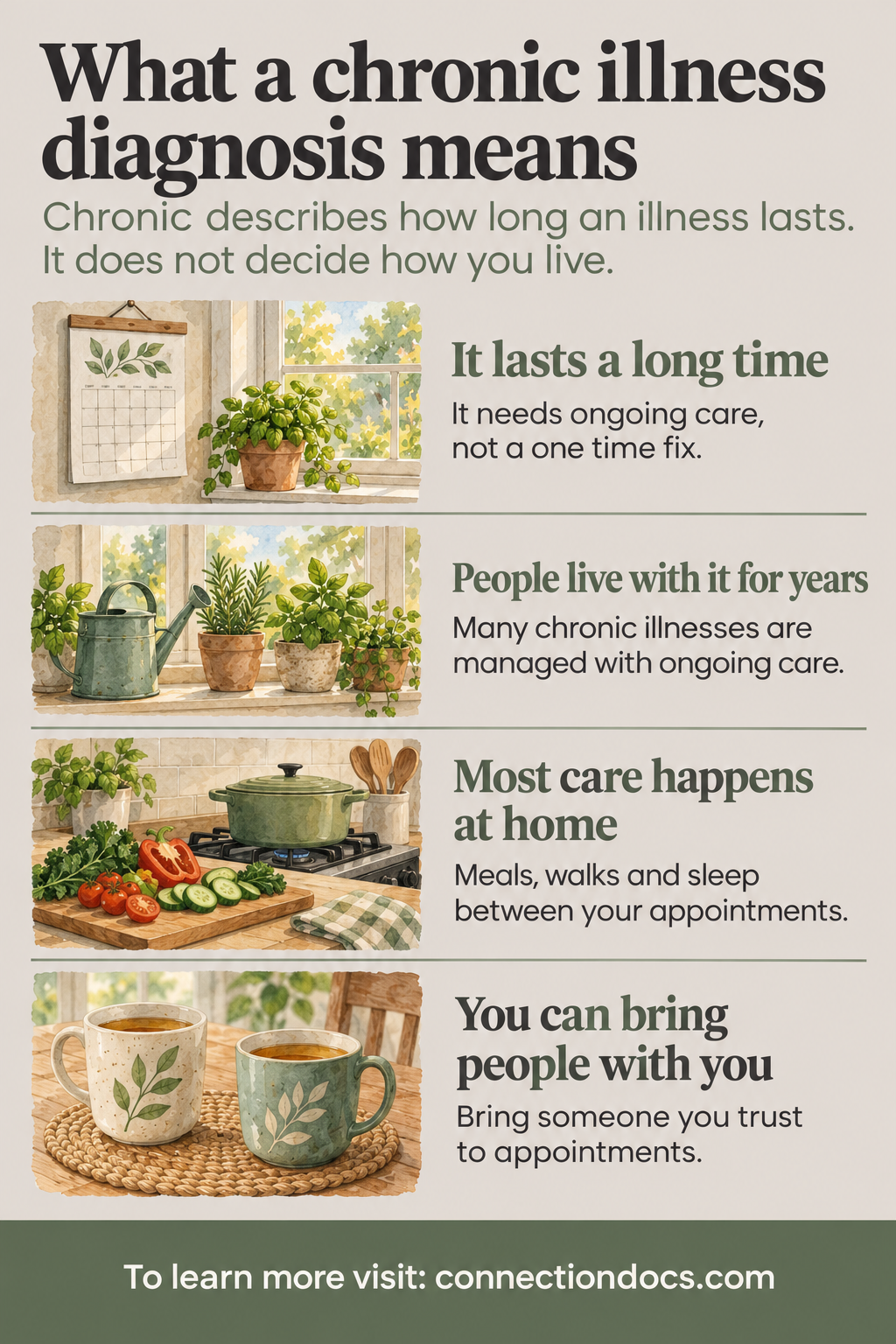
In plain language, a chronic illness is a health condition that lasts a long time and needs ongoing care rather than a one-time fix.
The Centers for Disease Control and Prevention (CDC) defines chronic diseases as conditions that last one year or more and require ongoing medical attention, limit activities of daily living, or both.1 The National Cancer Institute uses a shorter yardstick: a disease that usually lasts three months or longer and may get worse over time. It adds that chronic diseases can usually be controlled, though not cured.2
So there isn’t one official definition. But notice what’s missing from both of them.
Neither one says hopeless.
And notice the word that is there: controlled. A chronic illness is something people manage and live with, often for many years.
These definitions describe time, not fate. They tell you the illness will be part of your life for a while. They say nothing about how full that life can be.
It also helps to know how much company you have. In CDC survey data from 2023, about three in four U.S. adults reported at least one of 12 common chronic conditions, and more than half reported two or more, counting conditions like obesity, high cholesterol, and depression.3 If you’ve just joined that group, you haven’t stepped outside of ordinary life. You’ve stepped into one of its most common chapters.
Chronic Illness vs. Acute Illness: Why the Difference Matters
Most of us grow up understanding illness through an acute lens. Acute conditions happen suddenly and last a short time.4 Think strep throat, a broken wrist, appendicitis, or the flu. You get sick, you get treated, and in time you get back to normal.
Chronic conditions last a long time, often years.5 Many develop gradually, and most can be controlled even when they can’t be cured.2
Acute and chronic describe time, not severity, and the two can overlap. A heart attack is a sudden, acute event, while the heart disease underneath it is chronic.
The difference matters for one big reason: it changes who does most of the work.
In an acute illness, your medical team does most of the heavy lifting. In a chronic illness, most of the work happens in your everyday life. In a widely cited 2012 essay in the New England Journal of Medicine, the authors observed that people with chronic illness may spend just a few hours a year with clinicians, but about 5,000 waking hours a year on their own, making everyday choices about medications, food and drink, and smoking.6
Five thousand hours.
That’s where medications get taken or skipped, where meals get made, where walks happen or don’t, where fear gets talked about or swallowed. Which means one of the most important members of your care team is the person reading this.
That isn’t a burden we’re placing on you. It’s power we’re handing back to you.
Examples of Chronic Illness
Chronic illness is a big family. The CDC notes that chronic diseases such as heart disease, cancer, and diabetes are the leading causes of death and disability in the United States, and the full list is much longer.1,7,8 It includes:
- Heart disease, high blood pressure, and stroke
- Cancer
- Diabetes
- Chronic lung diseases, such as COPD and asthma
- Chronic kidney disease and liver disease
- Arthritis and osteoporosis
- Autoimmune conditions, such as lupus and multiple sclerosis9
- Alzheimer’s disease and other dementias
- Obesity
- Depression and other long-term mental health conditions
- Substance use disorders, including alcohol use disorder
- Epilepsy, HIV, and hepatitis
Many people live with more than one of these at once. If that’s you, coordinating care across several conditions and specialists is its own skill, and it’s not one you have to master alone.
Is Cancer a Chronic Illness?
Sometimes, yes.
Many cancers are treated with the goal of cure, and many people finish treatment and move forward with no evidence of disease. But the American Cancer Society notes that some cancers can become a chronic, ongoing illness, much like diabetes or heart disease. This is often true of ovarian cancer, chronic leukemias, and some lymphomas, and sometimes of cancers that have spread, such as metastatic breast or prostate cancer. Many of these can’t be cured, but some can be kept under control for months, and sometimes years, through ongoing treatment, cycles of treatment and rest, or careful monitoring.10
That shift is part of a much larger story. As of January 1, 2025, about 18.6 million Americans were living with a history of cancer, and that number is projected to top 22 million by 2035.11 In the National Cancer Institute’s definition, you become a cancer survivor on the day you’re diagnosed, and you remain one for the rest of your life.12
If your cancer is being managed as a chronic illness, the language can feel jarring at first. People ask us, “If they aren’t trying to cure it, what are we doing?” The honest answer is that the goals may be control, time, comfort, and quality of life, often all at once. Those aren’t consolation prizes. For many people, they’re the whole point.
What a Chronic Illness Diagnosis Doesn’t Mean
The word chronic carries a lot of weight it hasn’t earned. Here are a few things it does not mean.
It doesn’t mean you caused this.
After a diagnosis, many people go looking for the moment they went wrong. The extra glass of wine. The stressful job. The years they didn’t exercise.
Daily habits do shape risk, and we’ll talk about that below. But risk is not blame. Genetics, environment, age, and plain chance all play large roles. Even for cancer, researchers estimate that about 4 in 10 cases among U.S. adults 30 and older are tied to changeable risk factors like smoking, excess weight, and alcohol. The majority are not.13 Self-blame doesn’t make anyone healthier. It just adds suffering to an already hard season.
It doesn’t mean you are your diagnosis.
In a 1982 paper, the sociologist Michael Bury drew on interviews with people living with rheumatoid arthritis to describe chronic illness as a “biographical disruption,” an event that upends the assumptions of everyday life and forces people to rethink their life story and who they are.14 A year later, sociologist Kathy Charmaz published a study of 57 people with a range of chronic illnesses and described a quieter kind of suffering she called the loss of self: watching old images of yourself fall away before new ones have had a chance to form.15
Both observations ring true. The disruption is real. So is the grief.
But the story doesn’t end with the disruption. Over time, many people find a way to write the illness into their story without letting it become the whole story. You are a person who has an illness. You are not an illness that happens to have a person attached.
It doesn’t mean you’re powerless.
Remember those 5,000 hours. Programs exist to help people build the everyday skills of living with chronic illness. In a meta-analysis of one of them, the Chronic Disease Self-Management Program, participants reported small to moderate gains in confidence, mood, and health-related distress that were still present 9 to 12 months later.16
And if energy is your scarcest resource, spoon theory, which we explore in a companion post, offers a simple way to decide where yours goes.
You may not control the diagnosis. You have a great deal of say in the life you build around it.
It doesn’t mean you have to feel okay about it.
People living with a chronic disease are at higher risk of depression, and people who have both tend to have more severe symptoms of each.9 Depression is treatable, even alongside a chronic illness, with talk therapy, medication, or both.9 And when depression and medical care are managed together, the benefits can reach both. In one randomized trial of 214 adults with depression and poorly controlled diabetes, coronary heart disease, or both, nurse care managers who treated mood and medical risk factors together got better results than usual care over 12 months: a clear improvement in depression and modest improvements in blood sugar and cholesterol.17
If you’ve been feeling flat, hopeless, or unlike yourself for more than a couple of weeks, please tell your care team. That isn’t weakness. It’s part of treating the whole person. And if you ever have thoughts of harming yourself, call or text 988, the Suicide and Crisis Lifeline, or call 911 in an emergency.9
What It Does Mean: A New Kind of Partnership
It means ongoing care: regular check-ins, monitoring, and adjustments as your body and your treatment change. It means learning the patterns of your own condition: what makes it flare, what helps, and what a good day and a hard day look like.
It also means asking new questions. Here are a few we encourage people to bring to their care team:
- What is the goal of my treatment right now: cure, control, comfort, or some mix?
- What does a good day look like with this condition, and what should make me call you?
- What can I do between appointments that would make the biggest difference?
- How will we know whether this plan is working?
- If I see more than one specialist, who is coordinating the big picture?
Good decisions start with good questions. You’re allowed to ask every one of these, and to ask again if the answer doesn’t make sense.
Living Well With a Chronic Illness: The Four F’s
Medical care matters enormously. But it fills a small fraction of your hours. The rest of your life happens in four places we call the Four F’s: Fun, Food, Fitness, and Family.
Fun
Fun is your connection with yourself: the things you love and the things that make you feel like you.
When illness arrives, these are often the first things to go. Days fill up with appointments, prescriptions, and portal messages. But meaning matters for health. A meta-analysis of ten studies including more than 136,000 people found that a stronger sense of purpose in life was linked to about a 17% lower risk of death from any cause, and a similarly lower risk of cardiovascular events like heart attack and stroke.18 That’s an association, not a guarantee. But it’s a meaningful one.
So ask yourself the question we ask so many people: What makes you glad to be alive? Then protect a little time for it every week, the same way you’d protect a medical appointment.
Food
There is no single perfect diet, and anyone who promises one is selling something. Different conditions have different needs, and different people love different foods. The best eating pattern is the one that fits your body, your illness, and your life.
That said, the evidence for whole, plant-based foods is consistent. In three long-running studies of more than 200,000 health professionals who started out free of chronic disease, those whose diets scored highest for healthy plant foods like vegetables, fruits, whole grains, legumes, and nuts had about a 25% lower risk of coronary heart disease over up to 28 years than those who scored lowest. Plant-based diets heavy in refined grains, sweets, and sugary drinks were linked to higher risk.19 A review of nine studies with more than 300,000 adults found a similar pattern for type 2 diabetes: about a 23% lower risk overall, and about 30% lower when the diet emphasized healthy plant foods.20 These are associations rather than proof, but they point the same way. The quality of the plant foods matters.
Start small. Add a handful of beans to a soup. Swap white rice for brown. Keep fruit where you can see it. And if your condition comes with specific nutrition needs, such as potassium limits in kidney disease, carbohydrate planning in diabetes, steady amounts of leafy greens if you take warfarin, or extra calories and protein when treatment affects your appetite, work with your care team or a registered dietitian to build a plant-forward plan that fits. If you take insulin or other diabetes medicines, check in before big changes, since doses may need adjusting.
Fitness
Movement is one of the most reliable tools we have. The Physical Activity Guidelines for Americans recommend that adults with chronic conditions who are able aim for the same targets as everyone else: at least 150 minutes a week of moderate activity, like brisk walking, plus muscle-strengthening activities at least two days a week. Those who can’t should be as active as their abilities allow and avoid inactivity. Either way, the guidelines recommend working with your health care provider on the types and amounts of activity that fit your condition.21
The guidelines also make one of our favorite points in all of public health: a little activity is better than none.
Fitness doesn’t have to mean a gym. It can mean a walk outside after dinner, standing up from a chair ten times, carrying your own groceries, or a few minutes of stretching in the fresh air. Functional fitness, the kind that keeps you doing the things you love, is the goal.
Family
Family is the people around you: partners, children, siblings, and the friends who have become family.
Relationships aren’t a luxury when you’re living with a chronic illness. A landmark review of 148 studies with more than 300,000 people found that those with stronger social relationships had 50% greater odds of survival over the study periods.22 And in 2023, the U.S. Surgeon General warned that a lack of social connection can raise the risk of early death about as much as smoking up to 15 cigarettes a day.23
Let people in. Tell them what helps and what doesn’t. Bring someone you trust to your appointments, even the virtual ones. Let them carry a little of the weight.
If You’re Reading This to Stay Well
Not everyone reading this has a diagnosis. Some of you are here because you’d like to keep it that way.
Chronic illness isn’t only a later-life story. In 2023, nearly 6 in 10 adults ages 18 to 34 reported at least one chronic condition, counting common ones like obesity, depression, and asthma.3 The CDC notes that many preventable chronic diseases share a short list of risk factors: smoking, poor nutrition, physical inactivity, and excessive alcohol use.1 That doesn’t apply to every diagnosis, and it’s never a reason for blame. But it does mean that a surprising amount of prevention lives in ordinary daily choices.
The Four F’s are prevention, too. Many of the same habits that help people live well with a chronic illness are also linked to a lower risk of developing one in the first place.
A Short Reflection: Write Your Own Definition
The medical definition of your illness describes time. Your definition can describe meaning.
There are no right answers here. Take ten minutes, a pen, and a quiet corner, and complete these sentences:
- When I first heard my diagnosis, the word that stuck with me was ________.
- What I’m afraid this diagnosis means is ________.
- What I know it does not mean is ________.
- One thing I want my life to keep including is ________.
- The people I want beside me are ________.
Then write one sentence that begins like this:
“I am a person living with ________, and I am still ________.”
Read it out loud. Then choose one small step for this week from any of the Four F’s. One walk. One phone call. One new recipe. One hour doing something that makes you feel like yourself.
Chronic Means Long-Lasting
A chronic illness is a long road. That part is true.
But long-lasting is not the same as life-ending, and it doesn’t have to mean a smaller life. Many people find that a diagnosis, for all its disruption, sharpens their sense of what matters and who matters.
The word chronic describes how long an illness will be with you.
You get to decide how you’ll live alongside it.
If you’ve recently heard the word chronic and you’re trying to sort out what it means for your treatment, your decisions, and the people you love, we’d love to help you think it through. We work with people entirely virtually, so you can join from wherever you are. Book a Connection Call with us and let’s talk about what comes next.
This article is for general education and is not a substitute for individualized medical advice. Please talk with your own care team about your situation.
References
- Centers for Disease Control and Prevention. About Chronic Diseases. Last reviewed May 14, 2026. https://www.cdc.gov/chronic-disease/about/index.html
- National Cancer Institute. Chronic disease. NCI Dictionary of Cancer Terms. https://www.cancer.gov/publications/dictionaries/cancer-terms/def/chronic-disease
- Watson KB, Wiltz JL, Nhim K, Kaufmann RB, Thomas CW, Greenlund KJ. Trends in Multiple Chronic Conditions Among US Adults, By Life Stage, Behavioral Risk Factor Surveillance System, 2013-2023. Prev Chronic Dis. 2025;22:E15. https://www.cdc.gov/pcd/issues/2025/24_0539.htm
- National Institute of Diabetes and Digestive and Kidney Diseases. Dictionary definition: acute. https://www.niddk.nih.gov/Dictionary/A/acute
- National Institute of Diabetes and Digestive and Kidney Diseases. Dictionary definition: chronic. https://www.niddk.nih.gov/Dictionary/C/chronic
- Asch DA, Muller RW, Volpp KG. Automated Hovering in Health Care: Watching Over the 5000 Hours. N Engl J Med. 2012;367(1):1-3. https://doi.org/10.1056/NEJMp1203869
- Centers for Disease Control and Prevention. Fast Facts: Health and Economic Costs of Chronic Conditions. Last reviewed May 26, 2026. https://www.cdc.gov/chronic-disease/data-research/facts-stats/index.html
- Goodman RA, Posner SF, Huang ES, Parekh AK, Koh HK. Defining and Measuring Chronic Conditions: Imperatives for Research, Policy, Program, and Practice. Prev Chronic Dis. 2013;10:E66. https://www.cdc.gov/pcd/issues/2013/12_0239.htm
- National Institute of Mental Health. Understanding the Link Between Chronic Disease and Depression. NIH Publication No. 24-MH-8015. 2024. https://www.nimh.nih.gov/health/publications/chronic-illness-mental-health
- American Cancer Society. Managing Cancer as a Chronic Illness. Last revised October 10, 2025. https://www.cancer.org/cancer/survivorship/cancer-as-a-chronic-illness.html
- Wagle NS, Nogueira L, Devasia TP, et al. Cancer Treatment and Survivorship Statistics, 2025. CA Cancer J Clin. 2025;75(4):308-340. https://pmc.ncbi.nlm.nih.gov/articles/PMC12223361/
- National Cancer Institute, Office of Cancer Survivorship. Statistics and Graphs. https://cancercontrol.cancer.gov/ocs/statistics
- Islami F, Marlow EC, Thomson B, et al. Proportion and number of cancer cases and deaths attributable to potentially modifiable risk factors in the United States, 2019. CA Cancer J Clin. 2024;74(5):405-432. https://doi.org/10.3322/caac.21858
- Bury M. Chronic illness as biographical disruption. Sociol Health Illn. 1982;4(2):167-182. https://onlinelibrary.wiley.com/doi/10.1111/1467-9566.ep11339939
- Charmaz K. Loss of self: a fundamental form of suffering in the chronically ill. Sociol Health Illn. 1983;5(2):168-195. https://onlinelibrary.wiley.com/doi/10.1111/1467-9566.ep10491512
- Brady TJ, Murphy L, O’Colmain BJ, et al. A Meta-Analysis of Health Status, Health Behaviors, and Health Care Utilization Outcomes of the Chronic Disease Self-Management Program. Prev Chronic Dis. 2013;10:120112. https://www.cdc.gov/pcd/issues/2013/12_0112.htm
- Katon WJ, Lin EH, Von Korff M, et al. Collaborative Care for Patients with Depression and Chronic Illnesses. N Engl J Med. 2010;363(27):2611-2620. https://doi.org/10.1056/NEJMoa1003955
- Cohen R, Bavishi C, Rozanski A. Purpose in Life and Its Relationship to All-Cause Mortality and Cardiovascular Events: A Meta-Analysis. Psychosom Med. 2016;78(2):122-133. https://doi.org/10.1097/PSY.0000000000000274
- Satija A, Bhupathiraju SN, Spiegelman D, et al. Healthful and Unhealthful Plant-Based Diets and the Risk of Coronary Heart Disease in U.S. Adults. J Am Coll Cardiol. 2017;70(4):411-422. https://pubmed.ncbi.nlm.nih.gov/28728684/
- Qian F, Liu G, Hu FB, Bhupathiraju SN, Sun Q. Association Between Plant-Based Dietary Patterns and Risk of Type 2 Diabetes: A Systematic Review and Meta-analysis. JAMA Intern Med. 2019;179(10):1335-1344. https://pmc.ncbi.nlm.nih.gov/articles/PMC6646993/
- U.S. Department of Health and Human Services. Physical Activity Guidelines for Americans, 2nd edition. 2018. https://odphp.health.gov/sites/default/files/2019-09/Physical_Activity_Guidelines_2nd_edition.pdf
- Holt-Lunstad J, Smith TB, Layton JB. Social Relationships and Mortality Risk: A Meta-analytic Review. PLoS Med. 2010;7(7):e1000316. https://journals.plos.org/plosmedicine/article/info:doi/10.1371/journal.pmed.1000316
- Office of the U.S. Surgeon General. Our Epidemic of Loneliness and Isolation: The U.S. Surgeon General’s Advisory on the Healing Effects of Social Connection and Community. U.S. Department of Health and Human Services. 2023. https://www.hhs.gov/sites/default/files/surgeon-general-social-connection-advisory.pdf