What Being a Caregiver for a Family Member Really Involves
Oct 13, 2026
Nobody hands you a job description.
There’s no orientation, no training manual, no first day. There’s a phone call, or a scan result, or a fall in the middle of the night. And then, quietly, you find yourself doing things you’ve never done before.
Picture an ordinary Tuesday. At 7 a.m., you’re sorting pills into a weekly organizer. At 9:30, you’re on hold with the insurance company. At noon, you’re picking up a prescription and a few groceries he might actually eat. At 3, you’re reading a message in the patient portal and trying to decide whether it’s urgent. At dinner, you’re cutting food into smaller pieces. At 11 p.m., you’re lying awake, listening for footsteps in the hallway.
None of it is labeled “caregiving” on your calendar. All of it is.
If this sounds familiar, you’re a family caregiver, whether or not you’ve ever used the word. You’re also part of one of the largest and least visible workforces in the country. Here’s what the role really involves, what it costs, what it gives, and how to carry it without losing yourself.
What Does a Caregiver Do?
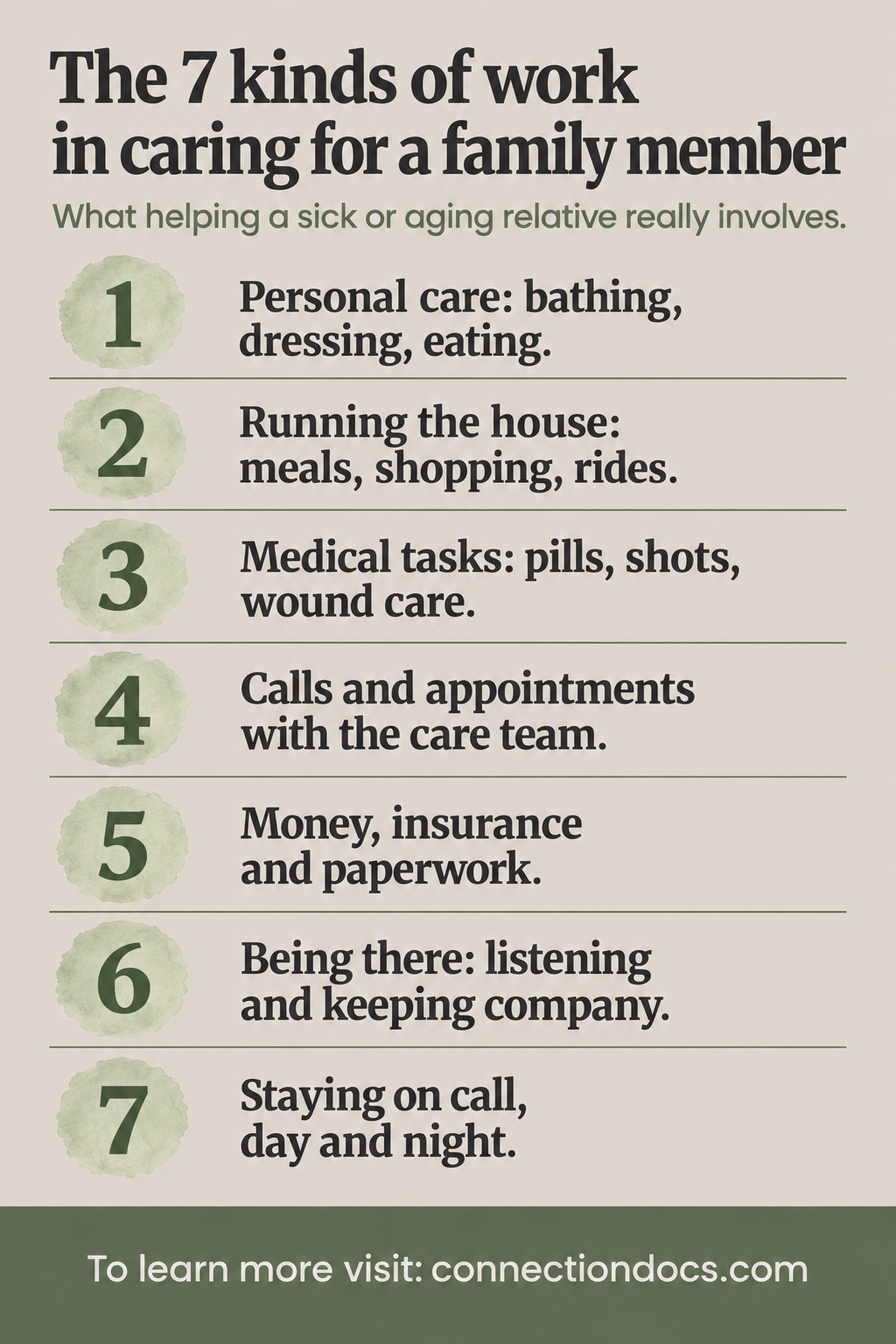
A family caregiver is someone who helps a relative or friend living with an illness, disability, or age-related needs, usually without pay. The work tends to fall into seven areas: personal care, running a household, medical and nursing tasks, care coordination and advocacy, money and paperwork, emotional support, and a constant watchfulness that rarely gets named.
You are far from alone in doing it. According to the 2025 Caregiving in the US report from AARP and the National Alliance for Caregiving, 63 million Americans, about 1 in 4 adults, provided ongoing care in the past year. That’s 20 million more people than in 2015. On average, caregivers spend 27 hours a week caring, nearly a quarter spend more than 40, and the average caregiving journey lasts five and a half years [1].
The Seven Parts of the Caregiver Role
When people ask what caregiver duties and responsibilities include, the honest answer is: more than anyone expects. Here’s how the role usually breaks down.
1. Personal Care: Activities of Daily Living
Clinicians use the term activities of daily living, or ADLs, for the basic tasks of caring for your own body: getting in and out of bed or a chair, dressing, bathing, using the toilet, managing continence, and eating [2, 1]. Two out of three family caregivers help with at least one of these, and nearly a quarter of those who do say it’s physically difficult [1].
This is often the most intimate part of caregiving, and the most delicate. When you can, do these things with your loved one rather than for them. Letting someone button their own shirt, even if it takes five minutes, protects something that matters more than efficiency: their sense of still being themselves.
2. Running a Household: Instrumental Activities of Daily Living
Instrumental activities of daily living, or IADLs, are the tasks that keep a life running: managing money, shopping, cooking, housework, and getting to appointments [1]. Eighty-four percent of caregivers help with three or more of them.
These tasks are easy to underestimate because they look ordinary. But when you’re doing them for two households, or squeezing them in around your own job and family, they add up fast.
3. Medical and Nursing Tasks
This is the part that surprises people most. More than half of family caregivers, 55 percent, now perform medical or nursing tasks such as giving injections, managing catheters, or monitoring vital signs. Only 22 percent have received any training to do them [1].
In AARP’s earlier Home Alone Revisited study of caregivers doing this kind of work, 82 percent managed medications, about half helped with mobility equipment or special diets, and 37 percent cared for wounds. About half worried about making a mistake [3].
Cancer caregiving is especially intense. In a national study, 72 percent of cancer caregivers performed medical or nursing tasks, and 43 percent did so without any preparation [4].
If you feel unprepared, it’s because no one prepared you. That isn’t a personal failing. And you have every right to ask for training. In most states, a law known as the CARE Act requires hospitals to record the name of a family caregiver, tell that person when their loved one will be discharged, and teach them the medical tasks they’ll need to do at home [5]. Since 2024, Medicare has also paid clinicians to train family caregivers of patients with certain conditions as part of the patient’s care [6].
4. Care Coordination and Advocacy
Caregivers become historians, translators, schedulers, and advocates. They keep the medication list current, retell the story to every new specialist, chase referrals, and ask the questions their loved one is too tired to ask. Seventy percent of caregivers monitor their loved one’s health, 64 percent communicate with providers, and 58 percent advocate on their behalf. About one in four caregivers who coordinate care say it’s difficult [1].
This is where caregivers often add the most value, and where many feel the most lost. Health care is complicated, and no one hands you a map.
5. Money, Insurance, and Paperwork
Caregiving costs money. In a 2021 AARP study, family caregivers spent an average of $7,242 a year of their own money on caregiving, about 26 percent of their income [7]. In the 2025 report, nearly half of caregivers (47 percent) described at least one negative financial impact: 31 percent had stopped saving, 23 percent had taken on more debt, and 14 percent couldn’t afford basic needs like food [1].
Then there’s the paperwork: insurance appeals, medical bills, benefit applications, and forms that seem to multiply overnight.
And there’s work. Seventy percent of caregivers between 18 and 64 hold jobs, and half of working caregivers have had to come in late, leave early, or take time off [1]. If you’re eligible, the federal Family and Medical Leave Act allows up to 12 weeks of unpaid, job-protected leave in a 12-month period to care for a spouse, child, or parent with a serious health condition [8].
6. Emotional Support and Companionship
Beyond the tasks, there is simply being there. Sitting through the frightening appointment. Listening at midnight. Absorbing fear and frustration. Holding hope when your loved one can’t.
This work is invisible, and it’s heavy. In the 2025 report, 38 percent of caregivers described high emotional stress [1]. Among cancer caregivers in an earlier national study, it was half [4].
Many caregivers also experience anticipatory grief: the sadness, worry, and sense of loss that can arrive before a death, most often while someone you love is very ill [9]. You may find yourself grieving a person who is still in the next room. That isn’t a betrayal. It’s love, beginning to prepare.
7. The Invisible Work: Always Being On Call
Then there’s the part almost no one talks about. The constant low hum of vigilance. Listening for a cough in the night. Checking your phone during every meeting. Running through the what-ifs on the drive home. Carrying the whole schedule in your head.
It doesn’t show up on any checklist of caregiver tasks. But caregivers feel it in their bodies, and it’s often what makes caregiving so exhausting even on days when “nothing happened.”
The Sandwich Generation and the Long Haul
For many people, caregiving doesn’t replace other responsibilities. It gets stacked on top of them. Nearly one in three family caregivers also has a child under 18 at home [1]. The Pew Research Center reports that a quarter of U.S. adults, and more than half of those in their 40s, are part of the sandwich generation, with a living parent 65 or older and a child they’re raising or supporting financially [10].
Taken together, this unpaid work is enormous. AARP estimates that family caregivers of adults provided 49.5 billion hours of care in 2024, worth about $1 trillion, more than the country spent on Medicaid that year [11].
What Caregiving Does to Your Health (and What It Doesn’t)
You may have heard that caregiving shortens your life. The real story is more nuanced, and more hopeful.
A well-known study of older spouses found that caregivers who felt strained had a 63 percent higher risk of death than people who weren’t caregiving [12]. But later, larger studies found that caregivers as a group actually lived a little longer than similar non-caregivers, with about 18 percent lower mortality in one study [13]. Researchers reviewing this work concluded that the usual portrayals of caregiving have been too bleak, and that support should focus on caregivers under the most strain [14].
In other words, it’s the strain we need to watch, more than the caring itself.
That matters, because caregiving also gives. In the 2025 report, about half of caregivers (51 percent) said caregiving gives them a sense of purpose or meaning. At the same time, 56 percent felt they had no choice about taking it on, and one in five rated their own health as fair or poor [1]. Both things can be true at once.
Caregiver Support: You Were Never Meant to Do This Alone
Here’s a striking number: 39 percent of caregivers say respite care would help them, but only 13 percent use it [1]. Respite care, short-term relief from a substitute caregiver for a few hours or a few days, is one of the most underused forms of caregiver support there is.
A few places to start:
- Eldercare Locator (1-800-677-1116) connects families with local services for older adults, including caregiver programs [15].
- The National Family Caregiver Support Program funds information, counseling, support groups, training, and respite through grants to states [16].
- Family Caregiver Alliance (800-445-8106) offers education and caregiver support groups [17].
- Caregiver Action Network runs a free Caregiver Help Desk at 855-227-3640 [18].
- For cancer caregivers, the American Cancer Society (1-800-227-2345, available 24/7) and CancerCare (800-813-4673), which offers free support from oncology social workers, are good places to start [19, 20].
You can also share the load closer to home. Look at the seven areas above and ask: who could own one of these? A sibling across the country can’t help with bathing, but they can handle the insurance calls. A friend who loves spreadsheets can manage the medication schedule. A neighbor can drive on Tuesdays.
Caring for Yourself Through the Four F’s
We think about health through four simple lenses: Fun, Food, Fitness, and Family. For caregivers, they aren’t luxuries. They’re how you keep going.
Fun
You are a person, not just a role. Protect one thing each week that is yours alone: a class, a walk, a show you love, coffee with a friend. Ten minutes of something that makes you feel like yourself isn’t selfish. It’s maintenance.
Food
Caregivers tend to eat standing up, eat whatever is left over, or forget to eat entirely. Keep it simple. A pot of lentil soup or vegetable chili on Sunday can feed you for days. Keep canned beans, frozen vegetables, and whole grains on hand for meals that come together in minutes. And when people ask how they can help, say “food,” and tell them exactly what you’d like.
Fitness
Caregiving is physical work: lifting, transferring, bending, standing for hours. If you’re helping someone move, ask a physical or occupational therapist to show you safe techniques. Keep some strength training in your week so your body can handle the load. And get outside when you can. Even a short walk around the block is a reset.
Family
The relationship underneath the caregiving still matters. It’s easy for a marriage to slide into a patient-and-nurse routine, or for a parent and grown child to start relating like a case and its manager. So make room for moments that have nothing to do with care: an old movie, a box of photos, a conversation about anything but medications. And remember the rest of the family, too: the kids who’ve gotten quiet, the partner whose needs have been on hold. A family meeting can help divide responsibilities fairly before resentment has a chance to build.
A Short Reflection: Make the Invisible Visible
Caregiving work is easy to underestimate, even for the person doing it. This exercise is meant to help you see it clearly, so you can make choices about it.
Take a sheet of paper and write down the seven areas: personal care, household, medical tasks, coordination, money and paperwork, emotional support, and being on call. Under each one, list what you actually did in the past week.
Then go back through your list and mark each item:
- Only me: things that truly require you.
- Someone else could: things you could hand off, hire out, or share.
- Could let go: things that aren’t as necessary as they feel.
Choose one item from the second group and ask for help with it this week. Then choose one thing just for you, something that brings you joy, and put it on your calendar like an appointment.
The Work of Love
Being a caregiver for a family member is some of the hardest work a person can do. It’s also some of the most meaningful. It asks you to be nurse, scheduler, advocate, and companion, often all before lunch.
You don’t have to do it perfectly. You don’t have to do it alone. And you don’t have to disappear inside it.
The person you’re caring for needs you. And you need you, too.
If you’re caring for someone you love and feeling overwhelmed by the medical decisions, the coordination, or simply the weight of it all, we’d love to help. We work with patients and families entirely virtually, so you can join from anywhere, even from a hospital waiting room. Book a Connection Call with us and let’s talk through what you’re carrying.
This article is for general education and is not a substitute for individualized medical, legal, or financial advice. Program details and eligibility rules change, so check current requirements with the organizations listed.
References
- AARP and National Alliance for Caregiving. Caregiving in the US 2025. Washington, DC: AARP; 2025. https://www.aarp.org/pri/topics/ltss/family-caregiving/caregiving-in-the-us-2025/ https://doi.org/10.26419/ppi.00373.001
- Edemekong PF, et al. Activities of daily living. StatPearls. Treasure Island (FL): StatPearls Publishing. https://www.ncbi.nlm.nih.gov/books/NBK470404/
- Reinhard SC, et al. Home Alone Revisited: Family Caregivers Providing Complex Care. AARP Public Policy Institute; 2019. https://www.caregiver.org/uploads/2023/02/home-alone-revisited-family-caregivers-providing-complex-care.pdf
- National Alliance for Caregiving, in partnership with the National Cancer Institute and Cancer Support Community. Cancer Caregiving in the U.S. 2016. https://www.caregiving.org/wp-content/uploads/2020/05/CancerCaregivingReport_FINAL_June-17-2016.pdf
- New state law to help family caregivers (the CARE Act). https://www.aarp.org/advocacy/caregiving/aarp-creates-model-state-bill-2014/
- Centers for Medicare and Medicaid Services. Calendar Year (CY) 2024 Medicare Physician Fee Schedule final rule (fact sheet). 2023. https://www.cms.gov/newsroom/fact-sheets/calendar-year-cy-2024-medicare-physician-fee-schedule-final-rule
- Skufca L, Rainville C. Caregiving Out-of-Pocket Costs Study 2021. AARP Research; 2021. https://www.aarp.org/pri/topics/ltss/family-caregiving/family-caregivers-cost-survey/
- Family and Medical Leave Act, 29 U.S.C. 2612 (Legal Information Institute, Cornell Law School). https://www.law.cornell.edu/uscode/text/29/2612
- Cleveland Clinic. Anticipatory grief: symptoms and how to cope. 2024. https://health.clevelandclinic.org/dealing-with-anticipatory-grief
- Pew Research Center. More than half of Americans in their 40s are ‘sandwiched’ between an aging parent and their own children. 2026. https://www.pewresearch.org/short-reads/2026/08/27/more-than-half-of-americans-in-their-40s-are-sandwiched-between-an-aging-parent-and-their-own-children/
- AARP Public Policy Institute. Valuing the Invaluable 2026: the economic value of family caregiving. 2026. https://www.aarp.org/pri/topics/ltss/family-caregiving/valuing-the-invaluable-2026-update/
- Schulz R, Beach SR. Caregiving as a risk factor for mortality: the Caregiver Health Effects Study. JAMA. 1999;282(23):2215-2219. https://doi.org/10.1001/jama.282.23.2215
- Roth DL, et al. Family caregiving and all-cause mortality: findings from a population-based propensity-matched analysis. American Journal of Epidemiology. 2013;178(10):1571-1578. https://doi.org/10.1093/aje/kwt225
- Roth DL, Fredman L, Haley WE. Informal caregiving and its impact on health: a reappraisal from population-based studies. The Gerontologist. 2015;55(2):309-319. https://doi.org/10.1093/geront/gnu177
- Administration for Community Living. Eldercare Locator. https://eldercare.acl.gov/
- Administration for Community Living. National Family Caregiver Support Program. https://acl.gov/programs/support-caregivers/national-family-caregiver-support-program
- Family Caregiver Alliance. https://www.caregiver.org/
- Caregiver Action Network. https://www.caregiveraction.org/
- American Cancer Society. Cancer caregiver support. https://www.cancer.org/cancer/caregivers.html
- Caregiving support. https://www.cancercare.org/caregiving