
The Bland Diet: What to Eat When Nausea Won’t Let You
Sep 15, 2026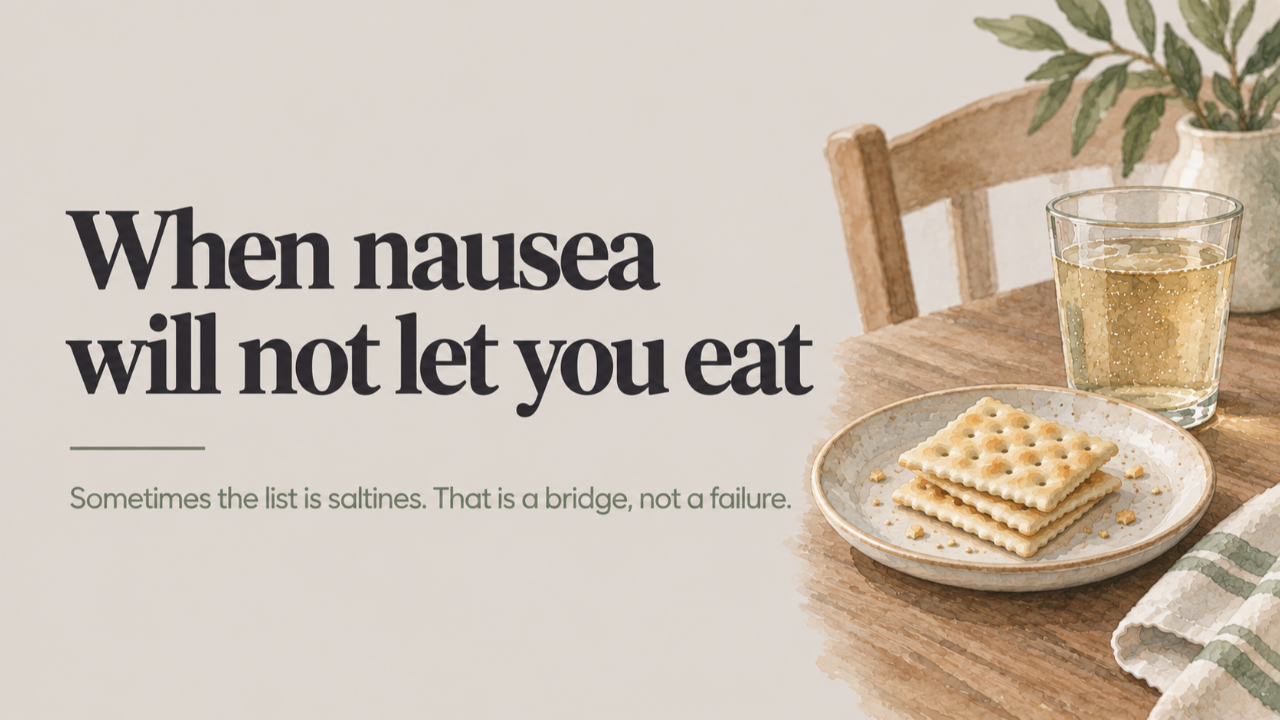
A gentle, evidence based guide to bland foods, hydration, and getting back to real eating, from two physicians who sit with people in the hardest weeks of treatment.
A few years ago I sat with a woman in the second week of her first chemotherapy cycle. She had a kitchen full of food. Her sister had stocked the refrigerator with kale, salmon, blueberries, bone broth, all the things the internet had told her a person with cancer should be eating.
She could not touch any of it.
What she could eat was saltine crackers. That was the list. Saltines, and sometimes a few sips of flat ginger ale.
When she told me this, she was not asking a nutrition question. She was apologizing. She said, almost under her breath, "I know I am supposed to be eating better than this." I remember thinking how much energy she was spending on shame at a moment when she had very little energy to spare.
So I want to start where I started with her. If saltines are what stays down today, the saltines are doing their job. Nausea is not a character flaw. It is not a failure of discipline. It is a physiologic event happening inside your body, and it deserves a strategy, not a verdict.
Nausea Is Not a Willpower Problem
Nausea has many doors into the body. Chemotherapy is the one most people know, and it works through several pathways at once, some in the gut and some in the brainstem. But nausea also arrives with radiation, anesthesia, opioid pain medication, antibiotics, kidney disease, gastroparesis, migraine, pregnancy, and sometimes the illness itself.
In cancer care we describe it in phases. Acute nausea shows up within the first day of treatment. Delayed nausea shows up after that first day and can linger for several more. And then there is anticipatory nausea, which is the strangest one to live with, because it arrives before anything has been given to you at all.
I have had patients tell me they start feeling sick in the parking garage, before a single drug has been hung. That is not imagination. That is a nervous system that learned something, the way a nervous system is built to learn.
Your body is also very good at forming food aversions while you are nauseated. If you eat a food you love on a terrible day, your brain can quietly file that food under danger and keep it there for years.
So protect the foods you love. Do not eat your favorite meal on a bad day just to prove you can. Save it for a better one.
What a Bland Diet Actually Is (and What It Is Not)
When a clinician says "try a bland diet," what they usually mean is a short term way of eating that asks as little as possible of your digestive system and as little as possible of your senses.
Bland foods tend to share four traits:
- Low in fat. . Fat slows stomach emptying, and a slower stomach means more nausea.
- Low in fiber. . Less residue moving through, less cramping and urgency.
- Mild in flavor. . Nothing spicy, nothing heavily acidic, nothing that burns a sore mouth.
- Low in aroma. . Smell is the trigger most people underestimate.
That is the whole concept. A bland diet is not a nutrition philosophy and not a healing protocol. It is a bridge, meant to carry calories and fluid across a rough stretch until your appetite returns, and then it is meant to end.
I want to be honest about something here, because it comes up constantly. There is no one perfect diet for a human being, and that is even more true when you are sick. Two people on the same chemotherapy regimen, the same dose, the same week, will tolerate completely different foods. One lives on scrambled eggs. The other cannot be in the same room as an egg. Neither of them is doing it wrong.
The goal is not to find the correct list. The goal is to find your list.
A Bland Food List to Start From
Use this as a starting menu, not a prescription. Cross off what does not work for you. Add what does.
Starches and grains
Dry toast, saltine crackers, pretzels, plain white rice, plain pasta or egg noodles, oatmeal, cream of wheat, unsweetened dry cereal, boiled or mashed potatoes.
Proteins that tend to be tolerated
Scrambled eggs, skinless chicken or turkey, plain yogurt, cottage cheese, tofu, peanut butter if the texture works for you, a mild protein shake sipped slowly.
Fruits and vegetables
Bananas, applesauce, canned peaches or pears, melon, cooked carrots, cooked squash, well cooked green beans.
Fluids and cold things
Clear broth, diluted juice, herbal or peppermint tea, flat ginger ale, sherbet, popsicles, ice chips, an oral rehydration or electrolyte drink.
What tends to make nausea worse
Greasy and fried food, very sweet or rich food, heavily spiced food, anything with a strong cooking smell, alcohol, and large volumes of anything at once. If your mouth is sore, acidic foods like citrus and tomato will sting.
One useful exception: for some people, sour and tart work when nothing else does. Lemon drops, sour candy, pickles, a squeeze of lemon in water. Major cancer centers suggest trying this, as long as your mouth is not sore.
The Rules That Matter More Than the Food List
If I could only give you one page of this article, it would be this one. In my experience, how you eat changes nausea more than what you eat.
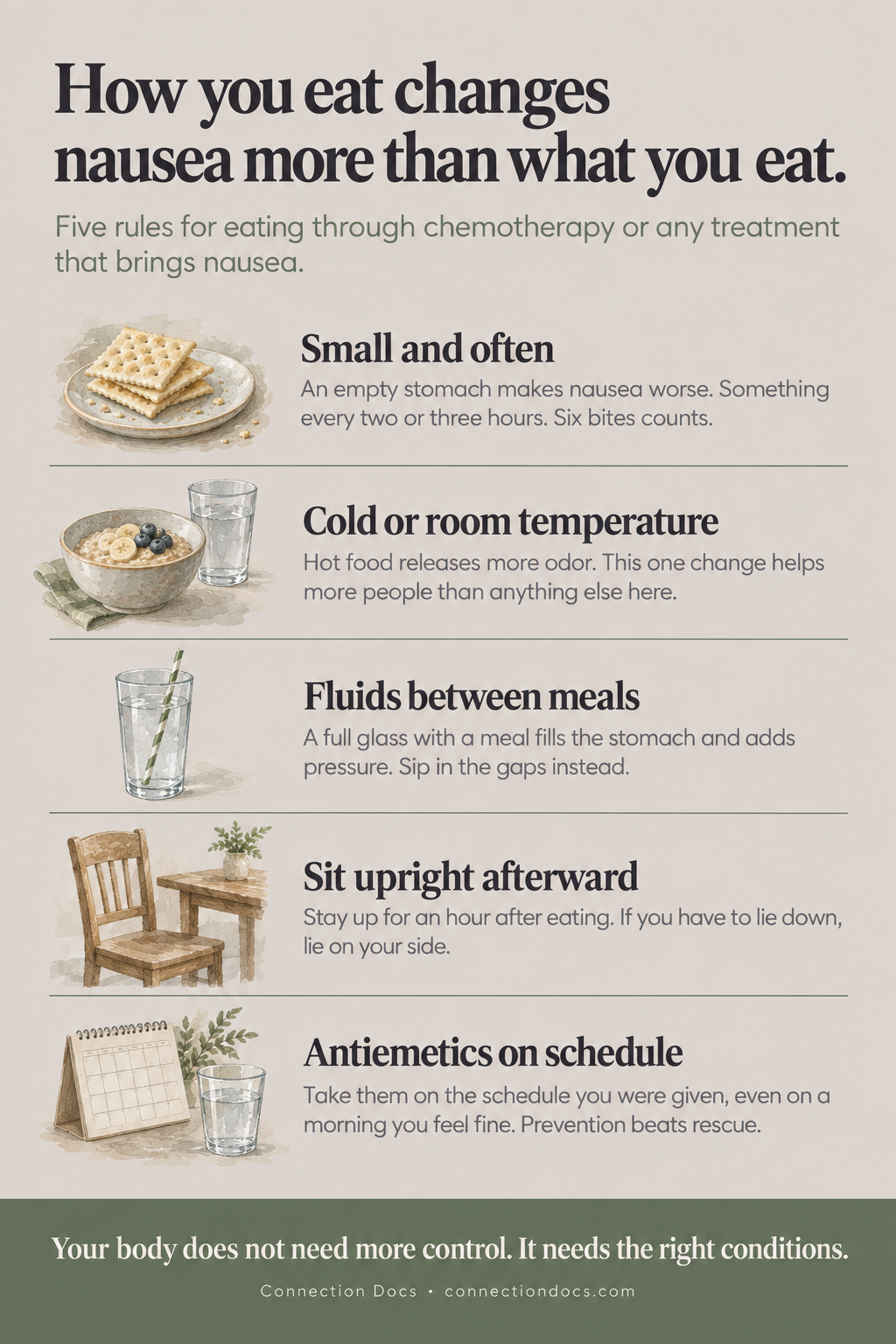
- Small and often. An empty stomach makes nausea worse, not better. Something small every two to three hours beats three real meals you cannot face. Six bites counts.
- Cold or room temperature. Hot food releases more odor. Cold or room temperature food releases less. This single change helps more people than almost anything else on the list.
- Fluids between meals, not with meals. Drinking a full glass with a meal fills the stomach and increases pressure. Drink most of your fluids in the gaps instead, sipping slowly, and use a straw if that helps.
- Sit upright for an hour after eating. Lying down right after eating makes reflux and nausea more likely. If you have to lie down, lie on your side.
- Let someone else cook. If you can, stay out of the kitchen while food is being prepared. Ask for a window open, a fan on, a lid on the pot. This is a reasonable thing to ask for.
- Learn your own treatment day pattern. Some people do better with a light snack before treatment. Others do better arriving with an empty stomach. Both are documented. Try one, notice, try the other.
- Take your antiemetics on schedule, not as rescue. This is the one I press hardest. Anti nausea medicine works far better as prevention than as rescue. Take it on the schedule you were given, even on a morning you feel fine. Waiting until you are already sick is starting a race from behind.
When You Cannot Eat at All, Drink
On the worst days, food is off the table and the real job is fluid. Dehydration is itself a cause of nausea, which is how people end up in a loop that tightens on itself.
Small sips throughout the day work better than a glass at a time. Popsicles, ice chips, gelatin, and frozen juice chips are often tolerated when liquids are not, because they go down slowly. If you have vomited, wait about an hour, then start again with small sips of something clear.
An electrolyte or oral rehydration drink is worth having in the house before you need it. Water alone does not replace what vomiting takes out of you.
Ginger, Peppermint, and Lemon: What the Evidence Actually Says
Ginger sits at the top of the advice people will hand you. Here is what the research honestly supports.
A systematic review and meta analysis published in the Journal of the Academy of Nutrition and Dietetics found that ginger supplementation at one gram per day or less, taken for more than three days, reduced the likelihood of acute vomiting by about sixty percent compared with control. A later review of twenty three randomized trials found the same narrow finding, that ginger reduced acute vomiting, but could not show a clear effect on nausea itself.
Read that carefully, because it matters. The stronger signal is for vomiting, not for the queasy feeling most people are actually trying to escape.
The American Society of Clinical Oncology, in its antiemetic guideline update, says the evidence remains insufficient to recommend for or against ginger, acupuncture, or acupressure. That is not the same as saying do not try it. It means ginger belongs in the category of reasonable things to test with your team, not things to substitute for prescribed medication. It can also interact with blood thinners, so ask first.
A systematic review of food based interventions for treatment related nausea found something I find quietly moving. The strongest evidence, with the highest certainty, was not for any clever remedy. It was for dietary counseling aimed at simply meeting your protein and calorie needs, and for protein supplementation. A peppermint drink, chamomile, and a colorless odorless diet also showed positive signals at lower certainty.
In other words, the most boring intervention had the best evidence. Get enough protein. Get enough calories. Ideally with a dietitian. That is the finding.
Lemon belongs here too, not as a food but as an air freshener. Several cancer centers suggest slicing a lemon or diffusing lemon oil while food is being prepared, because it masks the cooking smells that trigger nausea in the first place.
Do Not Stay Bland Longer Than You Need To
Most of us learned the BRAT diet, bananas, rice, applesauce, toast. It has quietly fallen out of favor, and for good reason.
The American Academy of Pediatrics no longer recommends it, on the grounds that it is too restrictive and too low in protein, fat, fiber, and micronutrients to help the gut recover. The guidance now is to return to a normal, varied diet as soon as it is tolerated. The same logic applies to adults. BRAT foods are a fine bridge. They are a poor destination.
This matters more during cancer treatment than almost anywhere else, because the thing you cannot afford to lose is muscle. Weight loss during treatment is rarely fat. It is lean tissue, and lean tissue is what carries you through the next cycle and the next recovery.
So think of it as a ladder, and climb it as soon as you can:
- Clear fluids and ice chips when nothing else stays down.
- Dry, salty, bland starches. Crackers, toast, rice.
- Add gentle protein. Eggs, yogurt, skinless chicken, a shake.
- Add cooked vegetables and soft fruit.
- Return to your normal eating, adjusted for whatever your treatment actually requires.
And ask for a referral to an oncology dietitian. Not later, now. Most cancer centers have one, most people never get sent, and it is one of the highest value appointments in the building.
When to Call Your Team, Today and Not Tomorrow
I want to be direct here, because uncontrolled nausea is treatable and far too many people endure it quietly, believing it is simply the price of admission.
Call your care team the same day if any of these are true:
- You cannot keep fluids down for twelve hours or more.
- You cannot keep your medications down, including the anti nausea medication.
- You have little or no urine output, or your urine is dark and concentrated.
- You have a fever of 100.4 degrees Fahrenheit or higher.
- There is blood in your vomit, or it looks like coffee grounds.
- You are vomiting repeatedly over hours, or vomiting with dizziness or confusion.
- Your nausea is not responding to the medication you were prescribed, or has lasted more than two days.
- You are losing weight without trying.
Uncontrolled nausea leads to dehydration, weight loss, treatment delays, and sometimes to people quietly deciding to stop treatment altogether. There are multiple medication classes and combinations available, and there is almost always another option. If the regimen you were given is not working, that is information your oncologist needs and wants.
Say the numbers out loud when you call. "I vomited four times yesterday and I have had about two glasses of fluid since Tuesday" gets a response. "I am hanging in there" does not.
Food Is Only One of the Four
We organize almost everything we teach around four things: Fun, Food, Fitness, and Family. In a season of nausea, Food gets all the attention, and the other three quietly collapse. That collapse costs more than people realize.
Fun
Fun is your connection to yourself. It is the part of you that exists outside of being a patient.
Nausea shrinks a life fast. Within a week it can reduce your world to a couch, a bathroom, and a medication schedule. So the question I ask is deliberately small: what is one thing you enjoy that requires no appetite and no energy?
Music. An audiobook. A show you have seen before. Ten minutes on a porch. A friend who does not ask how you are feeling. None of it treats nausea. All of it treats the narrowing.
Food
We have covered the practical side. What I want to add is the part that is not about nutrients at all.
Food is one of the primary ways human beings say I love you. When you stop eating, you often stop sitting at the table, and then you stop being in the room where your family is. Come to the table anyway. Bring your crackers. Sit with a cup of broth while everyone else eats dinner. The company is a separate nutrient.
Keep a simple two column note in your phone. Foods that worked. Foods that did not. Within two cycles you will have something no guide can give you, which is your own data.
Fitness
This is not the gym. This is functional fitness, the kind that keeps you able to do the things your life requires.
On a nauseated day that might be five minutes around the block, or standing at a window, or a few slow stretches in a chair. Gentle movement helps the stomach empty, helps mood, helps sleep, and helps you hold onto the muscle we talked about earlier.
Fresh air in particular helps nausea more than it has any right to. When a patient tells me the house smells like food and they cannot escape it, my first suggestion is not a medication. It is a door.
Family
Family is the people around you, whether or not you are related to them.
The hardest part of this season for many people is not the nausea. It is being cared for. Being fed. Being seen at less than your best by people who are used to you being the capable one.
Here is what I have watched work. Give people a specific job. A vague "let me know if you need anything" almost never converts into help. A text that says "can you drop saltines, ginger ale, popsicles, and plain yogurt on the porch" converts every time. It also gives the person who loves you something to do with their helplessness, which is a gift you are giving them, not a favor you are asking.
And let them cook. Someone else in the kitchen is not just convenience. It is a clinical recommendation.
If You Are Reading This to Prevent, Not to Treat
Some of you are here because you are well and intend to stay that way. This article still belongs to you, for one reason. The people who move through serious treatment best are, almost without exception, the people who arrived with reserve. Muscle to lose. Relationships already built. Habits already in place. Nobody builds those in the week after a diagnosis.
The prevention version of everything above is unglamorous. Eat enough protein. Lift something heavy a couple of times a week. Walk most days. Sleep. Keep the friendships that require effort. Stay connected to what you enjoy, so there is a life on the other side of treatment that you actively want back.
That last one is not a soft suggestion. Over and over, the people who fight hardest through the ugliest weeks are the ones with something specific waiting for them. A grandchild. A garden. A trip. A Tuesday with a friend.
One Last Thing
Back to the woman with the saltines.
Four months later she told me she had eaten a bowl of her mother’s soup and kept it down, and that she cried at the table. Not because the soup was remarkable, but because for a while she had believed that part of her life was over.
It was not. It was interrupted.
If you are in the interrupted part right now, eat what stays down. Sip more than you think you need to. Call your team sooner than feels polite. Let people feed you. And do not let anyone, including yourself, convince you that a cracker is a failure.
It is a bridge. You are allowed to use it.
Talk With Us
If you or someone you love is in the middle of treatment decisions and the information feels like more than you can hold, we would be glad to sit with you for a conversation. No pressure and no pitch, just two physicians who do this work every day.
You can book a connection call with us here: https://www.connectiondocs.com/connection-call
With warmth,
Dr. Alona and Dr. Matt
This article is for general education and is not a substitute for medical advice from the clinicians who know your case. Please talk with your own care team before changing your diet, adding a supplement, or adjusting any medication.
References and Further Reading
- National Cancer Institute. Eating Hints: Before, During, and After Cancer Treatment
- American Cancer Society. Managing Nausea and Vomiting at Home
- Roswell Park Comprehensive Cancer Center. Food Strategies to Combat Nausea
- Roswell Park Comprehensive Cancer Center. Managing Nausea During Cancer Treatment
- UT Health San Antonio MD Anderson Cancer Center. Dietary Management for Chemotherapy Induced Nausea and Vomiting
- UCSF Health. Nutrition Plans for Cancer Patients Undergoing Treatment
- Dana-Farber Cancer Institute. Managing Cancer Side Effects With Nutrition
- Crichton M, et al. Efficacy of Ginger in Ameliorating Chemotherapy Induced Nausea and Vomiting: A Systematic Review Update and Meta-Analysis. Journal of the Academy of Nutrition and Dietetics
- Effects of Ginger Intake on Chemotherapy Induced Nausea and Vomiting: A Systematic Review of Randomized Clinical Trials. Nutrients, 2022
- Hesketh PJ, et al. Antiemetics: ASCO Guideline Update
- Systematic review of food interventions for cancer treatment related nausea and vomiting. Duke Scholars summary
- Cleveland Clinic. BRAT Diet: What It Is and Foods To Eat
- Cleveland Clinic. 4 Things You Should Know About Cancer and Dehydration
- Johns Hopkins Medicine. Cancer Diet: Foods to Add and Avoid During Cancer Treatment