
Symptoms of Caregiver Burnout: The Signs We Miss in the People Who Love the Hardest
Sep 14, 2026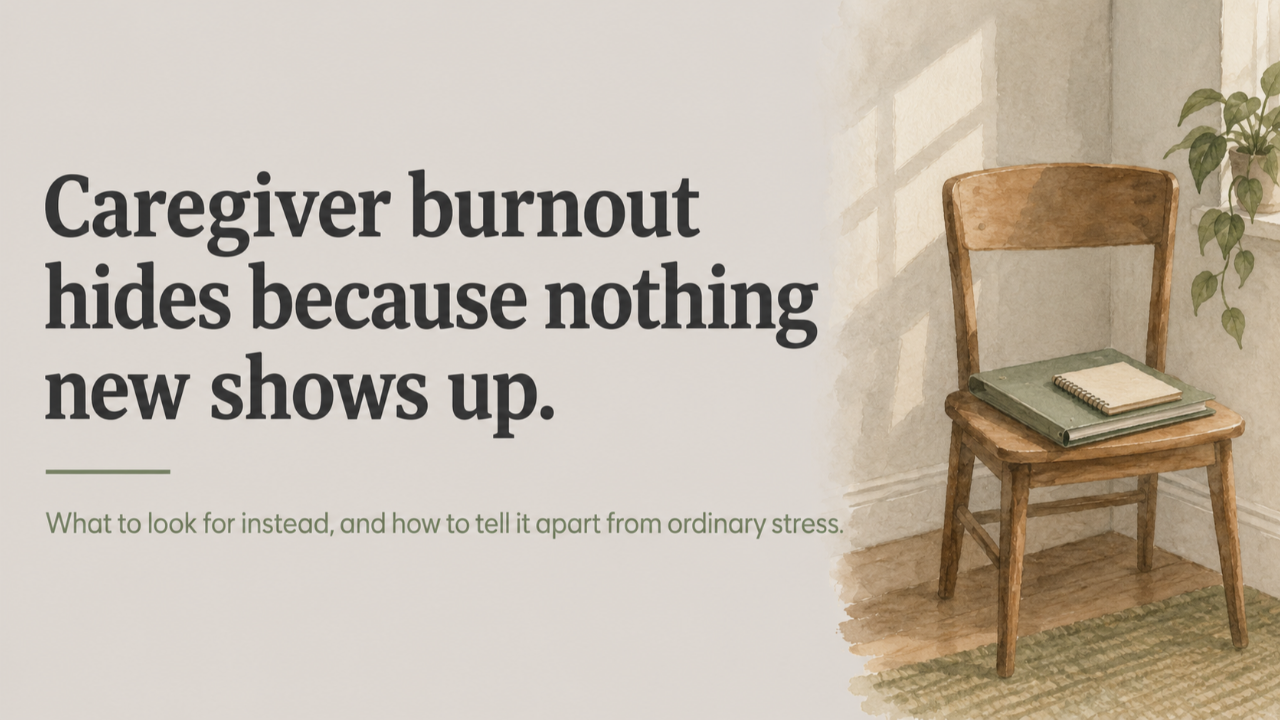
There is a chair in almost every exam room that nobody talks about.
The patient sits on the table. We talk about scans and labs, the next infusion, the side effects, the plan for the next six weeks. And over in the corner there is a chair with a person in it, holding a folder. Inside that folder is a medication list written in three colors of ink, a printout of the last imaging report, and a small notebook of questions written down at two in the morning.
That person is usually a spouse. Sometimes an adult daughter who moved back home. Sometimes a friend who simply refused to let someone go through this alone.
When we turn toward that chair and ask, "And how are you doing?" the answer is almost always the same.
"I’m fine. We’re just focused on him right now."
We have heard that sentence thousands of times between us. And we have learned that it is rarely a lie. It is something more complicated than a lie. It is the sound of a person who has stopped checking.
That is where caregiver burnout begins. Not with a collapse. With a quiet decision to stop looking at yourself.
What Caregiver Burnout Actually Is
Caregiver burnout is a state of physical, emotional, and mental exhaustion that develops from the sustained work of caring for someone else. The Cleveland Clinic describes it that way, and adds something important: it often comes with a shift in attitude, from warm and engaged to flat and detached. Studies they cite suggest that more than six in ten caregivers experience symptoms of burnout at some point.
This is not a small population. In 2025, AARP and the National Alliance for Caregiving reported that 63 million Americans, nearly one in four adults, had provided ongoing care for an adult or a child with a serious medical condition or disability in the past year. That is roughly 20 million more people than a decade earlier. Nearly one in four of them provides 40 or more hours of care each week. Almost one in three is also raising children at the same time.
So if you are reading this feeling like you are quietly failing at something everyone else handles gracefully, please hear us. You are one of tens of millions of people carrying a team sized workload alone.
Burnout is not a character flaw. It is not a shortage of love. It is what happens when the demands placed on a human being exceed that human being’s resources, for long enough, without relief.
Why the Symptoms of Caregiver Burnout Are So Hard to See From the Inside
Most illness announces itself by adding something. A lump. A pain. A fever. A cough that will not quit.
Caregiver burnout works the other way. It announces itself by subtraction.
The book club you stopped attending. The friend you stopped calling back. The walk you used to take. The guitar in the closet. The morning coffee on the porch that turned into coffee in the car. Nothing appeared. Things simply left, one at a time, and each departure was reasonable on the day it happened.
Burnout also hides because your attention is pointed away from yourself by design. The instrument you would normally use to notice your own decline is aimed at someone else’s face, breathing, appetite, and pill box.
And then there is guilt, which keeps the whole thing invisible. Guilt says other people have it worse. Guilt says you will rest when this is over, as though your body has agreed to that schedule.
It has not.
Physical Symptoms of Caregiver Burnout
There is no blood test for burnout. But the body keeps a ledger anyway, and these are the entries we see most often.
- Fatigue that sleep does not repair. This is the single most reported physical symptom. You get a full night, or even a rare weekend off, and you wake up feeling no different.
- Changes in sleep. Falling asleep the moment you sit down, or lying awake at 3 a.m. running logistics. Often both, in the same week.
- Changes in appetite or weight. Eating almost nothing during the day and then everything at ten at night, or losing interest in food altogether.
- Getting sick more often and staying sick longer. Colds that linger. Shingles. Cold sores. Flares of conditions that had been quiet for years.
- New or worsening physical complaints. Headaches, jaw tension, neck and low back pain, reflux, palpitations, a chest that feels tight for no cardiac reason.
- Your own health care quietly abandoned. The mammogram you rescheduled twice and then forgot. The prescription that ran out in April. The dentist you have not seen since the diagnosis.
Emotional Symptoms of Caregiver Burnout
The emotional symptoms of caregiver burnout overlap heavily with the symptoms of depression and anxiety, which is not a coincidence.
- Irritability that feels out of proportion. A dropped fork, a repeated question, a misplaced remote, and suddenly you are furious.
- A short fuse aimed at the person you love most, followed by a wave of shame.
- Sadness, tearfulness, or a heaviness that sits on your chest when you wake up.
- Guilt about resting, guilt about wanting to leave the house, guilt about being tired at all.
- Resentment toward the person you are caring for, and then horror at yourself for feeling it. This is one of the most common things caregivers confess to us, usually in a whisper, usually convinced they are the only one.
- Emotional numbness. Not sadness. Flatness. The sense of watching your own life from the next room.
- Loss of interest in things you used to enjoy, including things that used to reliably lift you.
And one more, which we include because leaving it out would be a disservice. The Cleveland Clinic lists thoughts of wanting to hurt yourself or the person you are caring for among the symptoms of caregiver burnout. If that thought has visited you, it does not make you a monster. It makes you a human being who has been past their limit for too long. It does mean you need help today rather than someday. In the United States you can call or text 988 at any hour and talk to someone.
Behavioral Signs of Caregiver Burnout
Sometimes the clearest signs of caregiver burnout are not feelings at all. They are patterns other people can see before you can.
- Withdrawing from friends and family. Invitations declined reflexively, before you even consider them.
- Drinking more in the evening, or leaning harder on something to fall asleep.
- Refusing help that is genuinely offered, while privately resenting that no one helps.
What Is a Common Sign of Caregiver Burnout? The One Most People Miss
If you ask us for the single most common sign, it is not fatigue. Fatigue is expected. Fatigue is the price of admission.
The sign we watch for is this: your own life has disappeared from your own calendar.
Open it and look. Count the entries that exist for you. Not appointments for the person you care for. Not errands that serve the household. Things that exist because you wanted them to exist. For many caregivers deep in burnout, the honest count is zero, and it has been zero for months.
There is a second signal that matters just as much, and it is a shift in language. Early on, caregivers say some version of "this is hard." Later, when burnout has taken hold, they say some version of "this will never get better."
That move from difficulty to hopelessness is the hinge. It is the point where rest alone stops being enough, and where real support needs to enter the picture.
Caregiver Stress, Caregiver Fatigue, and Compassion Fatigue: What Is the Difference?
These words get used interchangeably, and the distinctions matter, because they point toward different solutions.
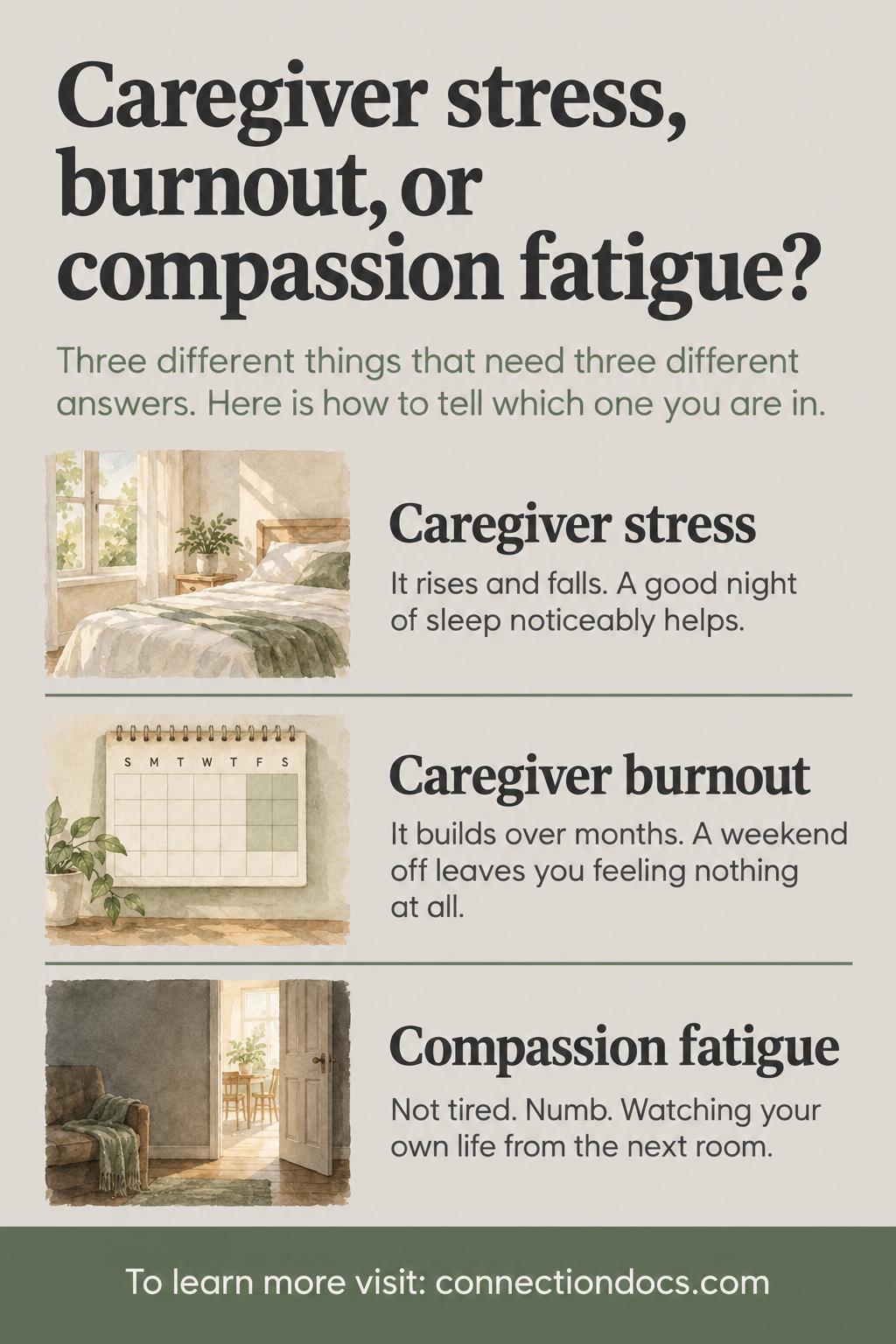
Caregiver stress is the normal response to high demand. It rises and falls. A good night of sleep, a weekend of help, or a stretch of good news noticeably improves it. A person under stress still believes things can improve.
Caregiver burnout is cumulative and chronic. It builds over months and years. Rest helps less than it used to. Hopelessness has entered the room. This is the state where a full weekend off leaves you feeling nothing at all, and that emptiness is the most useful diagnostic clue we know.
Compassion fatigue is related but distinct, and it is more common in people exposed to suffering for long stretches. It shows up as numbness and a reduced ability to feel with someone, rather than as exhaustion. Many caregivers experience both at once.
Caregiver burnout also tends to develop in recognizable stages. It usually begins with over functioning, that first surge of energy and competence after a diagnosis. Then comes strain, when the demands outlast the adrenaline. Then exhaustion. Then depletion and detachment, when the person who was once fully present is going through the motions. Knowing the stages is useful for exactly one reason. It lets you intervene earlier.
Why This Matters Medically, Not Just Emotionally
We are not trying to frighten anyone who is already frightened. But we would be poor physicians if we did not tell you what the research shows.
In a landmark study published in JAMA in 1999, Richard Schulz and Scott Beach followed older spousal caregivers for four years. Those who were providing care and reporting mental or emotional strain had a 63 percent higher risk of death during that period than noncaregivers of the same age. Strain, not caregiving alone, was the variable that mattered.
More recently, a 2024 CDC analysis of national survey data found that 13 of 19 health indicators were worse for caregivers than for noncaregivers. Lifetime depression was reported by 25.6 percent of caregivers compared with 18.6 percent of noncaregivers, and caregivers also reported higher rates of frequent mental distress and multiple chronic conditions.
We share these numbers for one reason. Caregivers deserve to be treated as patients too.
So here is a concrete request. At your next visit with your own physician, say this sentence out loud: "I am a caregiver." Mayo Clinic specifically recommends telling your clinician that you are in this role, and it changes the conversation. It moves you from the chair in the corner to the chair that gets examined.
Coming Back: Four Doors, Not Twelve Steps
We are not going to hand you a twenty item self care plan. A long list of new obligations is the last thing an exhausted person needs.
Instead we want to offer four doors. We call them the Four F’s: Fun, Food, Fitness, and Family. You do not need to walk through all four. Most people find that opening one makes the others easier to reach.
Fun: Your Connection With Yourself
Fun is the most underestimated medicine in caregiving, and the first thing to get cut.
By fun we do not mean vacations or anything expensive. We mean the specific things that make you feel like yourself. The woodworking bench. The fishing rod. The choir. The garden. The long phone call with the friend who makes you laugh until you cannot breathe.
Ask yourself a question we ask patients constantly: what made you glad to be alive before all of this started?
Then take the answer seriously enough to put it on the calendar. Twenty minutes, twice a week, defended like an appointment. Not "when things settle down." Things do not settle down. That is the nature of serious illness, and waiting for a calm stretch is how three years go by.
There is real science underneath this. In a randomized trial of family caregivers of people with dementia, an individualized activity program improved positive affect over twelve months. Positive affect is not a luxury. It is part of what allows a person to keep showing up.
Food: Eating in a Way That Actually Works for You
The caregiver diet is a real phenomenon. Coffee at six, nothing until two, crackers from the waiting room, whatever is left on the plate you were trying to get someone else to finish, and then a large and slightly desperate meal at ten at night.
We want to say clearly that there is no single perfect diet. Anyone who tells you otherwise is selling something. Bodies differ, cultures differ, budgets differ, and the food that sustains one person leaves another sluggish. Your job is not to follow someone else’s rules. Your job is to find what works for you and then make it easy to repeat.
A few things we suggest to caregivers, offered gently:
- Protect one real meal a day that you eat sitting down, not standing at the counter. One is enough to start.
- Put protein in the first thing you eat. It steadies the rest of the day more than almost any other change.
- When someone asks what they can do, say food. Then actually accept it when it arrives.
- Watch the evening drink. Many caregivers find that one glass to take the edge off has quietly become three, and alcohol is a reliable saboteur of the sleep you are already short on.
And please do not turn food into one more test you can fail. You are already carrying enough.
Fitness: Functional Movement, Not a Fitness Plan
We are talking about functional fitness. Steps. Strength. Being outside. The kind of movement that keeps you capable of lifting, transferring, carrying, and standing through a long day.
The evidence here is encouraging. A randomized trial of a home based exercise program for family caregivers found improvements in health related quality of life and physical fitness, and exercise based programs have been studied specifically as a way to reduce caregiver burden and strain.
What this looks like in real life:
- Walk the perimeter of the hospital or clinic while an infusion runs. It is often twenty minutes you already have.
- Ten minutes of strength work twice a week. Body weight is fine. A pair of dumbbells under the bed is fine.
- Choose the habit that survives a bad week. A plan requiring a gym, a change of clothes, and forty minutes will not survive a hospital admission. A ten minute walk will.
Family: The People Around You
If Fun is about your relationship with yourself, Family is about the people around you. This may be the most protective door of the four.
Burnout thrives in isolation. The 2023 Surgeon General’s Advisory on loneliness laid out how strongly social connection predicts physical and mental health, and how isolation predicts the opposite. Caregivers are among the most quietly isolated people in American life, often in a house full of activity.
People genuinely want to help. What stops them is not indifference, it is uncertainty. "Let me know if you need anything" is an offer with no handle on it. So hand them a handle. Tuesday pharmacy runs. Thursday dinner. Sunday afternoon sitting with him from two to five so you can leave the house. A phone call every Wednesday at eight, about anything other than illness.
Respite care deserves its own paragraph. It is temporary relief from caregiving, and it comes in more forms than most people realize: in home aides, adult day programs, and short stays at facilities that accept someone for a few days while a caregiver travels or simply sleeps. The ARCH National Respite Network maintains a locator for finding providers, and their guidance is worth repeating. Arrange respite before you are exhausted, not after.
Using it is not abandonment. It is maintenance on the only caregiver your person has.
A Five Question Check In You Can Do This Week
If you want a simple way to check yourself, sit with these five questions. Answer them honestly, then answer them again in a month.
- When did I last wake up feeling genuinely rested?
- Who have I spoken with this week who was not a clinician and not the person I care for?
- What have I done in the last seven days purely because I enjoy it?
- Have I missed my own appointments, screenings, or medications?
- When I imagine six more months of this, do I feel steadiness or dread?
When Self Care Is Not Enough
Please reach out to a clinician if you are experiencing any of the following:
- Low mood, hopelessness, or loss of interest lasting two weeks or longer.
- Anxiety or insomnia that is interfering with your ability to function.
- Increasing use of alcohol, sedatives, or other substances to get through the day or the night.
- Any thought of harming yourself or the person you are caring for. In the United States, call or text 988 right away.
Depression and anxiety in caregivers are common, they are treatable, and treating them tends to improve the care being given as much as it improves the person giving it.
One Last Thought
We want to go back to that chair in the corner of the exam room.
If you are the person sitting in it, we want you to know something. You are not a visitor to this illness. You are inside it. The exhaustion you feel is not a sign that you are failing at caregiving. It is evidence of how much you have been carrying, for how long, and how well you have hidden it.
The most loving thing we have ever watched a caregiver do was not another sleepless night. It was calling a friend and saying, out loud, that they could not do this alone anymore.
The person you love does not need a perfect caregiver. They need a caregiver who is still here in a year, still recognizable, still capable of laughing at something with them at the kitchen table.
That version of you is worth protecting. Starting this week, and starting small.
Talk With Us
If you are recognizing yourself somewhere in this article, you do not have to sort it out alone.
Whenever you are ready, you are welcome to book a connection call with us.
Book a Connection Call with Dr. Alona and Dr. Matt
References and Further Reading
Cleveland Clinic: Caregiver Burnout, What It Is, Symptoms and Prevention
AARP and National Alliance for Caregiving: Caregiving in the US 2025
National Alliance for Caregiving: Caregiving in the US research hub
CDC MMWR: Changes in Health Indicators Among Caregivers, United States, 2015-2016 to 2021-2022
Mayo Clinic: Caregiver stress, tips for taking care of yourself
US Surgeon General Advisory: Our Epidemic of Loneliness and Isolation
ARCH National Respite Network: Resources for Caregivers and the National Respite Locator
Randomized trial: individualized physical activity and mental health outcomes in family caregivers
Randomized trial: home based exercise, quality of life, and physical fitness in caregivers
American Cancer Society: Tips for Caregiver Burnout
CancerCare: Coping With the Stress of Caregiving
This article is for general education and is not a substitute for individual medical advice. If you are in crisis in the United States, call or text 988 to reach the Suicide and Crisis Lifeline.