Spoon Theory: How to Spend Your Energy When You Live With a Chronic Illness
Oct 28, 2026
Picture waking up on a weekday morning. Before your feet even touch the floor, you’re already doing math.
A shower would feel good, but it will cost something. So will drying your hair. Then there’s the grocery run you’ve been putting off, the work call at ten, the dinner you promised to cook, and the call to the pharmacy that will almost certainly put you on hold. You add it all up and quietly realize the total is more than you have.
Most people never have to do that math. Many people living with a chronic illness do it every single day.
There’s a name for this experience. It’s called spoon theory, and it started with a conversation in a diner.
What Is Spoon Theory?
In her 2003 essay “The Spoon Theory,” Christine Miserandino, a writer who lives with lupus, describes a late night in a diner during college, when her best friend asked what being sick actually felt like. Christine realized she had never found the words for it, not even for herself.1
Christine reached for the closest props she could find. She gathered up spoons and handed her friend twelve of them. Each spoon, she explained, stood for one of the limited things she could do in a day. Most people start the day without ever having to count. People living with chronic illness start with a limited number and have to decide, all day long, how to spend them.
Then she asked her friend to walk through an ordinary day, giving up a spoon for each task. Getting out of bed. Showering. Getting dressed. Getting to work. The spoons disappeared fast, and long before the day was over, every remaining choice meant giving something else up.
Her essay traveled far beyond lupus. Today, each spoon is widely understood as a unit of energy, and many people living with chronic conditions call themselves “spoonies,” a shared identity for people who live with limited energy.2
Here is spoon theory explained in one sentence:
Spoon theory says energy is a limited daily budget: every activity costs something, and once the spoons are spent, anything more is borrowed from tomorrow.
Spoon theory isn’t a medical measurement. You won’t find spoons on a lab report. It’s a metaphor. But it’s one of the most useful ones we know, because it gives language to something that is otherwise invisible.
Why Energy Works Differently With a Chronic Illness
Everyone gets tired. The fatigue that comes with chronic illness is a different animal.
In lupus, studies estimate that between 67% and 90% of people live with fatigue, and many describe it as their most bothersome symptom.3 In a Norwegian study of about 1,450 people with multiple sclerosis, 81% had fatigue on a standard questionnaire, and about two-thirds of them rated it severe.4 And in a large international survey of people with rheumatic diseases such as rheumatoid arthritis and lupus, roughly half reported severe fatigue.5
In cancer, fatigue is one of the most common side effects of treatment. Between 30% and 60% of people have moderate to severe fatigue during treatment, and for 20% to 30%, it lingers for months or even years afterward.6 It’s typically described as a persistent, distressing exhaustion that’s out of proportion to recent activity and gets in the way of daily life.7
The causes are often layered: the illness itself, treatment side effects, anemia, pain, poor sleep, low mood, medications, and the loss of strength that comes from doing less over time.7
That’s why we always add this: if your fatigue is new, getting worse, or simply unexplained, tell your care team. Some causes, like anemia, thyroid problems, sleep apnea, depression, and medication side effects, can be treated.7 Spoon theory helps you manage the energy you have. It should never stop anyone from looking for the reasons that energy is low. And if fatigue ever comes with fever, shortness of breath, chest pain, fainting, or bleeding, get medical care right away.
The Boom-and-Bust Cycle
Here’s a pattern we see often.
You wake up on a good day. Finally. You feel almost like your old self, so you do everything: the laundry, the errands, the deep clean of the kitchen, the coffee with the friend you’ve been missing.
Then you pay for it. For the next two or three days, you can barely get off the couch. In spoon terms, you borrowed from tomorrow, and tomorrow started short.1
Clinicians who work with chronic pain and fatigue call this the boom-and-bust cycle: bursts of too much activity on good days, followed by long stretches of rest to recover.8 Both extremes, avoiding activity and pushing through severe pain, have been linked with poorer outcomes in people with chronic pain.9
The alternative is pacing: spreading activity more evenly across the day and the week, breaking tasks into smaller pieces, and resting before you hit empty rather than after.8 In spoon language, pacing means not spending every spoon on a good day. Christine herself has written about keeping an extra spoon in reserve.1 It’s a habit worth borrowing.
Pacing looks a little different depending on the condition. For many people with chronic pain, it means finding a steady baseline and building up gradually from there.8,10 For people with ME/CFS, it means staying within your limits rather than pushing to raise them.11,12 The research on pacing is still young. A 2026 systematic review of quota-based pacing programs for chronic pain (nine studies, 873 people) found results leaning toward better function but rated confidence in the evidence as very low.13 Still, in our experience, pacing gives many people steadier, more predictable days.
A note on post-exertional malaise
For some people, especially those living with myalgic encephalomyelitis/chronic fatigue syndrome (ME/CFS), even minor physical or mental effort can trigger a crash. It’s often delayed by 12 to 48 hours, and recovery can take days, weeks, or longer. This is called post-exertional malaise.14,12 The CDC describes pacing for ME/CFS as balancing activity and rest: learning your own limits for physical and mental activity, then planning your days to stay within them. Some patients and doctors call this staying inside your “energy envelope.”11 Guidance from the UK’s National Institute for Health and Care Excellence (NICE) also advises against graded exercise therapy, a program of fixed, step-by-step increases in exercise, for people with ME/CFS.12
If that pattern sounds familiar, please talk with your care team before adding activity.
How to Spend Your Spoons: The Four Ps of Energy Conservation
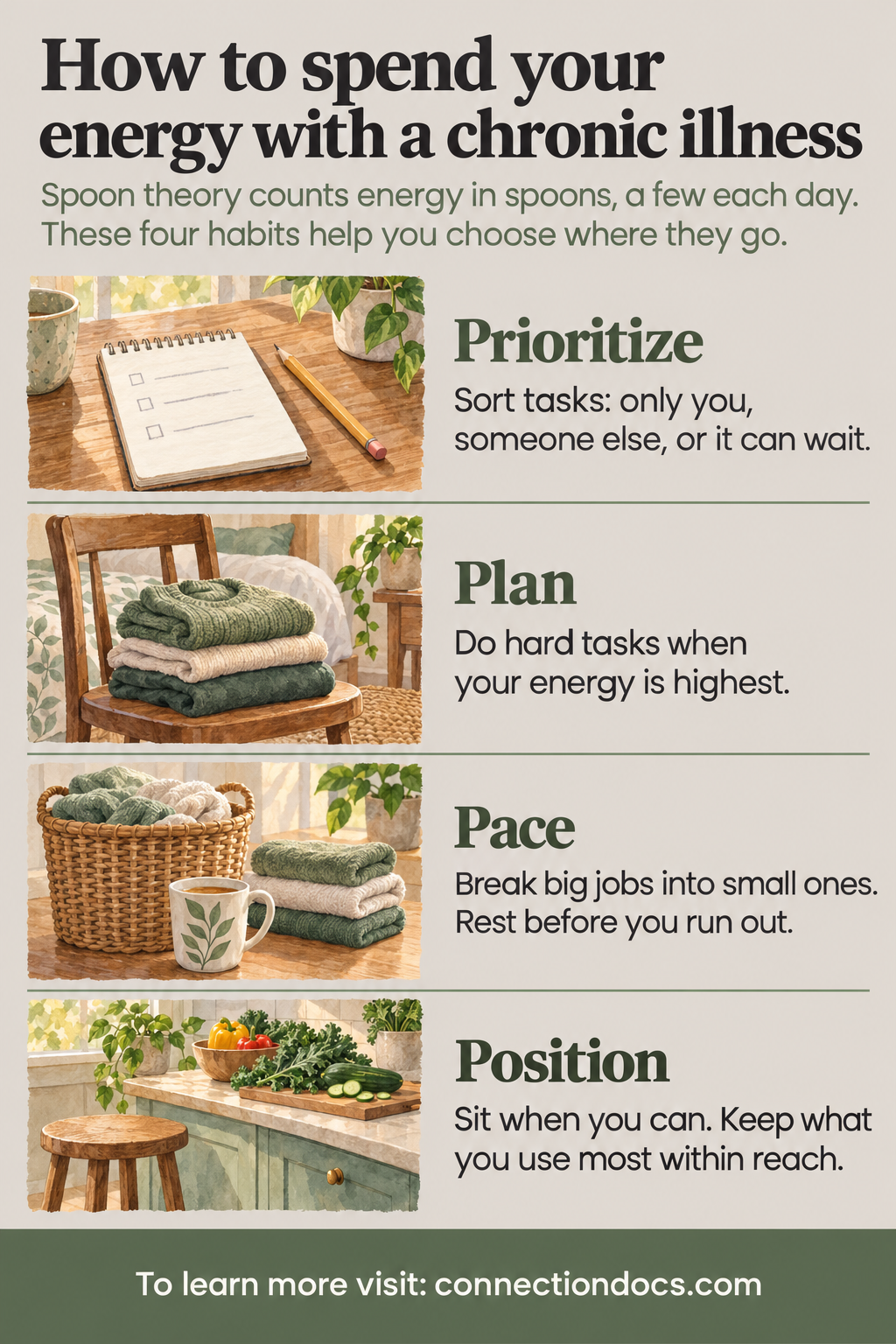
Occupational therapists often teach energy conservation around four Ps: prioritize, plan, pace, and position.15 For cancer-related fatigue, the evidence behind energy conservation is limited but real. In a randomized trial of 396 adults starting chemotherapy or radiation, three phone sessions with a nurse focused on energy conservation led to a modest but statistically significant drop in fatigue compared with a nutrition-focused program, though everyday functioning didn’t change.16
Prioritize
Look at your list and sort it: what truly needs you, what someone else could do, and what can wait or quietly disappear. Not everything that feels urgent is important.
Plan
Notice when your energy tends to be highest, and put your hardest tasks there. Spread heavy chores across the week instead of stacking them on one day. Lay out tomorrow’s clothes tonight. Plan rest the way you’d plan an appointment.
Pace
Break big jobs into smaller ones. Alternate heavy tasks with light ones. Rest before you’re exhausted, not after.
Position
Sit whenever you can: a stool at the kitchen counter, a chair in the shower, a seat while you fold laundry. Keep the things you use most within easy reach. Every bend, stretch, and extra trip across the house costs a little.
Spending Your Spoons Through the Four F’s
Pacing tells you how to spend your spoons. The Four F’s, Fun, Food, Fitness, and Family, help you decide where.
Fun: Always budget a spoon for joy
When energy is scarce, the first thing most people cut is the thing that brings them joy. Chores feel mandatory. Fun feels optional.
We’d gently push back on that.
In a study of nearly 1,400 adults, people who took part in more enjoyable leisure activities had lower blood pressure, lower levels of the stress hormone cortisol, smaller waists, better moods, and less depression.17 The study shows an association, not proof of cause. Still, it’s a good reminder that joy isn’t a reward you earn after every obligation has been paid. It’s part of what keeps you going.
So protect at least one spoon a day for something that makes you glad to be alive. It doesn’t have to be big: ten minutes outside, a favorite song, a call with someone who makes you laugh, a few pages of a good book.
Food: Make eating a low-spoon task
Cooking can be one of the most spoon-expensive parts of the day. The answer isn’t to give up on good food. It’s to make good food cost less. The National Cancer Institute’s Eating Hints booklet, written for people going through cancer treatment, offers a useful starting point:18
- Stock your kitchen with healthy foods that need little or no cooking. Our plant-based favorites: canned beans, hummus, pre-washed greens, frozen vegetables, whole-grain bread, oats, fruit, nuts, and seeds.
- Cook ahead on high-spoon days and freeze meal-size portions. A big pot of lentil soup or a tray of vegetables roasted on parchment can become several meals.
- Let friends and family shop and cook for you, and tell them what you’d actually like.
- If your appetite is low, try five or six small meals instead of three big ones.
If your treatment lowers your white blood cell count, or you’ve been told to limit fiber, ask your care team or a dietitian how to adapt this list. During those times, the same booklet advises extra food safety steps, like scrubbing raw produce well and choosing roasted nuts over raw ones.18
One of our favorite low-spoon plates: a scoop of beans, a scoop of whole grains, a handful of greens, and a spoonful of salsa or tahini. Five minutes, almost no cleanup.
There’s also early evidence that what you eat may affect how tired you feel. In a randomized trial of 103 women receiving chemotherapy for breast cancer, those assigned to a plant-based, high-protein diet reported less fatigue over the course of treatment, while fatigue rose in the comparison group.19 It’s a single study, so we hold it loosely, but it’s an encouraging sign.
If you’re losing weight without trying or struggling to eat enough during treatment, talk with your care team or a registered dietitian. On those days, getting enough nourishment comes first.
Fitness: Movement can grow your spoon supply
One important exception first. If you live with ME/CFS, or you tend to feel worse a few hours to a few days after physical or mental effort, skip the build-slowly advice below. For you, pacing comes first, and any change in activity should be planned with your care team.
For many other people, this next part is surprising. When you’re exhausted, rest feels like the only logical answer. But in cancer-related fatigue, too much inactivity and too much daytime sleep can contribute to fatigue.7 The National Cancer Institute suggests keeping naps under an hour, since long daytime sleep can make it harder to sleep well at night.20
The evidence for movement is consistent, especially in cancer. A meta-analysis of 113 randomized trials with more than 11,000 participants found that exercise and psychological approaches, alone or together, modestly reduced cancer-related fatigue, while the medications studied did not significantly help.21 The American Society of Clinical Oncology’s 2024 guideline recommends exercise, cognitive behavioral therapy, mindfulness-based programs, and tai chi or qigong for people dealing with fatigue during cancer treatment.6
Think of movement as an investment rather than an expense. Spend a spoon on a short walk today, and over the coming weeks, you may find that you have a few more to work with.
Start smaller than you think you need to: five minutes of walking, standing up from a chair a few times, gentle stretching outside in the fresh air (with sun protection if you have lupus or take a medicine that makes you sun-sensitive). Then build slowly. If you’re in active cancer treatment, check with your oncology team before starting an exercise program,6 especially if you have bone metastases, low blood counts, or heart or lung problems.
And if physical or mental effort tends to leave you worse a few hours to a few days later, don’t push through it. Talk with your care team about a plan that starts with pacing.
Family: Let the people around you carry a few spoons
One of the most powerful things about spoon theory is that it gives the people around you a way to understand. Christine’s own family and friends came to use spoons as shorthand for what she could manage on a given day.1
“I’m low on spoons today” is a lot easier to say than a long explanation of why you’re canceling dinner again. It’s also a lot easier for the people who love you to hear.
Family and friends can save you spoons directly, too, by taking tasks off your plate. So if you love someone with a chronic illness, here’s our suggestion. Instead of asking, “Is there anything I can do?” offer something specific. “Can I pick up your prescription on Thursday?” “I’m making soup tonight, and I’ll drop some off tomorrow.”
An open-ended offer asks the person to spend a spoon figuring out what to ask for. A specific one hands them a spoon back.
A Short Reflection: Your Spoon Inventory
Spoon theory becomes most useful when you make it personal. Set aside fifteen minutes for this one. There are no right answers, only a clearer picture of where your energy goes.
- On a typical day, how many spoons do you wake up with? Pick a number between 1 and 12 that feels true.
- List the things you do on a normal day, and give each one a spoon cost.
- Mark each item: Only me, Someone else could, Could let go, or Brings me joy.
- Now look for the hidden leaks: the spoons spent on worry, on scrolling, on saying yes when you meant no, on managing everyone else’s feelings.
Then ask yourself:
- Where are my spoons going that I wouldn’t choose?
- What is one task I could hand off this week?
- What is one joy I want to protect, no matter what?
Put that joy on your calendar like an appointment. Because it is one.
Rest Is Not Failure
Some days you’ll wake up with a drawer full of spoons. Some days you’ll have three.
On the three-spoon days, rest is not laziness, and it is not failure. It’s strategy. It’s how you make sure there’s something left for tomorrow, and for the people and moments that matter most.
You can’t always choose how many spoons you get.
You can choose where they go.
If you’re living with a chronic illness and your energy never seems to stretch far enough, especially when big medical decisions are using up the spoons you have left, we’d love to help. We work with people entirely virtually, so you can join from your couch on a low-spoon day. Book a Connection Call with us and let’s talk about where your energy is going and what you need most.
This article is for general education and is not a substitute for individualized medical advice. New, worsening, or unexplained fatigue deserves a conversation with your own care team.
References
- Miserandino C. The Spoon Theory. ButYouDontLookSick.com. Written 2003. Accessed October 27, 2026. https://butyoudontlooksick.com/articles/written-by-christine/the-spoon-theory/
- Wanberg LJ, Pearson DR. Evaluating the Disease-Related Experiences of TikTok Users With Lupus Erythematosus: Qualitative and Content Analysis. JMIR Infodemiology. 2024;4:e51211. https://pmc.ncbi.nlm.nih.gov/articles/PMC11063877/
- Kawka L, Schlencker A, Mertz P, Martin T, Arnaud L. Fatigue in Systemic Lupus Erythematosus: An Update on Its Impact, Determinants and Therapeutic Management. J Clin Med. 2021;10(17):3996. https://pmc.ncbi.nlm.nih.gov/articles/PMC8432566/
- Broch L, Simonsen CS, Flemmen HØ, et al. High prevalence of fatigue in contemporary patients with multiple sclerosis. Mult Scler J Exp Transl Clin. 2021;7(1):2055217321999826. https://pmc.ncbi.nlm.nih.gov/articles/PMC7985949/
- Overman CL, Kool MB, Da Silva JA, Geenen R. The prevalence of severe fatigue in rheumatic diseases: an international study. Clin Rheumatol. 2016;35(2):409-415. https://pmc.ncbi.nlm.nih.gov/articles/PMC4752960/
- Bower JE, Lacchetti C, Alici Y, et al. Management of Fatigue in Adult Survivors of Cancer: ASCO-Society for Integrative Oncology Guideline Update. J Clin Oncol. 2024;42(20):2456-2487. https://pmc.ncbi.nlm.nih.gov/articles/PMC12082589/
- PDQ Supportive and Palliative Care Editorial Board. Fatigue (PDQ): Health Professional Version. National Cancer Institute. Updated November 6, 2024. https://www.cancer.gov/about-cancer/treatment/side-effects/fatigue/fatigue-hp-pdq
- Royal National Orthopaedic Hospital NHS Trust. Pacing. Patient information guide. Updated July 16, 2025. https://www.rnoh.nhs.uk/patients-and-visitors/patient-information-guides/pacing
- Andrews NE, Strong J, Meredith PJ. Activity pacing, avoidance, endurance, and associations with patient functioning in chronic pain: a systematic review and meta-analysis. Arch Phys Med Rehabil. 2012;93(11):2109-2121. https://pubmed.ncbi.nlm.nih.gov/22728699/
- Nielson WR, Jensen MP, Karsdorp PA, Vlaeyen JW. Activity pacing in chronic pain: concepts, evidence, and future directions. Clin J Pain. 2013;29(5):461-468. https://pubmed.ncbi.nlm.nih.gov/23247005/
- Centers for Disease Control and Prevention. Manage ME/CFS. May 10, 2024. https://www.cdc.gov/me-cfs/management/index.html
- National Institute for Health and Care Excellence. Myalgic encephalomyelitis (or encephalopathy)/chronic fatigue syndrome: diagnosis and management. NICE guideline NG206. 2021 (reviewed January 2025). https://www.nice.org.uk/guidance/ng206/chapter/Recommendations
- Antcliff D, Burns L, English E, et al. Operant Approach Activity Pacing Interventions for the Management of Chronic Pain: A Systematic Review. Clin J Pain. 2026;42(9):e1393. https://pubmed.ncbi.nlm.nih.gov/42085181/
- Centers for Disease Control and Prevention. Symptoms of ME/CFS. May 10, 2024. https://www.cdc.gov/me-cfs/signs-symptoms/index.html
- Royal Berkshire NHS Foundation Trust. Occupational Therapy and Energy Conservation: Information for Patients. Reviewed June 2026. https://www.royalberkshire.nhs.uk/media/mx0duzbw/occupational-therapy-and-energy-conservation_all-wards_jun26.pdf
- Barsevick AM, Dudley W, Beck S, Sweeney C, Whitmer K, Nail L. A randomized clinical trial of energy conservation for patients with cancer-related fatigue. Cancer. 2004;100(6):1302-1310. https://pubmed.ncbi.nlm.nih.gov/15022300/
- Pressman SD, Matthews KA, Cohen S, et al. Association of enjoyable leisure activities with psychological and physical well-being. Psychosom Med. 2009;71(7):725-732. https://pmc.ncbi.nlm.nih.gov/articles/PMC2863117/
- National Cancer Institute. Eating Hints: Before, During, and After Cancer Treatment. NIH Publication No. 22-7157. December 2022. https://www.cancer.gov/publications/patient-education/eating-hints
- Sathiaraj E, Afshan K, R S, et al. Effects of a Plant-Based High-Protein Diet on Fatigue in Breast Cancer Patients Undergoing Adjuvant Chemotherapy: A Randomized Controlled Trial. Nutr Cancer. 2023;75(3):846-856. https://pubmed.ncbi.nlm.nih.gov/36546552/
- National Cancer Institute. Cancer Fatigue. Updated September 20, 2024. https://www.cancer.gov/about-cancer/treatment/side-effects/fatigue
- Mustian KM, Alfano CM, Heckler C, et al. Comparison of Pharmaceutical, Psychological, and Exercise Treatments for Cancer-Related Fatigue: A Meta-analysis. JAMA Oncol. 2017;3(7):961-968. https://pmc.ncbi.nlm.nih.gov/articles/PMC5557289/