Simple Breathing Exercises for Stress and Recovery
Oct 13, 2026
Matt wrote recently on our Substack about something he noticed in himself. When a conversation around him turns tense, his breathing changes first. It becomes shallow. Sometimes he holds it altogether. Long before his mind registers that anything is wrong, his body has already braced.
Most of us do some version of this. We hold our breath while we wait for the phone call with results. We breathe high and fast in our chests in the waiting room. We lie awake at night breathing as if we’re running from something.
Here’s the good news: breath works in both directions. Stress changes how we breathe, and how we breathe can change how stressed we feel. It’s one of the few parts of your nervous system you can reach on purpose, anytime, anywhere, for free.
Let’s look at how that works, what the research actually shows, and six simple breathing exercises you can start using today.
How Breathing Calms Your Nervous System
Your autonomic nervous system has two main branches. The sympathetic branch prepares you for action: heart rate up, muscles tense, breath fast and shallow. The parasympathetic nervous system helps you rest, digest, and recover.
The vagus nerve is a major pathway of that rest-and-recover system, and breathing is closely tied to it. Your heart naturally speeds up a little when you inhale and slows a little when you exhale. Researchers have proposed that slow breathing with longer exhales is one of the main ways practices like meditation and yoga signal safety to the body through the vagus nerve [1].
A review of studies on slow breathing, meaning fewer than 10 breaths a minute compared with the usual 12 to 20, found it was associated with higher heart rate variability (a marker of a flexible, resilient nervous system), more relaxation and comfort, and less anxiety, anger, and arousal [2].
There’s also a reason a deep sigh feels so good. We naturally sigh every few minutes to reopen the tiny air sacs in our lungs, and we sigh more often under stress [3]. Some researchers describe the sigh as a kind of reset button for both breathing and emotion [4].
What the Research Shows (and What It Doesn’t)
Breathing exercises are not a cure for anything. But the evidence that they can help is real.
- A 2023 meta-analysis of randomized trials found that breathwork produced small to moderate reductions in stress, anxiety, and depression compared with control conditions [5].
- In a Stanford study, people practiced for just five minutes a day for a month. Everyone improved, but those practicing a technique called cyclic sighing had the largest gains in positive mood, along with a slower resting breathing rate, compared with those doing mindfulness meditation [6].
- For people living with cancer, a 2023 guideline from the Society for Integrative Oncology and the American Society of Clinical Oncology recommends mindfulness-based programs, yoga, and relaxation therapies to ease anxiety and depression [7]. Many of these practices use the breath as a central tool.
- The National Cancer Institute lists deep breathing among the techniques that can help reduce nausea and vomiting [8], and Memorial Sloan Kettering recommends relaxation techniques such as deep breathing for managing anxiety [9].
- An American Heart Association scientific statement rated device-guided slow breathing as reasonable to try, alongside standard care, for lowering blood pressure [10].
Most of these studies are small and short, and many involved healthy young adults rather than people living with illness. So think of breathing as a supportive tool: free, low-risk, and always with you, not a replacement for medical care.
Six Simple Breathing Exercises for Stress and Recovery
You don’t need special equipment or a quiet room. Start with whichever technique appeals to you, and practice it for a few minutes when you’re relatively calm, so it feels familiar when you really need it.
1. Diaphragmatic Breathing (Belly Breathing)
This is the foundation for everything else. Many of us breathe mostly with the upper chest, especially when we’re stressed. Diaphragmatic breathing invites the breath lower.
- Sit comfortably, or lie on your back with your knees bent.
- Place one hand on your upper chest and the other just below your rib cage.
- Breathe in slowly through your nose, letting your belly rise against your hand while your chest stays relatively still.
- Exhale slowly, letting your belly fall.
- Practice for 5 to 10 minutes, a few times a day [11].
In a small randomized study of working adults, eight weeks of diaphragmatic breathing training lowered cortisol (a stress hormone), improved sustained attention, and reduced negative mood [12].
2. The Physiological Sigh (Cyclic Sighing)
This is the technique from the Stanford study, and it may be the quickest way to take the edge off a stressful moment.
- Inhale through your nose.
- When your lungs feel full, take a second, shorter sip of air through your nose to top them off.
- Exhale slowly and completely through your mouth, letting the exhale last longer than the two inhales combined.
- Repeat for one to five minutes.
You can use a few sighs in a tense moment, or practice for five minutes a day, which is what the Stanford researchers studied [6].
3. Box Breathing
Box breathing, also called square breathing, is simple enough to remember under pressure. Cleveland Clinic notes that it’s used by U.S. Navy SEALs [13].
- Inhale through your nose for a count of 4.
- Hold gently for 4.
- Exhale for 4.
- Hold for 4.
- Repeat for 3 to 4 rounds.
Never strain during the holds. If holding your breath makes you anxious or lightheaded, shorten the holds or skip them.
4. 4-7-8 Breathing for Sleep
Popularized by Dr. Andrew Weil, 4-7-8 breathing has roots in yogic breathing practices [14].
- Rest the tip of your tongue just behind your upper front teeth.
- Inhale quietly through your nose for a count of 4.
- Hold your breath for a count of 7.
- Exhale through your mouth with a soft whoosh for a count of 8.
- Repeat for a total of four breaths.
If the hold feels too long, count faster while keeping the same ratio [15].
Many people like this one at bedtime. To be honest with you, though, the research on 4-7-8 breathing is thin. A small study found it lowered heart rate and blood pressure during a single session [16], and a trial in patients recovering from bariatric surgery found it reduced anxiety [17]. We haven’t found good evidence that it improves sleep itself, and a recent study found that slow, steady breathing at about six breaths a minute did more for heart rate variability [18]. If it helps you relax, use it. If it makes you uncomfortable, try the next technique instead.
5. Resonance Breathing (Coherent Breathing)
Resonance breathing, sometimes called coherent breathing, simply means breathing slowly and evenly at about five to six breaths per minute.
- Inhale gently through your nose for about 5 seconds.
- Exhale gently for about 5 to 6 seconds.
- Continue for 5 to 10 minutes.
At around this pace, the natural rise and fall of your heart rate lines up with your breathing, which appears to strengthen the reflexes that help regulate blood pressure [19]. The ideal rate varies a little from person to person, so treat these numbers as a starting point. Keep the breath soft rather than big, because overbreathing can make you lightheaded.
Because there are no breath holds, many people find this the most comfortable place to start, and it’s a lovely practice at bedtime.
6. Pursed-Lip Breathing for Breathlessness
If you live with a lung condition, are recovering from an illness, or get short of breath with exertion, pursed-lip breathing is one of the most practical tools you can learn. The American Lung Association calls pursed-lip breathing and belly breathing the two most useful exercises taught in pulmonary rehabilitation [20].
- Breathe in through your nose for about 2 seconds.
- Purse your lips as if you were about to whistle or blow out a candle.
- Breathe out slowly through your lips for 4 seconds or longer.
Pursed-lip breathing keeps your airways open longer, helps release trapped air, and can ease breathlessness [21].
Which Breathing Exercise Should You Use?
Think of these as tools in a toolbox. A few suggestions:
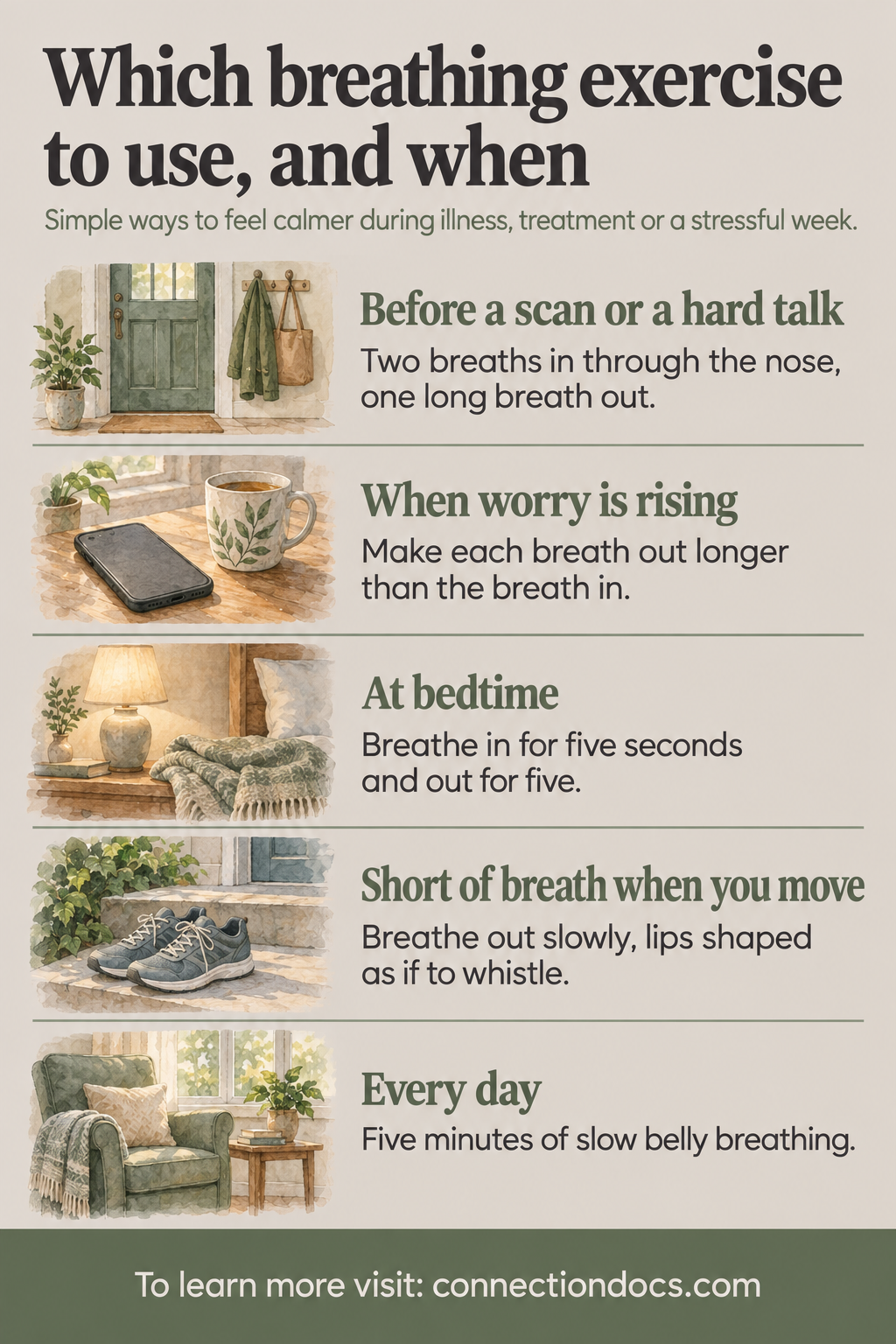
- Before a scan, procedure, or hard conversation: two or three physiological sighs, or a few rounds of box breathing.
- When anxiety or panic is rising: focus on making your exhale longer. Slow breaths out through pursed lips can help, and try not to breathe faster or deeper than you need to.
- At bedtime: resonance breathing or 4-7-8 breathing.
- When you’re short of breath with activity: pursed-lip breathing.
- As a daily practice: five minutes of belly breathing, resonance breathing, or cyclic sighing, ideally at the same time each day.
How to Practice Safely
Relaxation techniques like these are generally considered safe for healthy people [22]. A few cautions:
- Go gently. Breathing too fast or too deeply lowers the carbon dioxide in your blood, which can cause lightheadedness and tingling around your mouth or in your hands [23]. If that happens, return to normal, relaxed breathing.
- Don’t force breath holds. Shorten them or skip them if they’re uncomfortable.
- Check with your care team first if you have a lung or heart condition, have had recent surgery, or are pregnant, and especially before trying any rapid or intense breathwork [24, 25].
- Notice your emotions. For a small number of people, especially those with a history of trauma, focusing on the breath can stir up anxiety [22]. If that happens, open your eyes, feel your feet on the floor, and try again later or with support.
- Know when it isn’t stress. New or worsening shortness of breath, chest pain, or trouble breathing is a reason to call your doctor or 911, not a reason to practice breathing exercises.
Breathing Through the Four F’s
We think about health through four simple lenses: Fun, Food, Fitness, and Family. Your breath runs through all of them.
Fun
Fun is your connection with yourself, and breathing is one of the quickest ways back to it. Try pairing a few slow breaths with something you love: a favorite song, the first sip of morning tea, the moment you step outside. Let your breath become a way of arriving in your own life.
Food
Before you eat, take three slow breaths. Shifting toward rest-and-digest is a gentle way to begin a meal, and it helps you notice flavor, fullness, and how food makes you feel. Whether it’s a warm bowl of lentil soup or a simple plate of fruit, a pause turns eating into a meal rather than something you rushed through.
Fitness
Breath and movement belong together. On walks, try matching your breath to your steps, perhaps breathing in for three steps and out for four. When you lift weights, breathe out as you lift rather than holding your breath. And when you finish exercising, a few minutes of slow breathing is a lovely way to let your body settle.
Family
Our nervous systems are wired to respond to one another. When someone you love is anxious, your slow, steady breathing can become an anchor in the room. Try breathing together before a doctor’s call, or at bedtime with your kids. Sometimes the most helpful thing you can offer isn’t advice. It’s a steady presence.
A Five-Minute Practice to Try Today
Set a timer for five minutes and sit somewhere comfortable.
For the first minute, simply notice your breath without changing it. Where do you feel it? Is it fast or slow, high in your chest or low in your belly?
For the next three minutes, practice cyclic sighing: two inhales through the nose, then one long exhale through the mouth.
For the last minute, let your breath return to normal, and notice what has changed.
Afterward, you might jot down a few thoughts:
- When did my breathing change today, and what was happening?
- Where in my body do I hold tension?
- Which of these techniques felt most natural to me?
- When could I set aside five minutes each day this week?
Your Breath Is Always With You
Some days, illness can make it feel as though almost nothing is in your control. Your breath is one thing that is.
You don’t have to do it perfectly. You only have to notice, pause, and take one breath that is a little slower than the one before.
Then another.
If you’re living with a new diagnosis or a chronic illness and want support finding tools that help you feel more grounded, we’d love to talk. All of our conversations happen virtually, so you can join from home. Book a Connection Call with us and let’s take the next step together.
This article is for general education and is not a substitute for individualized medical advice. If you have a heart or lung condition, have had recent surgery, or are pregnant, talk with your care team before starting new breathing practices. If you have chest pain or sudden trouble breathing, call 911.
References
- Gerritsen RJS, Band GPH. Breath of life: the respiratory vagal stimulation model of contemplative activity. Frontiers in Human Neuroscience. 2018;12:397. https://www.frontiersin.org/journals/human-neuroscience/articles/10.3389/fnhum.2018.00397/full
- Zaccaro A, et al. How breath-control can change your life: a systematic review on psycho-physiological correlates of slow breathing. Frontiers in Human Neuroscience. 2018;12:353. https://www.frontiersin.org/journals/human-neuroscience/articles/10.3389/fnhum.2018.00353/full
- Li P, et al. The peptidergic control circuit for sighing. Nature. 2016;530:293-297. https://www.nature.com/articles/nature16964
- Vlemincx E, et al. Respiratory variability and sighing: a psychophysiological reset model. Biological Psychology. 2013;93(1):24-32. https://doi.org/10.1016/j.biopsycho.2012.12.001
- Fincham GW, Strauss C, Montero-Marin J, Cavanagh K. Effect of breathwork on stress and mental health: a meta-analysis of randomised-controlled trials. Scientific Reports. 2023;13:432. https://www.nature.com/articles/s41598-022-27247-y
- Balban MY, et al. Brief structured respiration practices enhance mood and reduce physiological arousal. Cell Reports Medicine. 2023;4(1):100895. https://doi.org/10.1016/j.xcrm.2022.100895
- Carlson LE, et al. Integrative oncology care of symptoms of anxiety and depression in adults with cancer: Society for Integrative Oncology-ASCO guideline. Journal of Clinical Oncology. 2023;41(28):4562-4591. https://doi.org/10.1200/JCO.23.00857
- National Cancer Institute. Nausea and vomiting and cancer treatment. https://www.cancer.gov/about-cancer/treatment/side-effects/nausea-vomiting
- Memorial Sloan Kettering Cancer Center. Managing anxiety. https://www.mskcc.org/cancer-care/patient-education/managing-anxiety
- Brook RD, et al. Beyond medications and diet: alternative approaches to lowering blood pressure: a scientific statement from the American Heart Association. Hypertension. 2013;61(6):1360-1383. https://doi.org/10.1161/HYP.0b013e318293645f
- Cleveland Clinic. Diaphragmatic breathing. https://my.clevelandclinic.org/health/articles/9445-diaphragmatic-breathing
- Ma X, et al. The effect of diaphragmatic breathing on attention, negative affect and stress in healthy adults. Frontiers in Psychology. 2017;8:874. https://www.frontiersin.org/journals/psychology/articles/10.3389/fpsyg.2017.00874/full
- Cleveland Clinic. How box breathing can help you destress. 2021. https://health.clevelandclinic.org/box-breathing-benefits
- Cleveland Clinic. 4-7-8 breathing method for sleep and relaxation. https://health.clevelandclinic.org/4-7-8-breathing
- Weil A. Breathing exercises: 4-7-8 breath. https://www.drweil.com/videos-features/videos/breathing-exercises-4-7-8-breath/
- Vierra J, et al. Effects of sleep deprivation and 4-7-8 breathing control on heart rate variability, blood pressure, blood glucose, and endothelial function in healthy young adults. Physiological Reports. 2022;10(13):e15389. https://doi.org/10.14814/phy2.15389
- Aktaş GK, Ilgin VE. The effect of deep breathing exercise and 4-7-8 breathing techniques applied to patients after bariatric surgery on anxiety and quality of life. Obesity Surgery. 2023;33(3):920-929. https://doi.org/10.1007/s11695-022-06405-1
- Marchant J, et al. Comparing the effects of square, 4-7-8, and 6 breaths-per-minute breathing conditions on heart rate variability, CO2 levels, and mood. Applied Psychophysiology and Biofeedback. 2025;50(2):261-276. https://doi.org/10.1007/s10484-025-09688-z
- Lehrer PM, Gevirtz R. Heart rate variability biofeedback: how and why does it work? Frontiers in Psychology. 2014;5:756. https://www.frontiersin.org/journals/psychology/articles/10.3389/fpsyg.2014.00756/full
- American Lung Association. Breathing exercises. https://www.lung.org/lung-health-diseases/wellness/breathing-exercises
- Cleveland Clinic. Pursed lip breathing. https://my.clevelandclinic.org/health/treatments/9443-pursed-lip-breathing
- National Center for Complementary and Integrative Health. Relaxation techniques: what you need to know. https://www.nccih.nih.gov/health/relaxation-techniques-what-you-need-to-know
- Hyperventilation. https://medlineplus.gov/ency/article/003071.htm
- Harvard Health Publishing. Six relaxation techniques to reduce stress. https://www.health.harvard.edu/mind-and-mood/six-relaxation-techniques-to-reduce-stress
- Cleveland Clinic. Should you try holotropic breathwork? Here’s what it does. 2022. https://health.clevelandclinic.org/should-you-try-holotropic-breathwork-heres-what-it-does