
Quad Exercises That Support Daily Movement
Sep 02, 2026
There is a detail that comes up in our conversations more often than any number on a lab report. Somewhere in the middle of talking about scans and treatment plans, someone mentions, almost in passing, that they have started pushing off the arms of the chair to stand up.
They rarely think it is worth saying out loud. The body made that decision quietly, somewhere over the last year or two, and the mind simply agreed to go along.
We always slow down when we hear it, because that small reach is rarely about the chair. It is usually the first clear signal that the quadriceps, the big muscles on the front of your thighs, have started asking for help with something they used to handle alone.
If you have recently been diagnosed with cancer or another life-altering illness, this may feel like an odd thing to focus on. You have scans to schedule, decisions to make, people to tell. Thighs seem small next to all of that.
We would gently offer a different view. The strength in your legs is one of the few parts of this whole experience that still answers to you. It is not a consolation prize. It is the part of your body that determines whether you can get to the bathroom without calling for someone, whether you can climb the three steps into your daughter's house, whether you can stand long enough to finish a conversation you actually want to be in.
So let us talk about quad exercises. Not the kind designed to change how your legs look in a photograph, but the kind that quietly protect your ability to move through your own life.
What Your Quads Actually Do All Day
The quadriceps femoris is a group of four muscles running down the front of your thigh. Three of them cross only the knee. One of them, the rectus femoris, crosses the hip as well. Together they do one essential job: they straighten your knee, and they control the speed at which it bends.
That sounds mechanical until you notice how often you use it.
- Standing up from a chair, a bed, a toilet, or the driver's seat of a car
- Climbing stairs, and, more demanding still, walking back down them
- Stepping up a curb, into a bathtub, or over a threshold
- Lowering yourself onto a couch instead of dropping the last several inches
- Catching yourself when your foot lands somewhere unexpected
That last one deserves a pause. The quads are a large part of your body's braking system. When you stumble, they buy you the fraction of a second you need to recover. Research in older adults has repeatedly found that weakness in these muscles limits the ability to walk, to rise from a chair, and to carry out daily activities independently, and that it raises the risk of falls.
There is a reason the simple sit-to-stand test, where you count how many times you can rise from a chair without using your hands, shows up everywhere in the aging research. It is a stand-in for quadriceps size and power, and it is a surprisingly honest window into what is coming. In the Toledo Study for Healthy Aging, which followed close to two thousand adults over age sixty-five for roughly seven years, low relative sit-to-stand power was associated with a higher likelihood of falls and fractures, longer hospital stays, and a significantly increased risk of death from any cause in both men and women.
We are not sharing that to frighten anyone. We share it because it cuts both ways. If the chair can tell you that something is slipping, then the chair can also tell you when something is coming back.
Why This Matters More After a Diagnosis, Not Less
Illness and its treatments are very good at taking muscle. Reduced appetite, inflammation, nausea, steroids, hormone therapy, bed rest, and the sheer fatigue of it all pull in the same direction. And the legs tend to go first, because the legs are what you stop using first.
Here is the part that often surprises people. Muscle is not just about mobility. It appears to influence how well treatment itself goes.
A meta-analysis of nearly eight thousand patients with solid tumors found that low muscle mass was associated with poorer overall survival. Separate work has linked low skeletal muscle mass with higher rates of severe treatment-related toxicity, dose reductions, treatment delays, and early discontinuation of chemotherapy. The drugs are dosed largely by body surface area, but they are metabolized in a body whose lean tissue varies enormously from person to person.
On the other side of the ledger, movement helps. A systematic review and meta-analysis of sixteen cohort studies found that people who did muscle-strengthening activities had roughly a ten to seventeen percent lower risk of all-cause mortality, cardiovascular disease, total cancer, and diabetes, with most of that benefit appearing at only thirty to sixty minutes per week. Thirty minutes. That is two short sessions.
For people already in treatment, the 2019 international roundtable convened by the American College of Sports Medicine concluded that exercise during and after cancer treatment is safe and improves fatigue, anxiety, depressive symptoms, physical function, and quality of life. Their practical target is about thirty minutes of moderate aerobic activity three times a week, plus resistance training roughly twice a week. A 2026 consensus statement focused specifically on older adults living with and beyond cancer echoed that guidance and added balance training, given the higher fall risk in this group.
And if surgery is ahead of you, the window before it is not dead time. A 2026 meta-analysis of fifty-five randomized trials of prehabilitation in surgical cancer patients found shorter hospital stays and fewer postoperative complications.
The message across all of it is consistent. You are not too sick to strengthen. You may need to strengthen differently, and more gently, and with your care team's blessing. But the door is open.
Three Gentle Rules Before You Begin
First, talk to your oncology or medical team before starting, especially if you have bone metastases, low platelet counts, an active infection, severe anemia, a new fracture, a recent surgery, or significant neuropathy. These are not automatic stop signs. They are reasons to adjust.
Second, start below what you think you can do. The most common reason people quit in week two is that week one was heroic. We would rather you finish a session thinking that was easy.
Third, let pain be information rather than a verdict. Mild muscle soreness a day later is normal and fine. Sharp, localized joint pain, or pain that lingers for more than a day, means the exercise needs modifying, not abandoning.
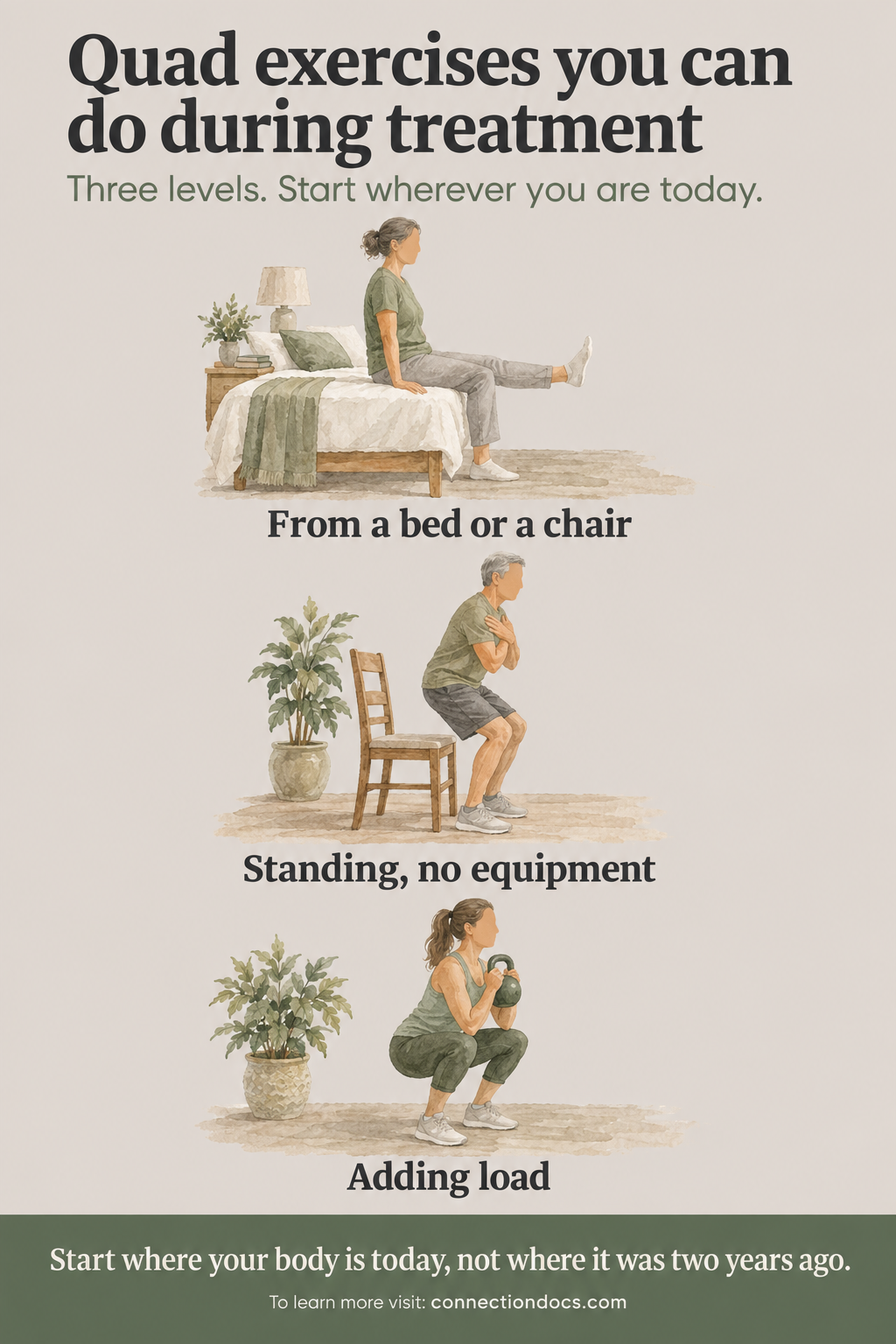
Level One: Quad Exercises You Can Do From a Bed or a Chair
These are where we start with almost everyone in active treatment, recovering from surgery, or simply deconditioned after a hard few months. They require nothing. You can do them during an infusion, in a hospital bed, or while the coffee brews.
- Quad Sets
Sit or lie with your leg straight out in front of you. Press the back of your knee down toward the surface, tightening the muscle on top of your thigh. Hold for five seconds, then release. Aim for ten repetitions on each leg, two or three times a day.
This is the most basic quad strengthening exercise there is, and it is the one most often dismissed. Do not dismiss it. When a knee is painful or a leg has been immobilized, this is the exercise that reminds the muscle it still has a job.
- Straight Leg Raise
Lying on your back, bend one knee with the foot flat. Keep the other leg straight, tighten the quad, and lift that straight leg about twelve inches. Lower it slowly, taking three full seconds on the way down. Eight to twelve repetitions per side.
The slow lowering is where most of the benefit lives. Controlled lengthening is exactly what your quads do when you walk downstairs.
- Seated Knee Extension
Sit tall in a chair with your feet flat. Straighten one knee until the leg is roughly parallel to the floor. Hold for two seconds at the top, squeezing the thigh, then lower with control. Ten to fifteen repetitions per side.
When this becomes easy, add a light ankle weight or loop a resistance band around your ankle and the chair leg.
- Heel Slides
Lying down, slowly slide one heel toward your buttocks, then slide it back out until the leg is straight. Ten repetitions per side. This restores the range of motion that makes every other exercise possible, which matters enormously after knee surgery or a long stretch of bed rest.
- Seated Marching
Sitting upright, lift one knee toward your chest, set it down, then the other. Thirty seconds, rest, repeat. It looks like nothing. It quietly trains the hip flexor half of your quadriceps group, plus the pattern you use every time you lift a foot over a curb.
Level Two: Standing Quad Exercises at Home, No Equipment Needed
Once the seated work feels easy, these are the bodyweight quad exercises that most directly transfer into daily life.
- The Sit-to-Stand, Also Known as the Chair Squat
If you only do one exercise from this entire article, do this one.
Sit toward the front of a sturdy chair, feet flat and about hip width apart. Lean your chest forward over your knees, press through your heels, and stand without using your hands. Then sit back down slowly, taking three seconds to lower. That slow descent is the whole point.
Start with five repetitions and build toward two or three sets of ten. If standing without hands is not possible yet, use one hand on the chair arm, start from a higher surface like the edge of a bed, or practice only the lowering half.
This is the single most functional quad exercise we know of, because it is not a simulation of something you do. It is the thing you do, roughly sixty times a day.
- Wall Sit
Stand with your back against a wall and walk your feet out about eighteen inches. Slide down until your knees are bent somewhere between thirty and ninety degrees, whatever is comfortable. Hold for ten to thirty seconds. Repeat three times.
Because nothing moves, this is often well tolerated by painful knees. A small bend held honestly beats a deep bend held badly.
- Step-Ups
Using a bottom stair or a low step, place one foot fully on the step, press through that heel, and rise. Step back down with control, leading with the opposite foot. Eight to ten repetitions per side, holding a rail as needed.
Step-ups train the quads and glutes together in the exact pattern stairs demand. If you want a quad and glute exercise that pays for itself, this is it.
- Step-Downs
Stand on a low step. Slowly lower one heel toward the floor, tapping lightly, then return. The working leg is the one still on the step. Six to eight repetitions per side.
Going down stairs is harder on the quads than going up. Most people who fear stairs are really afraid of the descent, and this is the exercise that answers it.
- Supported Split Squat
Stand with one foot forward and one back, holding a countertop for balance. Lower straight down a few inches, keeping your torso upright, then press back up. Six to ten repetitions per side.
Single-leg work matters because life is single-leg. Every step you take is a brief moment of standing on one.
Level Three: Adding Load When You Are Ready
If you are past treatment, feeling stable, and cleared by your team, adding external resistance is where the strongest returns live. You do not need a gym. Dumbbells, a kettlebell, or a loaded backpack will do.
- Goblet squat: hold a weight at your chest and squat to a comfortable depth. The front-loaded position naturally keeps you upright and shifts work onto the quads.
- Dumbbell step-up: the step-up from above, holding weight in each hand.
- Rear-foot-elevated split squat: back foot resting on a bench or chair. Demanding, and worth working toward.
- Machine leg press and leg extension: useful for isolating the quads when balance is limited or a knee needs a predictable path.
A reasonable prescription, consistent with the resistance training guidance in the oncology literature, is six to ten exercises, one to three sets of eight to fifteen repetitions, one to three times per week, at a moderate effort.
Do Not Skip the Quad Stretch
Quad stretching exercises are among the most searched movements online, and for good reason. Tight quads pull on the kneecap and the front of the hip, and long hours sitting make them shorter.
The standing version: hold a wall or chair, bend one knee, and bring your heel toward your buttocks, keeping the knees close together. Hold thirty seconds per side.
The gentler floor version: lie on your side, bend the top knee, and draw the heel back toward you. Hold thirty seconds.
Stretch after you train, not before. Warm muscle lengthens more willingly.
How Much, and How Often
You do not need much. That is the genuinely good news buried in the research.
- Two or three sessions per week is the target used in nearly every set of guidelines for people with chronic illness or cancer.
- Ten to twenty minutes per session is enough to start.
- Effort around a six or seven out of ten, where the last two repetitions feel like work but your form is still clean.
- Progress by adding one repetition, one set, or a slower lowering phase before you add weight.
Consistency beats intensity every time. A modest session done fifty times this year will change your life more than a perfect session done four times.
If Your Knees Hurt
Many people arrive at this topic searching for quad exercises for bad knees, and they arrive convinced that strengthening will make things worse.
It is usually the opposite. Quadriceps strengthening is one of the best-supported non-drug treatments for knee osteoarthritis. A recent review of randomized trials found that quadriceps strengthening significantly reduced pain and improved function over eight to twelve week programs, with straight leg raises and terminal knee extensions among the effective movements. A broader 2026 state-of-the-art review was more measured, noting that the average benefits are real but modest, and that they fade when people stop. Which is simply another way of saying that the exercise works while you do it.
There is also a quiet feedback loop worth naming. Knee pain makes people use the leg less, the quad shrinks, and the weaker quad leaves the joint with less protection. Imaging work has found selective quadriceps atrophy on the painful side. Breaking that loop early is one of the more useful things you can do for a joint.
Practical adjustments for sore knees: stay in shallow ranges, favor isometrics like quad sets and wall sits, use step-ups rather than deep squats, and work below the depth that produces pain rather than through it.
Where the Other Three F's Come In
We organize almost everything we teach around four words, and none of them work well alone.
Food
Muscle cannot be built out of nothing. If you are training and not eating enough protein, you are asking your body to do construction without materials. Many adults, especially older adults and those in treatment, do well spreading protein across the day rather than loading it all into dinner. There is no single perfect diet here and there never has been. The right pattern is nourishing, tolerable on a hard day, and still something you will be eating in a year. If treatment has changed your appetite or your taste, that is worth a real conversation with an oncology dietitian rather than a guess.
Fun
The best quad exercise is often not an exercise at all. It is the hill on a walk you enjoy. It is dancing in the kitchen. It is gardening, which the research on muscle-strengthening activity explicitly counts. If the movement you have chosen feels like a punishment you owe your body, it will not survive contact with a bad week. Find the version you would do anyway.
Family
Nearly everyone we know who has sustained a strength habit through illness had someone in it with them. A spouse who does the chair squats too. A friend on the phone during the walk. An adult child who texts to ask whether it got done today. You are far more likely to stand up from that chair ten times if someone is standing up with you. Let the people around you carry some of this. It also gives them something to do with their worry.
A Practice for This Week
Not a program. Just one practice.
Pick a chair you use every day. Each time you sit down in it, stand back up one extra time before you walk away. That is it. One extra repetition, several times a day, in a chair you were going to use anyway.
Then, at the end of the week, sit down and notice. Was it easier on Friday than on Monday? Did your hands reach for the armrests less often?
That noticing matters as much as the repetition. When so much of a diagnosis is about things happening to you, there is something steadying about finding one small place where you can watch yourself get stronger.
A Soft Invitation
If you are newly diagnosed, or somewhere in the middle of treatment, or caring for someone who is, you may be finding that the hard part is not the information. It is knowing which of the thousand available things actually matter for you, in your situation, this month.
That is the conversation we love having. If you would like to talk it through with two physicians who will sit with the whole picture and not just the scan, you are welcome to book a Connection Call.
Book a call here: https://www.connectiondocs.com/connection-call
With warmth, Dr. Alona & Dr. Matt
References and Further Reading
Momma H, et al. Muscle-strengthening activities are associated with lower risk and mortality in major non-communicable diseases: a systematic review and meta-analysis of cohort studies. British Journal of Sports Medicine, 2022. https://pubmed.ncbi.nlm.nih.gov/35228201/
Campbell KL, et al. Exercise Guidelines for Cancer Survivors: Consensus Statement from International Multidisciplinary Roundtable. Medicine & Science in Sports & Exercise, 2019. https://www.ncbi.nlm.nih.gov/pmc/articles/PMC8576825/
Winters-Stone KM, et al. Exercise recommendations for older adults living with and beyond cancer: a consensus statement. Cancer, 2026. https://acsjournals.onlinelibrary.wiley.com/doi/10.1002/cncr.70252
Alcazar J, et al. Low relative sit-to-stand power is associated with falls, fractures, hospitalization and all-cause mortality in older adults. Toledo Study for Healthy Aging. https://www.sciencedirect.com/science/article/pii/S2095254625000614
Hegde S, et al. Effectiveness of Quadriceps Strength Training in Adults With Knee Osteoarthritis: A Systematized Review. Musculoskeletal Care, 2025. https://onlinelibrary.wiley.com/doi/10.1002/msc.70134
From paradox to population impact: rethinking strengthening in knee osteoarthritis, a state-of-the-art review, 2026. https://pubmed.ncbi.nlm.nih.gov/42170370/
Surov A, Wienke A. Low skeletal muscle mass is a predictor of treatment related toxicity in oncologic patients: a meta-analysis. Clinical Nutrition, 2021. https://www.clinicalnutritionjournal.com/article/S0261-5614(21)00410-6/abstract
What is the Relationship Between Sarcopenia and Cancer? ASCO Daily News. https://dailynews.ascopubs.org/do/relationship-between-sarcopenia-and-cancer
Exercise-based prehabilitation programs reduce hospital stay and postoperative complications in surgical patients with cancer: systematic review and meta-analysis, 2026. https://pubmed.ncbi.nlm.nih.gov/42527160/
Quadriceps muscle strength is a discriminant predictor of dependence in daily activities in nursing home residents. https://www.ncbi.nlm.nih.gov/pmc/articles/PMC6759157/
U.S. Department of Health and Human Services. Physical Activity Guidelines for Americans, 2nd Edition. https://health.gov/our-work/nutrition-physical-activity/physical-activity-guidelines
American Cancer Society. Physical Activity and the Person with Cancer. https://www.cancer.org/cancer/survivorship/be-healthy-after-treatment/physical-activity-and-the-cancer-patient.html
This article is for general education and is not a substitute for individualized medical advice. Please speak with your own care team before beginning a new exercise program.