Participation, Not Perfection
Oct 20, 2026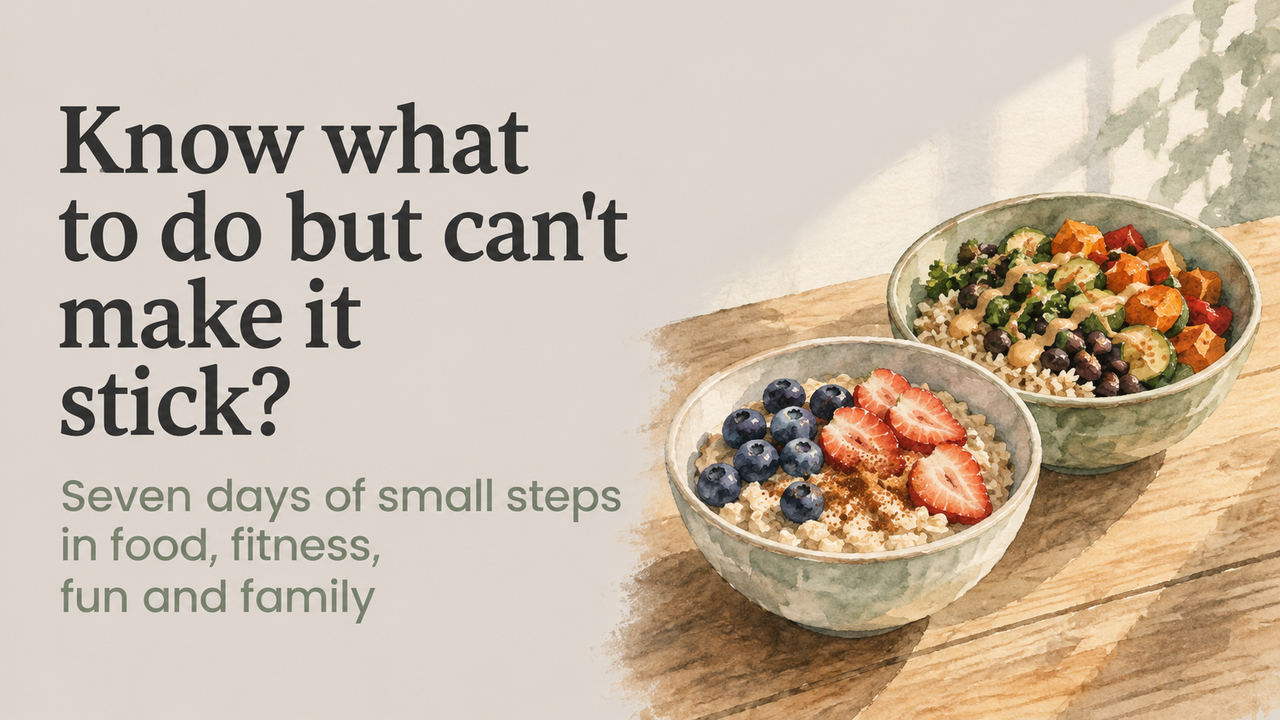
My friend Adam Sud asked a question recently that I haven’t been able to put down.
Why do highly motivated, intelligent people consistently act in opposition to their own best goals?
If you’ve been diagnosed with cancer or another life-altering illness, or you’re working to prevent one, you may know that question from the inside. You’ve been handed the list: eat more vegetables, move every day, sleep, manage stress.
You know what to do. And some days, you just can’t seem to do it.
Adam says most of what would make our lives better is alarmingly simple. But simple doesn’t mean easy.
I’ve known Adam for years, since we were both part of the plant-based community in Los Angeles. We recently talked about behavior change, and I think our conversation can take real weight off your shoulders.
Here’s the short version: if you’re struggling to make changes stick, it probably isn’t a willpower problem.
It was never a character flaw.
Knowing Isn’t the Hard Part
Most of the people Alona and I work with don’t need more information. Many come to us after years of specialists and protocols. Others know exactly what they want to change and have done it, for a week or two, before life pulled them back.
It’s like golf. I can watch a professional swing and understand exactly what they’re doing. Then I pick up the club, and the ball goes… somewhere.
Understanding something in your head and getting it into your body are completely different things, which is why elite golfers have a whole team of coaches.
Lost in the Desert
Adam offered an image that has stayed with me. Imagine you’re blindfolded and dropped in the middle of a desert. The blindfold comes off, and there’s nothing but sand in every direction.
Why would you feel anxious?
Most people say it’s because they don’t know where to go. Adam sees it differently. It’s because there are too many directions, and no way to tell which one is least likely to hurt you.
That’s what a new diagnosis can feel like. Every website, every friend, and every specialist points somewhere different. Which diet? Which treatment? Which supplement your neighbor swears by?
In a study published in Nature Communications, volunteers learned which images in a game were likely to be followed by a painful electric shock. Their stress, measured by how they felt and by changes in their pupils and skin, rose and fell with uncertainty itself.
Not knowing is its own kind of pain.
So we don’t start by promising a cure. We start with a direction. As Adam frames it: if we aim right here, there’s a really good chance the next 30 days will feel more hopeful than today. A direction lets the nervous system stand down, and a calmer nervous system makes clearer decisions.
Adam’s Seven-Day Experiment
Adam knows that desert personally.
In 2012, by his own account, he weighed nearly 350 pounds and was living with type 2 diabetes, high blood pressure, high cholesterol, depression, and anxiety. He had just spent 37 days in a rehab hospital for addiction and was living in a halfway house.
He knew he could be sober, he told me. But he couldn’t be sick and sober. That future didn’t feel hopeful enough to fight for.
So he tried a plant-based diet, starting with a seven-day experiment that was almost impossibly simple:
- Breakfast: oats with cinnamon and fruit
- Lunch: a rice and bean bowl with vegetables and sauce on top
- Dinner: the same rice and bean bowl
He wrote the first day’s meals on a piece of paper, drew an arrow through the rest of the week, and wrote one word above it.
Repeat.
What he noticed wasn’t only what happened in his body. It was what predictability did for his nervous system. Breakfast was no longer a problem to solve each morning. It was a decision already made, one that looked exactly like his goals.
After seven days, his blood pressure had come down, and his blood sugar, which started around 390, had dropped by about 150 points. So he ran the experiment again. And again, for ten months. Within about a year, he says, he had lost 175 pounds and no longer needed his medications.
He described the shift this way: “This is not a moral problem. This is not a discipline issue. This is a system and design problem.” Seeing it that way, he said, cut his anxiety by about 90 percent.
The research backs him up. In a randomized trial published in Diabetes Care, people with type 2 diabetes who followed a low-fat vegan diet for 22 weeks lost more weight than those on a standard diabetes diet, and 43 percent were able to reduce their diabetes medications, compared with 26 percent on the standard diet. Among those whose medications stayed the same, blood sugar control improved about three times as much. Eating patterns built on vegetables, fruits, whole grains, and beans are also central to the American Cancer Society’s guideline for cancer prevention.
One note from the doctor in me: if you take medication for diabetes or blood pressure, make big changes to how you eat together with your physician, because doses sometimes need to change quickly.
You don’t have to eat the same three meals for ten months. There’s no one perfect diet for everyone. The point isn’t the oats. It’s designing something simple enough to quiet the noise. That’s why our cooking coach starts with what you love to eat, then helps you make it with whole, plant foods, in the healthiest way possible.
Experiments, Not Rules
Alona and I have come to think of healing as a series of experiments rather than a set of rules. Rules are pass or fail. An experiment that doesn’t go as planned is simply information.
Adam’s process is simple. Make the plan easy enough that you’d want to repeat it, then see what happens when it meets your real life for a couple of weeks. When did it get hard, and why does that make sense? When did it feel effortless, and what made it easy? Then adjust.
It’s like asking someone to scratch your back. No, go right. A little higher. Now lower. There. Every time they missed, they weren’t getting it wrong. They were getting closer to right.
That’s why I tell people the worst thing they can do is be polite. Please don’t tell me something is working to spare my feelings. Where it isn’t working is where the useful information lives.
Adam shared a popular story that the 1969 moon mission was off course most of the way and arrived through constant correction. The real story is less dramatic, and more useful. NASA’s mission report shows the flight plan built in several scheduled chances for “midcourse corrections,” small engine firings to nudge the spacecraft toward its target. Apollo 11 needed just one in each direction, but no one planned the trip expecting perfection.
Correction was the plan.
Habit research agrees. In a study from University College London, new daily behaviors took an estimated 18 to 254 days to become automatic, with 66 days being typical, and missing a single day didn’t materially affect the process.
So if you “fall off the wagon,” you haven’t failed. You’ve learned something. As long as you keep coming back and treating it as information, it’s very hard to fail.
Honesty helps in relationships, too. More than once, I’ve stopped an argument with Alona by saying, “I’m feeling really ashamed right now, and I don’t know where to go from here.” She softens right away, and we find our way back to each other. Adam reminded me that you don’t build trust by offering help. You build it by asking for it.
Lower the Rung
This is where perfectionism undermines so many smart, motivated people. Adam asked two questions worth sitting with.
Who defined the standard you’re using to decide whether you did it right? And who is the judge telling you that because you missed today, tomorrow isn’t worth the effort?
I recently gave an entire talk on perfectionism, and I still catch that inner judge in myself.
Adam’s alternative is disarmingly simple. He tells the people he coaches: “I don’t need you to be me today. I need you to be more of the person you would like to be today, by any amount.”
Any amount. If your day looks 10 percent more like the life you want, that counts. Tomorrow, maybe 15 percent feels doable. His rule of thumb: set your bar low enough that you can reach it, but high enough that you’d be proud you did.
There’s a reason ladders don’t have rungs five feet apart.
The same goes for movement. If you’re dragging yourself to the gym, miserable and afraid of what happens if you don’t go, I’d honestly rather you skip it that day and find a way to move that you’d look forward to. A walk with a friend. Dancing in the kitchen. Playing on the floor with your grandkids.
The science is on the side of participation. In a meta-analysis of more than 47,000 adults, more daily steps were linked to progressively lower risk of death, with benefits leveling off around 6,000 to 8,000 steps a day for adults over 60 and 8,000 to 10,000 for younger adults. For people living with and beyond cancer, international exercise guidelines start with a simple message: avoid inactivity. Regular, moderate exercise can ease fatigue, anxiety, and depressive symptoms.
You don’t need the perfect workout. You need the next rung.
Relief Is Not Joy
Relief is taking off tight pants at the end of a long day. Joy is something else entirely. Nothing is tight. It’s open, expansive, alive.
You can eat six servings of greens out of fear and feel relief when you’re done, or eat a meal you genuinely love and feel joy. On paper, both look healthy. Inside your body, they’re very different experiences.
Adam pointed out that very few people run marathons because they love marathons. They love running. The people we know who have thrived on a whole-food, plant-based lifestyle for decades don’t do it because they think they should. They found a way to love it, and when you love something, the reason never needs justifying.
Adam also said something I wish every doctor could hear: no one really cares about their diabetes. They care about what it could cost them. Time with their grandkids. The ability to walk on their own two legs. That’s what’s worth aiming at.
Finding your aim starts with knowing what you need, a skill at the heart of Nonviolent Communication, which I teach. I recently told Alona that what really makes me happy is being around people and doing something adventurous, and I kept picturing a zip line with our daughter. We haven’t found one yet. But even if we never go, she and I have already had so much fun imagining it.
Adam tied this to the psychiatrist Viktor Frankl, who survived the Nazi concentration camps and wrote Man’s Search for Meaning. The way Adam sees it, when your life is aimed at something you care about, the struggles of your day don’t disappear. They’re just no longer pointless.
Connection Isn’t a Nice-to-Have
We often treat purpose and connection like extras, nice if you can fit them in after the “real” medicine. The science says otherwise.
At UCLA, Dr. Steve Cole and colleagues found that in chronically lonely people, immune cells showed more activity in genes linked to inflammation and less in genes that fight viruses and make antibodies. It was a small study of 14 people, but much larger studies of survival point the same way.
In a review of 148 studies with more than 300,000 people, stronger social relationships were linked to a 50 percent greater likelihood of survival. Among women with breast cancer, those who were socially isolated had about twice the risk of dying from the disease. The researchers believed the likely reason was less access to care, including the everyday caregiving that friends and family provide. And adults over 50 with the weakest sense of purpose had more than twice the risk of dying during the study period as those with the strongest.
I want to be careful here, because I know how research like this can land when you’re sick. No one gets cancer because they weren’t connected enough or positive enough. This isn’t one more thing to get right.
It’s good news. Connection is something you can add, starting today, and so is support. In a review of 56 randomized trials, psychological therapies such as cognitive behavioral therapy were linked to about a 15 percent improvement in beneficial immune function, lasting at least six months.
And it doesn’t have to be big. Recently, while I was driving my daughter to school, she asked if we could go a different way so she could see Tony, a crossing guard she likes. Tony had no idea. It felt a little awkward, but I thought, if we tell him, it might make his morning.
So we rolled down the window. “Hey Tony, we came this way because my daughter wanted to say hi. She really likes you.”
“Thank you so much!” he said, and he gave her a fist bump. She smiled, because she had given him something.
In moments like that, you can’t tell who’s giving and who’s receiving, and they’re at our fingertips every day. Adam shared a favorite exchange, which comes from James Norbury’s illustrated book Big Panda and Tiny Dragon. Big Panda wonders which matters more, the journey or the destination. Tiny Dragon chooses neither. What matters most is the company.
You Don’t Have to Hold This Alone
This is why Alona and I built our program the way we did. By the time people find us, many have lost trust in the medical system, and sometimes in themselves. They feel burnt out and alone with something enormous.
So instead of one doctor, they get a team of six walking alongside them. I handle the medical side, reviewing records and coordinating with specialists so nothing falls through the cracks. Alona focuses on the inner ecosystem: sleep, food, movement, and play. Others on the team help with trauma and grief, nervous system retraining, and cooking. A client coordinator holds it all together. Counting yours, that’s seven sets of hands instead of one.
Our work has three aims: bring clarity to the chaos, make your body as inhospitable as possible to chronic disease, and shift your focus from trying not to die to how you want to live.
We also give the people we work with our cell phone numbers. Many doctors worry they’ll be called all the time. In our experience, people don’t call enough. Sometimes I’ll call someone just because they were on my mind. It takes almost no time, and it says something that matters: you’re not alone.
Trust matters, too. A meta-analysis found that people who trust their health care professional report healthier behaviors, fewer symptoms, and better quality of life.
I can’t guarantee anyone an outcome. But I can guarantee how our team will show up, and you can guarantee how you’ll show up. When both are true, I imagine the outcomes will be pretty amazing.
Try Your Own Seven-Day Experiment
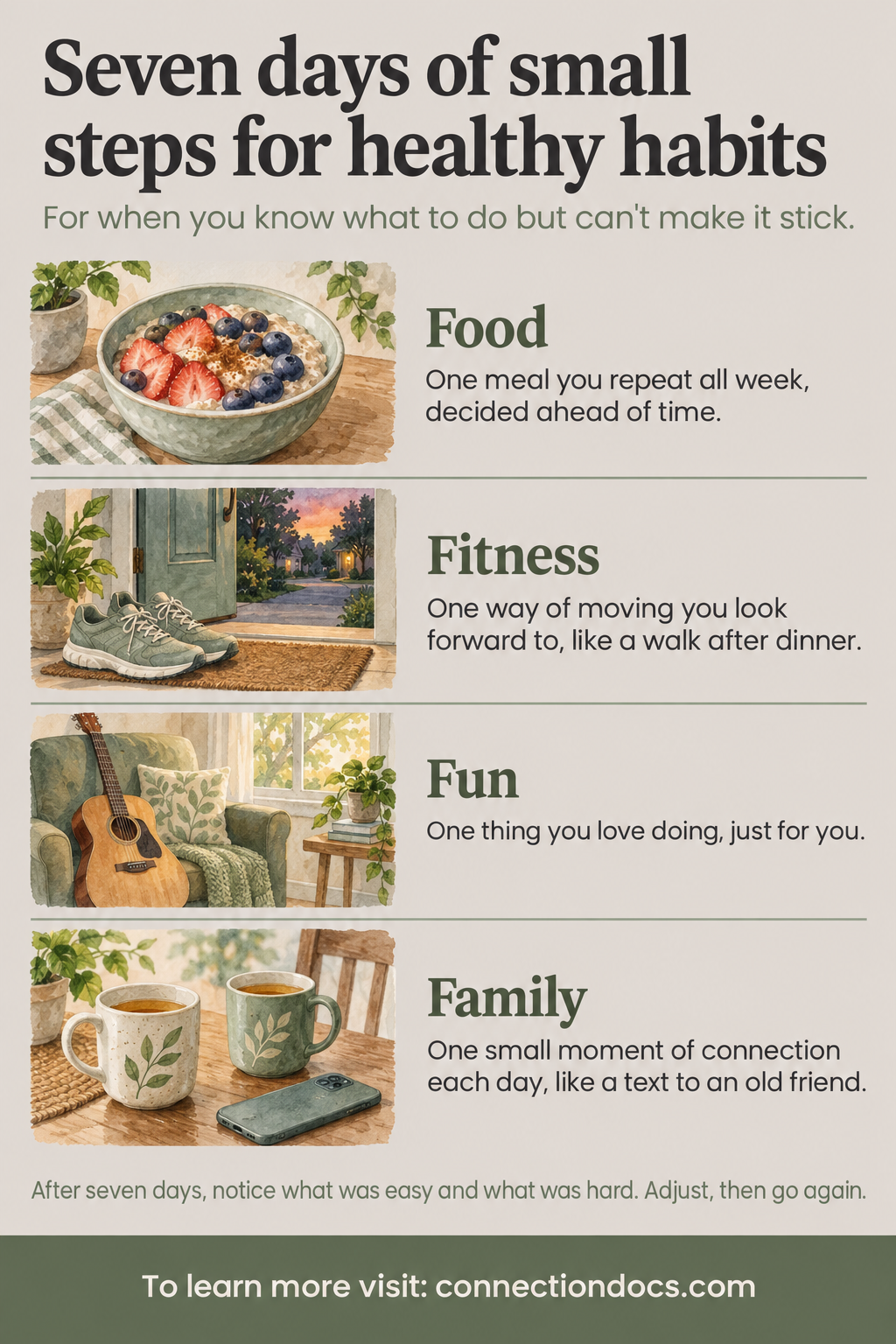
Pick one small thing in each area of your life, make it easy enough that you can almost guarantee you’ll do it, and run it for seven days.
- Food: One meal you can repeat that looks like your goals, like oats with cinnamon and berries or a bean and vegetable bowl with a sauce you love. Decide it ahead of time.
- Fitness: One way of moving you’d look forward to. A ten-minute walk after dinner counts.
- Fun: One thing that makes you glad to be alive. Give it a little room this week, even if that just means dreaming about it with someone.
- Family: One small moment of connection each day. A text to an old friend. A thank-you. A fist bump, if you’re so inclined.
At the end of the week, get curious instead of critical. When was it easy? When was it hard, and why does that make sense? What would make next week a little easier? Adjust, and run it again.
You’re not looking for perfection. You’re looking for participation.
More from Adam
If Adam’s story speaks to you, I can’t recommend his work enough. He coaches people working through addiction and people who feel addicted to food, including those struggling with weight or insulin resistance. His goal is to help what feels out of control finally make sense to you. You can learn more at adamsud.com, explore his coaching or book him to speak, and find him on Instagram at @thisisadamsud.
Wherever You Are, Start There
If you’re standing in your own desert right now, you don’t have to find the perfect path. You just need a first direction, and people willing to walk it with you.
If you’d like help finding yours, we’d love to talk. You can book a Connection Call with us here. No perfect plan required. Just a conversation about where you are, and where you’d love to go.
One rung at a time.
References
- de Berker AO, Rutledge RB, Mathys C, et al. Computations of uncertainty mediate acute stress responses in humans. Nature Communications. 2016;7:10996. https://doi.org/10.1038/ncomms10996
- Sud A. Adam Sud (official website). https://www.adamsud.com
- Barnard ND, Cohen J, Jenkins DJ, et al. A low-fat vegan diet improves glycemic control and cardiovascular risk factors in a randomized clinical trial in individuals with type 2 diabetes. Diabetes Care. 2006;29(8):1777-1783. https://doi.org/10.2337/dc06-0606
- Rock CL, Thomson C, Gansler T, et al. American Cancer Society guideline for diet and physical activity for cancer prevention. CA: A Cancer Journal for Clinicians. 2020;70(4):245-271. https://doi.org/10.3322/caac.21591
- NASA Manned Spacecraft Center. Apollo 11 Mission Report (MSC-00171). November 1969. https://www.nasa.gov/wp-content/uploads/static/apollo50th/pdf/A11_MissionReport.pdf
- Lally P, van Jaarsveld CHM, Potts HWW, Wardle J. How are habits formed: Modelling habit formation in the real world. European Journal of Social Psychology. 2010;40(6):998-1009. https://doi.org/10.1002/ejsp.674
- Paluch AE, Bajpai S, Bassett DR, et al. Daily steps and all-cause mortality: a meta-analysis of 15 international cohorts. The Lancet Public Health. 2022;7(3):e219-e228. https://doi.org/10.1016/S2468-2667(21)00302-9
- Campbell KL, Winters-Stone KM, Wiskemann J, et al. Exercise guidelines for cancer survivors: Consensus statement from international multidisciplinary roundtable. Medicine & Science in Sports & Exercise. 2019;51(11):2375-2390. https://doi.org/10.1249/MSS.0000000000002116
- Center for Nonviolent Communication. Dr. Marshall Rosenberg, founder. https://www.cnvc.org/about/marshall
- Frankl VE. Man’s Search for Meaning. Boston: Beacon Press. https://www.beacon.org/Mans-Search-for-Meaning-P602.aspx
- Cole SW, Hawkley LC, Arevalo JM, et al. Social regulation of gene expression in human leukocytes. Genome Biology. 2007;8(9):R189. https://doi.org/10.1186/gb-2007-8-9-r189
- Holt-Lunstad J, Smith TB, Layton JB. Social relationships and mortality risk: A meta-analytic review. PLoS Medicine. 2010;7(7):e1000316. https://doi.org/10.1371/journal.pmed.1000316
- Kroenke CH, Kubzansky LD, Schernhammer ES, et al. Social networks, social support, and survival after breast cancer diagnosis. Journal of Clinical Oncology. 2006;24(7):1105-1111. https://doi.org/10.1200/JCO.2005.04.2846
- Alimujiang A, Wiensch A, Boss J, et al. Association between life purpose and mortality among US adults older than 50 years. JAMA Network Open. 2019;2(5):e194270. https://doi.org/10.1001/jamanetworkopen.2019.4270
- Shields GS, Spahr CM, Slavich GM. Psychosocial interventions and immune system function: A systematic review and meta-analysis of randomized clinical trials. JAMA Psychiatry. 2020;77(10):1031-1043. https://doi.org/10.1001/jamapsychiatry.2020.0431
- Norbury J. Big Panda and Tiny Dragon. https://www.jamesnorbury.com/
- Birkhäuer J, Gaab J, Kossowsky J, et al. Trust in the health care professional and health outcome: A meta-analysis. PLoS One. 2017;12(2):e0170988. https://doi.org/10.1371/journal.pone.0170988