Is There a Best Diet for Cancer? Why the Answer Is Not the One You Want
Aug 24, 2026
Within days of a diagnosis, almost everyone I work with arrives at the same question.
What should I eat?
It may be the most searched question in all of medicine. Every month, hundreds of thousands of people type some version of it into a search bar. Cancer diet. Cancer fighting foods. Best food for cancer patients. Foods that prevent cancer. A seven day meal plan for cancer patients. Best diet to avoid cancer.
I understand the urgency behind those searches. I feel it too when someone I love is scared. So I want to be honest with you, because honesty will serve you better than reassurance.
There is no single best diet for cancer. Not for prevention, and not after a diagnosis.
That is not a dodge. It is the actual state of the evidence, and once you understand why it is true, it becomes freeing rather than discouraging.
What You Are Really Asking
When someone asks me about the best cancer diet, they are almost never asking a nutrition question.
A diagnosis takes something hard to name. Not just health. Predictability. The sense that your body is a place you can trust. Someone else now schedules your scans, doses your medication, and tells you what happens next.
Food is often the one place where it still feels like you have a vote.
That impulse is not a flaw. It is a strategy trying to meet a real need for safety and agency and hope, and it deserves respect rather than correction. I do not want to take it away from you. I want to point it somewhere it can help you, instead of somewhere it will quietly exhaust you.
Why There Is No Single Best Diet for Cancer Patients
Start with the obvious problem. Cancer is not one disease. Pancreatic cancer, early stage breast cancer, and chronic lymphocytic leukemia have little in common metabolically, and neither do their treatments.
Now add everything else that shapes what you can actually eat. Whether you are nauseated. Whether food tastes like metal. Whether you have mouth sores or diabetes or kidney disease. Whether you are losing weight or gaining it. How much muscle you have. What you can afford. Who cooks in your house. What you grew up eating. What you can keep down at three in the afternoon on the day after infusion.
This is exactly why the American Cancer Society Nutrition and Physical Activity Guideline for Cancer Survivors does not name a diet. It recommends an eating pattern that meets your nutrient needs and lines up with general chronic disease prevention: vegetables in a range of colors, whole fruits, fiber rich legumes, whole grains, and limits on red and processed meat, added sugar, and alcohol. That is a pattern, not a protocol. The vagueness that frustrates people is intellectual honesty.
The randomized trial evidence tells the same story, and it is worth knowing about because it is the strongest evidence we have.
Two large American trials tested diet changes in women treated for early stage breast cancer. The Women’s Intervention Nutrition Study randomized about 2,400 women to a low fat diet or usual care and found a lower risk of recurrence in the intervention group, though the benefit narrowed over longer follow up and appeared concentrated in women with hormone receptor negative tumors. The Women’s Healthy Eating and Living trial randomized about 3,100 women to a diet very high in vegetables, fruit, and fiber and low in fat, and after seven years found no reduction in recurrence or mortality.
Two large, careful, expensive trials. Similar populations. Different answers.
A recent systematic review of post diagnosis diet and breast cancer outcomes found the same thing: diet quality after diagnosis looks more clearly connected to overall survival than to recurrence.
If someone tells you the science is settled and they happen to be selling the settlement, that should give you pause.
What the Research Says About the Popular Cancer Diets
You have almost certainly met at least one of these. Here is where the evidence sits.
The ketogenic diet for cancer
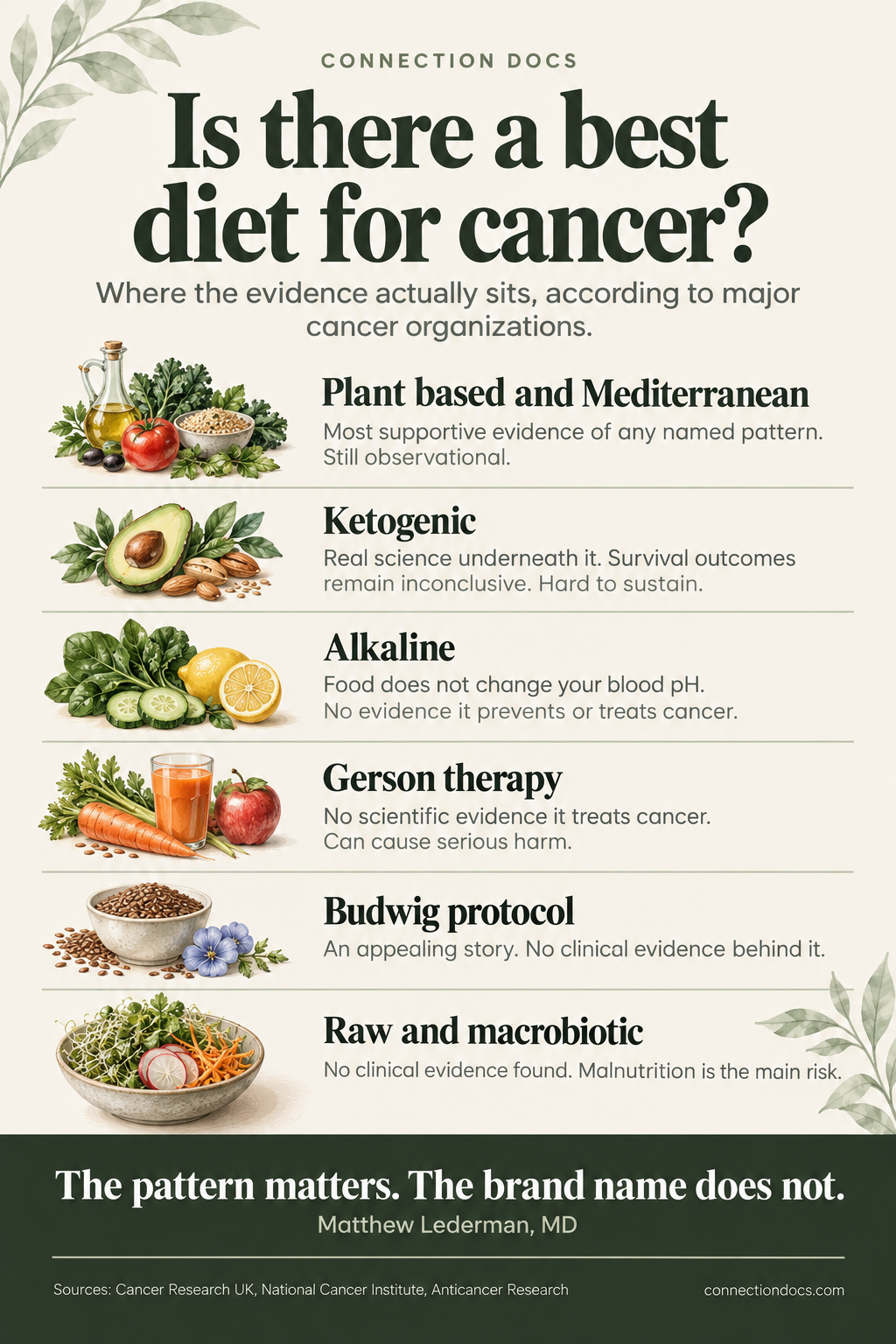
The keto diet for cancer is built on a real observation: many tumor cells consume glucose at high rates. The leap from that observation to treatment has not held up cleanly. A 2025 review of systematic reviews and meta analyses found reasonably consistent effects on metabolic markers and body composition, some quality of life benefit in selected patients, preliminary and inconsistent signals in glioma and breast cancer, and survival outcomes that remain inconclusive. Dropout rates are high because the diet is hard to sustain, especially alongside treatment side effects.
So it is not nonsense, and it is not proven. It may be reasonable for some people under supervision. Starting it without oversight while you are already losing weight is a real risk.
The alkaline diet
The premise is that you can make your body less acidic through food and that cancer cannot survive in an alkaline environment. Your blood pH sits in a very narrow range that your kidneys and lungs defend continuously, and food does not move it. Cancer Research UK points to a systematic review that found no evidence an alkaline diet prevents or treats cancer. It can change the pH of your urine. That is not the same thing. The version most people follow is also low in protein, which is a genuine problem during treatment.
Gerson therapy and the Budwig diet
Both come up constantly, and both promise a great deal. Gerson therapy involves a strict organic vegetarian regimen, up to thirteen glasses of juice a day, supplements, and coffee enemas. Cancer Research UK states plainly that there is no scientific evidence it treats cancer or its symptoms, and that it can cause serious harm. The National Cancer Institute’s review reached a similar place. The Budwig protocol, built around flaxseed oil and cottage cheese, has the same problem: an appealing story and no clinical evidence behind it.
A review in Anticancer Research systematically examined thirteen cancer diets, including raw food, macrobiotic, alkaline, Gerson, Budwig, and low carbohydrate approaches. The authors found no clinical evidence supporting any of them, and found case reports and preclinical data pointing to potential harm, primarily through malnutrition.
I want to say something careful here. People turn to these protocols most often when they have been told there is nothing more to be done. That is not gullibility. That is a person refusing to be passive in the face of their own life, and I respect it deeply. My concern is not that you want to act. It is what these particular protocols cost you in nutrition, in money, and in time you cannot get back.
Plant based, vegan, and Mediterranean patterns
These have the most supportive evidence of any named pattern, and it is still observational rather than definitive. Diets built around vegetables, fruit, whole grains, legumes, nuts, and olive oil are consistently associated with better overall health and better survival after a diagnosis. They also overlap almost entirely with what the major cancer organizations already recommend for everyone.
That overlap is the actual finding. The pattern matters. The brand name does not.
Does Sugar Feed Cancer?
This one deserves its own section. I have watched it cause more unnecessary fear than almost anything else.
The myth grows out of a misreading of the PET scan, which uses a glucose tracer and makes tumors light up. People conclude that sugar is uniquely feeding the cancer.
What the scan is actually showing is that cancer cells divide fast and use glucose faster than the tissue around them. Every cell in your body runs on glucose, including your brain and your immune cells. Specialists at Memorial Sloan Kettering make the point directly: cancer will use sugar if it is available, and it will also use protein and fat. Deprive it of one fuel and it turns to another. And your body makes its own glucose regardless of what you eat.
There is a real relationship between sugar and cancer risk, but it runs through a longer road. Diets heavy in refined sugar and ultra processed food contribute to excess body fat over time, and excess body fat is an established risk factor for more than a dozen cancers. That is worth acting on. It is a different claim from the idea that birthday cake feeds a tumor.
The same applies to fruit. I meet people in treatment who have stopped eating fruit because it contains fructose. Please eat the fruit.
While we are here: soy is not dangerous for breast cancer survivors either. The American Institute for Cancer Research has reviewed this repeatedly, and the evidence consistently shows that moderate intake of whole soy foods such as tofu, edamame, and soy milk does not raise recurrence risk. Some data suggest it may be modestly protective. Supplements and isolated isoflavones are a separate question with thinner evidence.
The Cancer Fighting Foods List, Reframed
Search for cancer fighting foods and you will find lists. Broccoli. Turmeric. Berries. Green tea. Garlic. Mushrooms. None of those foods fights cancer on its own. What the evidence supports is a pattern, and the pattern only works as a package.
The World Cancer Research Fund and AICR Cancer Prevention Recommendations are the closest thing we have to a consensus. They are not exotic:
- Be a healthy weight.
- Be physically active.
- Eat a diet rich in whole grains, vegetables, fruit, and beans, with at least 30 grams of fiber a day.
- Limit fast food and processed foods high in fat, starch, and sugar.
- Limit red meat and avoid processed meat.
- Cut down on sugar sweetened drinks.
- Limit alcohol.
- Do not rely on supplements for cancer prevention.
- Breastfeed your baby, if you can.
The organizations themselves emphasize that these work as a combined pattern rather than as individual behaviors picked off a list, and that the benefit grows with how many you follow. Research from Newcastle University published in BMC Medicine estimated that roughly two in five cancer cases might be preventable through adherence to these recommendations.
Notice what is on that list. Movement is there. Body composition is there. Not one item is a superfood. If you are searching for the best diet to prevent cancer, this is it.
The Risk That Almost Nobody Searches For
Here is the part I most want you to hear, because it rarely makes the lists. The nutritional danger in cancer is far more often too little than too much. Weight loss is a presenting symptom for a large share of patients, and by the time of a first medical oncology visit, a substantial majority have already lost some weight. Malnutrition during treatment is linked to more toxicity, more complications, reduced physical function, and worse survival.
The ESPEN clinical nutrition guidelines for cancer recommend roughly 25 to 30 calories per kilogram of body weight per day and 1.0 to 1.5 grams of protein per kilogram per day, meaningfully more protein than a healthy adult needs. Losing muscle during treatment is associated with more surgical complications, more toxicity, and shorter survival.
Now hold that next to a protocol built on juice, or one that removes protein while you are already struggling to eat.
I have watched people arrive having lost twenty pounds of muscle while following a regimen they believed was saving their life. They were doing everything they had been told. They were also getting weaker, which made treatment harder to tolerate, which made everything harder.
If you are in treatment and losing weight, ask your oncology team this week for a referral to a registered dietitian who specializes in cancer. Someone who can see your labs, not a program you found online.
Eating During Chemotherapy, When Nothing Works
The advice changes completely here, and I want to name that clearly. During active treatment, taste changes, mouth sores, nausea, and appetite loss are common. Food may taste metallic or like nothing at all. Smells you loved may become intolerable.
In that window, the best food for you is the food you can actually eat and keep down.
That may mean cold food instead of hot, because it carries less smell. Smaller portions more often. Plastic utensils if metal tastes wrong. Tart flavors if things taste flat, unless you have mouth sores. Protein worked into whatever you tolerate: eggs, yogurt, beans, smoothies, nut butters, fish.
This is a season, not a life sentence, and it has different rules. If scrambled eggs are what stays down on Thursday, then scrambled eggs are the correct diet on Thursday. Your team can help with anti nausea medication and mouth care so more foods become possible again.
Please do not let a nutrition ideal you read about online keep you from eating during the exact period when your body needs fuel most.
Where Food Actually Sits
My wife Alona and I organize our work around four things. Fun, Food, Fitness, and Family. Notice that food is one of the four.
That is deliberate. It is a correction to something I see constantly, which is a person spending ninety percent of their energy on the food quadrant while the other three quietly empty out.
The evidence for those other three is not soft. A meta analysis of ten prospective studies covering more than 136,000 people found that a strong sense of purpose in life was associated with roughly a 17 percent lower risk of death from any cause and a similar reduction in cardiovascular events.
Research from the University of Oxford found that people who eat socially feel better about themselves and hold wider support networks. Eating together does something that eating correctly alone does not.
And the ACS survivor guideline notes that physical activity after diagnosis is associated with improved survival in breast, colorectal, and prostate cancer. Movement has more direct survival evidence behind it than any specific food does.
So consider what a rigid protocol can cost. If the diet means you cannot eat at your daughter’s wedding, cannot share a meal with the friend who drove you to infusion, and cannot stop calculating, then the food quadrant has started eating the other three. That trade is almost never worth it, because those three are the parts of your life you were trying to protect in the first place.
How to Find the Diet That Works for You
Here is the shift I would offer, and it is small on paper and large in practice.
Stop asking: am I allowed to eat this?
Start asking: what choice cares for all of me right now?
The first question wants a rule and a verdict. The second takes in your body, your treatment, your appetite, your budget, and the people at the table with you. One makes food smaller. The other makes it usable.
Some practical anchors that hold up across almost every situation:
- Get enough protein, especially during treatment. Spread it across the day rather than loading it into dinner.
- Build meals around plants: vegetables, fruit, beans, whole grains, nuts. Variety matters more than any single item.
- Work toward 30 grams of fiber a day. Most people are far below that, and fiber has strong prevention evidence behind it.
- Reduce alcohol. This is one of the clearest and least popular findings in the field.
- Do not substitute a supplement stack for food. The prevention recommendations advise against relying on supplements, and some interact with treatment.
- Ask for a referral to an oncology dietitian instead of downloading a generic seven day meal plan for cancer patients. Yours should be built by someone who knows your diagnosis, your labs, and your side effects.
- Tell your oncology team about any diet you are considering, including the ones you think they will dismiss. A good team would rather discuss it than discover it.
And then, when you sit down to eat, try one more thing. Before the first bite, ask yourself what you would actually love. While you are eating, notice how it tastes, how it feels in your body, and whether the meal is happening in tension or in something more open. That noticing is not a soft add on to nutrition. For many people it is what finally makes a sustainable way of eating possible, because it replaces rules imposed from outside with information coming from inside.
What I Actually Want for You
You did not get cancer because you ate the wrong thing. I want to say that clearly, because a surprising number of people are quietly carrying that belief, and it is both false and cruel. And you cannot eat your way out of needing your medical team.
What food can do is real. It can help you tolerate treatment, protect your muscle, lower your risk of a second diagnosis and of the heart disease that shortens more survivors’ lives than people expect, and be a genuine pleasure in a season with fewer of them.
What it cannot do is buy you certainty. Nothing can. The search for the perfect protocol is often, underneath, a search for a guarantee that no diet is capable of issuing.
So keep caring for your health. Eat in a way that nourishes you and that you can actually live inside. Just do not miss your life while you are working so hard to protect it.
If you are in the middle of this and it would help to talk it through with two physicians who do this work every day, Alona and I offer a free connection call. There is no protocol waiting at the end of it. It is a conversation about your situation, what you are carrying, and what would actually help. If that sounds useful, you can book a call with us here.
References and Further Reading
- American Cancer Society Nutrition and Physical Activity Guideline for Cancer Survivors (2022): https://acsjournals.onlinelibrary.wiley.com/doi/10.3322/caac.21719
- ACS guideline, plain language summary for survivors and families: https://acsjournals.onlinelibrary.wiley.com/doi/full/10.3322/caac.21721
- WCRF and AICR Cancer Prevention Recommendations as a package of behaviours: https://www.wcrf.org/research-policy/global-cancer-update-programme/dietary-and-lifestyle-patterns/
- AICR 10 Cancer Prevention Recommendations: https://www.aicr.org/resources/media-library/10-cancer-prevention-recommendations/
- Newcastle University summary of WCRF/AICR adherence and cancer risk (BMC Medicine): https://from.ncl.ac.uk/cancer-risk-factors-and-lifestyle-choices
- Women’s Healthy Eating and Living (WHEL) randomized trial, JAMA: https://jamanetwork.com/journals/jama/fullarticle/208026
- Discussion of WINS, WHEL, and DIANA-5 dietary intervention trials, Clinical Cancer Research: https://aacrjournals.org/clincancerres/article/30/5/965/734296/The-Effect-of-Diet-on-Breast-Cancer-Recurrence-The
- Systematic review of post diagnostic diet and breast cancer outcomes: https://pmc.ncbi.nlm.nih.gov/articles/PMC13516070/
- The effect of a ketogenic diet on cancer, evidence from systematic reviews and meta analyses: https://pmc.ncbi.nlm.nih.gov/articles/PMC12966578/
- Cancer Research UK, alternative cancer diets including alkaline and ketogenic: https://www.cancerresearchuk.org/about-cancer/treatment/complementary-alternative-therapies/alternative-cancer-diets
- Cancer Research UK, Gerson therapy: https://www.cancerresearchuk.org/about-cancer/treatment/complementary-alternative-therapies/individual-therapies/gerson
- National Cancer Institute PDQ review of Gerson therapy: https://www.cancer.gov/about-cancer/treatment/cam/hp/gerson-pdq
- Counseling patients on cancer diets, a review of the literature, Anticancer Research: https://ar.iiarjournals.org/content/34/1/39
- Memorial Sloan Kettering, the lowdown on sugar and cancer: https://www.mskcc.org/news/no-sugar-no-cancer-look-evidence
- AICR food facts on soy and breast cancer: https://www.aicr.org/cancer-prevention/food-facts/soy/
- AICR, soy and breast cancer myths and misconceptions: https://www.aicr.org/resources/blog/soy-and-cancer-myths-and-misconceptions/
- ESPEN practical guideline, clinical nutrition in cancer: https://www.clinicalnutritionjournal.com/article/S0261-5614(21)00079-0/fulltext
- Protein intake, weight loss, and nutritional status during anti cancer treatment: https://pmc.ncbi.nlm.nih.gov/articles/PMC10745925/
- Purpose in life and its relationship to all cause mortality and cardiovascular events, a meta analysis: https://pubmed.ncbi.nlm.nih.gov/26630073/
- University of Oxford research on social eating and wellbeing: https://www.ox.ac.uk/news/2017-03-16-social-eating-connects-communities
This article is for general education and is not medical advice. Please discuss any dietary change with your oncology team, particularly during active treatment.