How to Make Your Body Inhospitable to Cancer: A Physician Couple's Guide to Your Terrain
Aug 26, 2026
We have sat across the table from hundreds of people who just heard the word cancer for the first time. And almost without exception, once the initial shock settles, the same question surfaces: “What can I actually do?”
It is a good question, and it is one that modern oncology, for all its extraordinary advances, does not always answer well. Chemotherapy, radiation, surgery, and targeted therapy are aimed at the tumor itself. They are essential, and they save lives. But they leave out a second, equally important target: the body the tumor is growing in.
Oncologists and integrative practitioners sometimes call this the “terrain,” a term borrowed from soil science. A seed dropped on packed clay struggles. The same seed dropped on rich, aerated soil thrives. Cancer cells behave the same way. They are opportunists, not invaders from outer space, and they exploit whatever environment your daily choices create: your blood sugar, your inflammation levels, your hormones, your sleep, your stress response, your gut microbiome, even your sense of connection to other people. (CancerChoices)
This is the idea we explored in a recent webinar, “How To Make Your Body Inhospitable To Cancer,” which you can watch below. We wanted to unpack the topic further here, because we think it is one of the most empowering, and one of the most misunderstood, concepts in oncology today.
To apply, click here.
To be clear, terrain is not a replacement for your oncologist's treatment plan, and it is not a guarantee. Genetics, environmental exposures, and plain bad luck play a role in every diagnosis, and no lifestyle is perfect enough to promise immunity. But terrain is real, it is measurable, and unlike your genes, it is yours to shape. We have found that organizing that work around four simple words, easy to remember even on the hardest days, helps more than any color coded meal plan ever could: Fun, Food, Fitness, and Family.
What the Science Actually Says About “Inhospitable”
Cancer cells need specific conditions to survive and spread: a steady glucose supply, a tolerance for low oxygen, a hospitable hormonal environment, and an immune system that is too depleted, too distracted, or too suppressed to notice them. Decades of research point to a cluster of physiological states that make this easier for cancer to accomplish: chronic low grade inflammation, insulin resistance, excess body fat, poor sleep, and social isolation.
The National Cancer Institute's Division of Cancer Control has spent years studying what researchers call the inflammation, insulin resistance, and obesity axis (NCI). In plain language, excess visceral fat behaves like an inflamed organ, releasing cytokines such as IL-6 and TNF-alpha that create an environment where cells proliferate more readily and resist the normal signals that would tell a damaged cell to self-destruct (NIH). That self-destruct process, called apoptosis, is one of the most important things your body does every single day, usually without you noticing it. Cancer, at its core, is often a failure of that system, cells that should die instead persist and multiply.
This is not fringe science. It is the same biology that connects obesity, type 2 diabetes, cardiovascular disease, and cancer risk, which is part of why the American Cancer Society's official cancer prevention guidelines look almost identical to the guidelines for preventing heart disease (American Cancer Society).
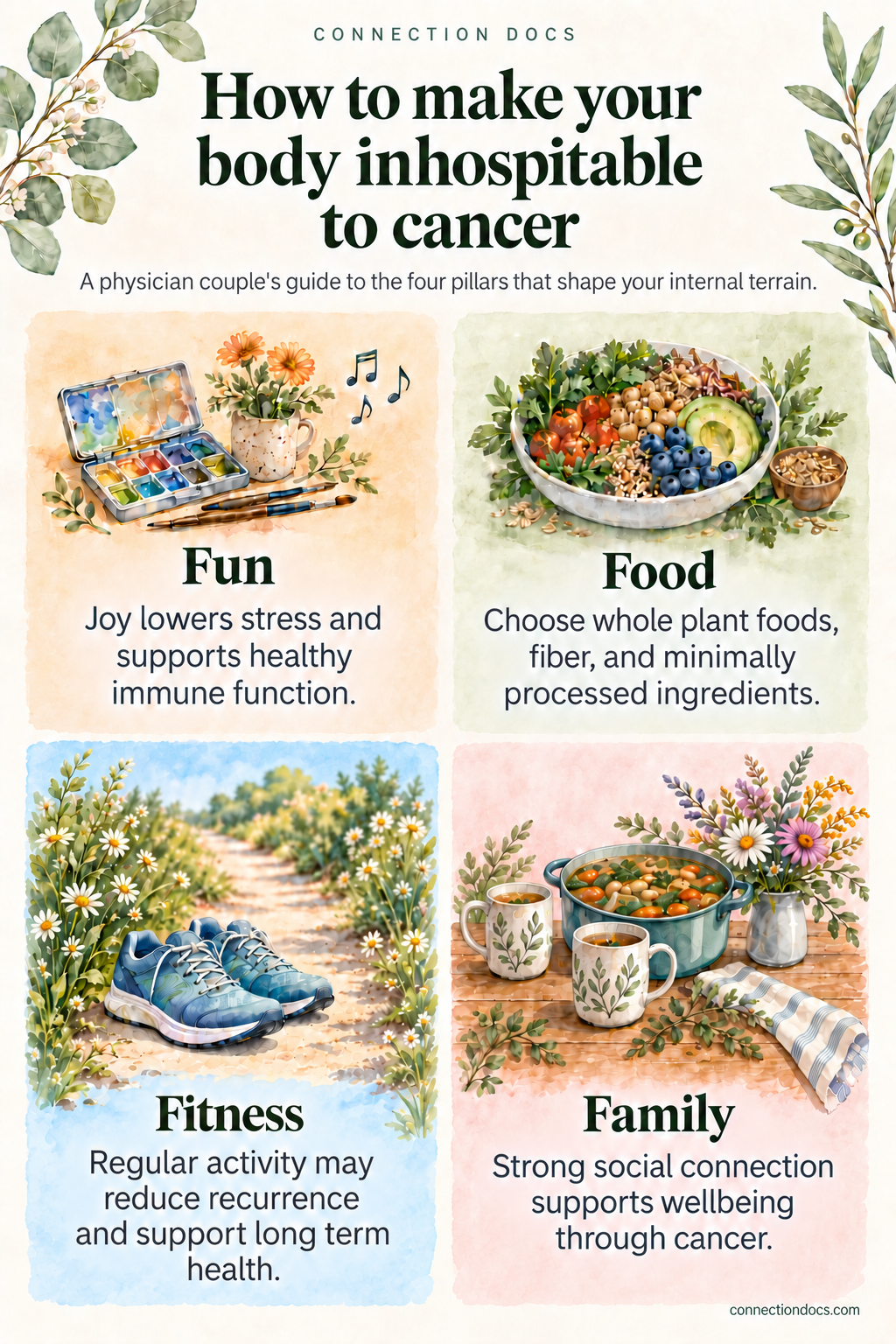
Fun: Reconnecting With What Makes You, You
Of the four pillars, “fun” is usually the one people are most tempted to skip. It can feel indulgent next to a cancer diagnosis. We would gently push back on that instinct.
Psychologist Lawrence LeShan spent decades studying people with cancer and noticed something striking: many had quietly abandoned the parts of themselves that made them feel most alive, long before their diagnosis. He never claimed this caused their cancer. That would be an oversimplification, and a harmful one. But he did notice that when people reconnected with music, art, adventure, or simple unstructured joy, something in them changed. They stopped organizing their life around avoiding death and started organizing it around embracing life.
There is a physiological piece here too. Chronic stress keeps cortisol and catecholamines elevated, and over time that dysregulates immune function and can promote signaling pathways that favor tumor growth and progression (PMC review). Genuine enjoyment, the kind that has nothing to do with productivity, is one of the most reliable ways to interrupt that stress response.
So we ask our patients a version of the question LeShan used to ask: what makes you glad to be alive? Not what lowers your risk. Not what your labs say. What lights you up?
For one patient, it was gardening, getting her hands back in soil after years of believing she did not have time. For another, it was reopening a paint set that had sat untouched since college. Fun does not have to be a hobby written into a wellness plan. It can be a walk with no destination, a phone call with an old friend, or ten minutes of a song that makes you want to dance in your kitchen.
If you are newly diagnosed, this might feel impossible right now, and that is okay. Grief and fear need room too. But as you are able, we would encourage you to treat joy as medicine, not as a reward you have to earn once you are “better.”
Food: There Is No Single Perfect Diet
Search “cancer diet” online and you will find a hundred conflicting protocols, each insisting it is the one true answer: keto, vegan, carnivore, alkaline, macrobiotic. We understand the appeal of a clear rulebook when everything else feels out of control. But in our experience, and in the research, there is no single diet that is right for every person.
What the evidence does support is more nuanced than any single diet: a pattern built around minimally processed whole foods, plenty of fiber, a wide variety of plants, and limited added sugar and alcohol. The American Cancer Society's dietary guidelines for cancer prevention emphasize exactly this, a plant forward eating pattern rather than a rigid protocol (American Cancer Society). Why does this matter for terrain? Because ultra processed foods and added sugars drive the same insulin resistance and inflammatory cascade we described above, the very conditions that make your terrain more hospitable to cancer, not less.
Fiber deserves special mention. It feeds the bacteria in your gut that, in turn, help regulate inflammation and immune function throughout your body. A gut microbiome starved of fiber and diversity is associated with a less resilient immune system, and emerging research even links fiber intake to better responses to cancer immunotherapy (Cancer Medicine, 2026). That matters enormously when your immune system is one of your body's primary defenses against abnormal cells.
Here is where we want to be honest with you: what works for your neighbor, your sister, or the influencer with two million followers might not work for you. Some people thrive on more protein and fewer carbohydrates. Some do better with more plants and fewer animal products. Some need to eat very differently during active treatment than during a season of prevention or remission, prioritizing calories and protein to maintain strength rather than restriction.
Our advice, consistently, is this: work with a registered dietitian, ideally one who specializes in oncology nutrition, rather than a generic internet protocol. Pay attention to how food makes you feel, not just how it scores on an app. And release the guilt. A single indulgent meal will not undo months of good choices, and stress about food is its own inflammatory trigger.
Fitness: Movement as Medicine, Not Punishment
Of everything we have studied in cancer prevention and survivorship, the evidence for physical activity may be the most consistently strong, and the most underused.
Exercise does not just burn calories. It changes your biology in ways that directly counter the conditions that let cancer thrive. Regular movement lowers circulating insulin, reduces systemic inflammation, improves immune surveillance, and helps regulate hormones such as estrogen that fuel certain cancers (PMC, breast cancer mechanisms). Research summarized by the National Cancer Institute found that breast cancer survivors who began meeting physical activity guidelines after not meeting them saw their risk of recurrence or death drop by nearly half (NCI). Other research shows that survivors who walk roughly three hours a week have meaningfully lower breast cancer mortality, and colon cancer survivors who walk about six hours a week see a similar benefit (CancerNetwork).
You do not need to run a marathon. You need consistency. Functional fitness, the kind that gets you in and out of a car easily, up a flight of stairs without pausing, and able to carry your own groceries, matters just as much as anything you would do in a gym. Strength training helps preserve the muscle mass that both treatment and aging tend to erode, and muscle itself is metabolically active tissue that helps regulate blood sugar.
If you are mid treatment, movement might look like a slow lap around your living room. If you are in prevention mode, it might look like a daily walk outside, a favorite class, or lifting weights a few times a week. Both count. The goal is not performance. It is steady, sustainable motion that tells your body, every day, that you are actively participating in your own defense. And there is a bonus most people do not expect: time outside, in sunlight and fresh air, correlates with better mood, better sleep, and lower stress, all of which loop right back into the terrain we have been talking about.
Family: The People Who Make the Terrain Livable
We saved this pillar for last, but it may be the one with the most surprising research behind it.
Psychologist Julianne Holt-Lunstad's landmark meta-analysis of more than 300,000 people found that strong social connection is associated with roughly a 50 percent reduction in risk of early death, an effect size comparable to quitting smoking. Loneliness and social isolation, by contrast, carry a risk on par with obesity (Perspectives on Psychological Science, 2015). More specific to cancer, a recent UK Biobank study found that social isolation and loneliness were independently associated with worse survival across several cancer types, including breast, prostate, and bladder cancer (ScienceDirect).
Why would loneliness affect something as biological as tumor growth? Chronic loneliness activates the same stress pathways we discussed earlier: elevated cortisol, heightened inflammation, and dysregulated immune signaling. Isolation, in a very real sense, is a physiological state, not just an emotional one.
This is why family belongs in this framework, and we mean it broadly. Family is not only the people you are related to by blood. It is whoever shows up: the friend who drives you to appointments, the neighbor who leaves soup on your porch, the support group that understands what you are going through without you having to explain it. If your biological family is not a source of support, building a chosen family is not a consolation prize. It is a legitimate, evidence backed part of your care.
If you are supporting someone through a diagnosis, know that your presence, not your advice, not your optimism, just your presence, is doing something measurable in their body. And if you are the one who is sick, let people in. Asking for help is not weakness. It may be one of the most protective things you do.
Tending the Terrain, Not Chasing Perfection
None of this is a cure, and we want to say that plainly, because we have watched too many people feel like they failed if they “did everything right” and still got sick, or got sicker. Terrain influences risk and resilience. It does not guarantee outcomes. Cancer is not a moral failing, and neither is developing it despite a healthy life.
But terrain is also not nothing. It is the difference between a body that is fighting for you and one that is fighting against itself. It is the difference between showing up to treatment depleted and showing up with reserves. And for those of you in prevention mode, still healthy and hoping to stay that way, it is some of the most meaningful work you can do.
We built our four pillars, Fun, Food, Fitness, and Family, because they are memorable on hard days, and because together they cover the parts of life that oncology too often leaves out of the conversation. You do not have to master all four at once. Pick the one that feels most within reach today. Then the next. Then the next.
You are not just a diagnosis, a lab value, or a treatment protocol. You are a whole person, living inside a body that responds, every single day, to how you feed it, move it, rest it, and surround it with people who love you. That is worth tending to.
If you are navigating a new diagnosis, or you would rather start building a healthier terrain long before you ever need to, we would love to talk with you. Book a free connection call with us here, and let's figure out your next step together.
References
- “Optimizing Your Body Terrain.” https://cancerchoices.org/resources/body-terrain-handbooks/optimizing-your-body-terrain/
- Experience Life. “What Is the Terrain Theory of Cancer?” https://experiencelife.lifetime.life/article/what-is-the-terrain-theory-of-cancer/
- National Cancer Institute, Division of Cancer Control and Population Sciences. “The Intersection of Chronic Inflammation, Insulin Resistance, Obesity, and Cancer Risk.” https://cancercontrol.cancer.gov/brp/events/intersection-of-chronic-inflammation
- Arcidiacono B, et al. “Insulin Resistance and Cancer Risk: An Overview of the Pathogenetic Mechanisms.” National Institutes of Health. https://pmc.ncbi.nlm.nih.gov/articles/PMC3372318/
- American Cancer Society. “American Cancer Society Guideline for Diet and Physical Activity for Cancer Prevention.” https://www.cancer.org/cancer/risk-prevention/diet-physical-activity/acs-guidelines-nutrition-physical-activity-cancer-prevention.html
- Ma Y, et al. “Chronic Stress in Solid Tumor Development: From Mechanisms to Interventions.” PMC. https://www.ncbi.nlm.nih.gov/pmc/articles/PMC9883141/
- Sousa et al. “Impact of Dietary Fiber Intake on the Immunological Response to Immunotherapy in Cancer Patients: A Scoping Review.” Cancer Medicine, 2026. https://pmc.ncbi.nlm.nih.gov/articles/PMC13425580/
- Bland et al. “A Systematic Review of the Biological Mechanisms Linking Physical Activity and Breast Cancer.” PMC. https://www.ncbi.nlm.nih.gov/pmc/articles/PMC7669467/
- National Cancer Institute. “Exercise and Survival for Women with Breast Cancer.” Cancer Currents Blog. https://www.cancer.gov/news-events/cancer-currents-blog/2020/breast-cancer-survival-exercise
- “The Role of Physical Activity in Cancer Prevention, Treatment, Recovery, and Survivorship.” https://www.cancernetwork.com/view/role-physical-activity-cancer-prevention-treatment-recovery-and-survivorship
- Holt-Lunstad J, Smith TB, Baker M, Harris T, Stephenson D. “Loneliness and Social Isolation as Risk Factors for Mortality: A Meta-Analytic Review.” Perspectives on Psychological Science, 2015. https://journals.sagepub.com/doi/full/10.1177/1745691614568352
- Liu Q, et al. “Association of Social Isolation and Loneliness with Cancer Prognosis: An Analysis of the UK Biobank.” ScienceDirect. https://www.sciencedirect.com/science/article/abs/pii/S0165032725024917