How to Make Friends When You Need Support Most
Oct 13, 2026
There is a particular kind of quiet that can follow a diagnosis.
At first, the phone doesn’t stop. Texts arrive faster than you can answer them. People say, “Let me know if you need anything,” and they mean it.
Then, somewhere around week six, the quiet comes.
The messages slow down. The friend you thought would be there for every appointment hasn’t called in a while. Coworkers stop asking. And just as your life has become harder, more frightening, and more complicated, your world seems to get smaller.
If you’ve felt this, please hear us: you are not imagining it, and you are not the only one.
Loneliness after a diagnosis is common, and it’s rarely talked about. We discuss scans, lab values, and treatment plans in great detail. We almost never ask, “Who are your people right now?”
So let’s talk about it. Why friendship matters so much when you’re sick, what the research says, and how to make friends as an adult, and keep them, at the very moment you need support most.
Why Loneliness Shows Up When You’re Sick
Loneliness was common long before you got sick. In 2023, the U.S. Surgeon General issued an advisory calling it an epidemic and noting that about half of American adults report feeling lonely [1].
A diagnosis tends to amplify it. In a national survey of more than 1,200 U.S. cancer survivors, about 36 percent reported moderate to severe loneliness [2]. Among cancer patients aged 70 and older in a Belgian and Dutch study, emotional loneliness rose from 26 percent to 42 percent in the year after diagnosis [3].
There are many reasons. Treatment takes over your calendar and drains your energy. A weakened immune system can make crowds risky. Some friends pull back because they don’t know what to say, or because your illness frightens them. And sometimes we pull back ourselves. In a survey of more than 2,000 people with cancer in the United Kingdom, 45 percent of those with close friends delayed telling them about the diagnosis or kept it secret altogether [4].
None of that makes you a failure at friendship. It makes you human, living through something that rearranges every part of life, including your relationships.
What the Research Says About Friendship and Health
We want to share some research here, gently, because it matters, and because it’s easy to hear it the wrong way.
In a landmark analysis of 148 studies including more than 300,000 people, those with stronger social relationships had a 50 percent greater likelihood of survival over the study periods than those with weaker ones [5]. A later analysis of 70 studies found that loneliness was linked with a 26 percent higher likelihood of death and social isolation with a 29 percent higher likelihood [6]. The Surgeon General’s advisory went so far as to say that the mortality impact of social disconnection is similar to that of smoking up to 15 cigarettes a day [1].
The pattern holds for people living with cancer. Among nearly 3,000 women with breast cancer, those who were socially isolated had about twice the risk of dying from their breast cancer [7]. A 2024 American Cancer Society study of cancer survivors found that the loneliest had a 67 percent higher risk of death than those with little or no loneliness [8].
Now, the important part.
These studies show links, not proof of cause. People who are sicker may have less energy for friendship, so it’s hard to untangle which came first. And when researchers have tested support groups directly, the benefits showed up in mood, coping, and quality of life rather than in longer survival [9, 10].
So if you’re lonely right now, this is not one more thing you’re doing wrong. It is not a reason to blame yourself. We are not offering friendship as a treatment.
We’re offering it because connection is part of what makes a life worth living. And it’s something you can begin to build, a little at a time, even now.
How to Make Friends as an Adult (Especially Now)
Making friends as an adult was hard before illness entered the picture. Most of us made our closest friends at school, on teams, or in early jobs, places that put us in the same room with the same people week after week. As adults, we have to create those conditions on purpose.
Here’s what tends to help, grounded in what researchers have learned about how friendships actually form.
Start With the People Already in Your Orbit
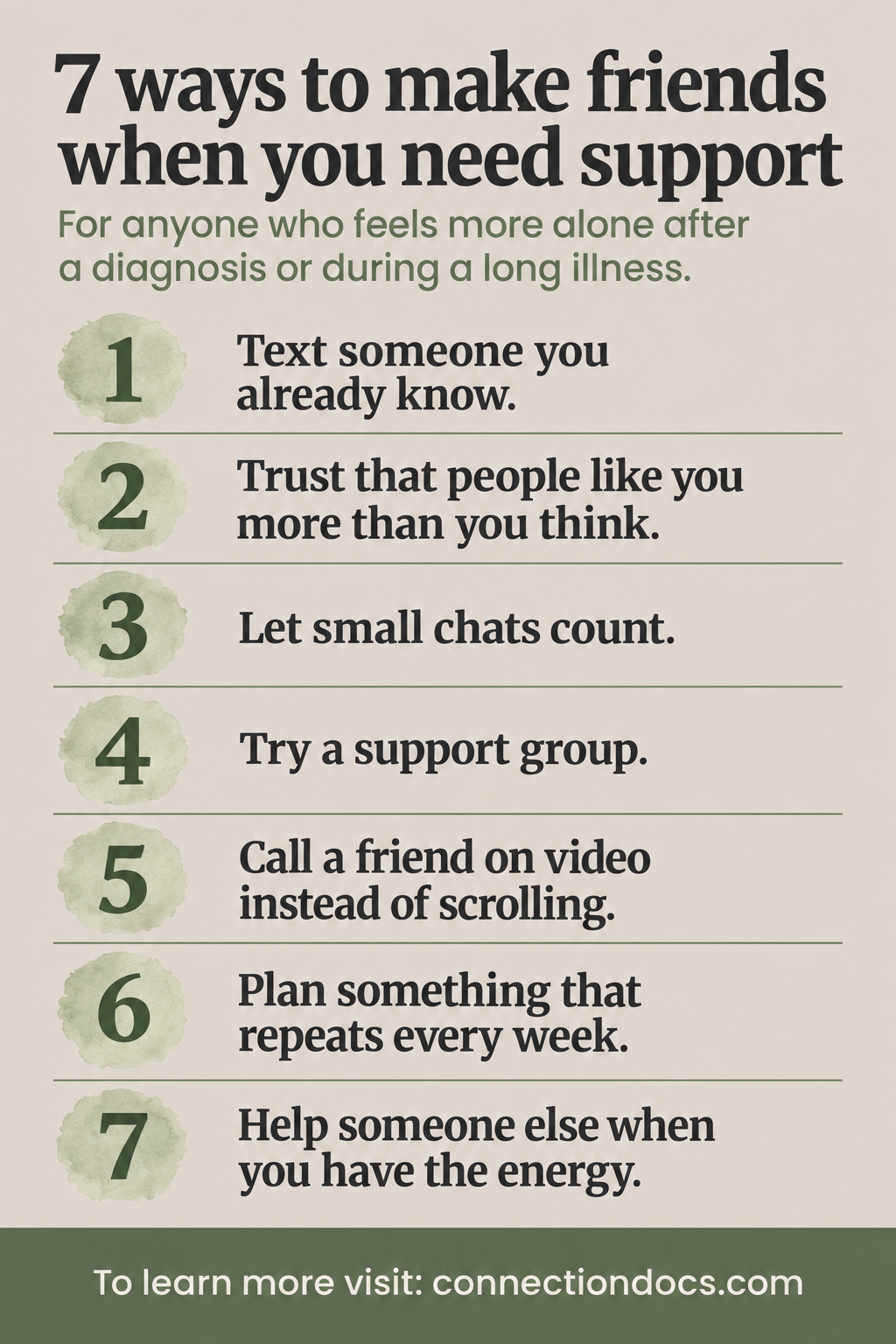
The fastest path to connection is often someone you already know. An old friend you drifted away from. A neighbor you wave to. A cousin you always meant to call.
Many of us hesitate to reach out because we assume it will feel awkward or unwelcome. The research says otherwise. In a series of experiments, people consistently underestimated how much others appreciated a brief, unexpected check-in, and the gap was bigger when the message was more of a surprise and when the two people weren’t especially close [11].
So send the text. It can be as simple as: “I’ve been thinking about you. How have you been?”
Remember That You’re Liked More Than You Think
After a conversation, most of us replay what we said and wince. Researchers call this the liking gap. Among strangers meeting in a lab, college dorm mates, and adults at a workshop, people consistently underestimated how much the other person liked them [12].
When fear tells you that you talked too much, or that you were a downer, or that they were only being polite, you can gently remind yourself: the evidence suggests you were liked more than you know.
Let Small Moments Count
Not every connection needs to become a deep friendship to matter. In one study, people who smiled, made eye contact, and chatted briefly with a barista felt more positive and more connected than people who kept the exchange efficient. Another found that people felt happier on days they interacted with more acquaintances than usual [13, 14].
The nurse who remembers your name. The person who sits near you at the infusion center every other Tuesday. The neighbor walking her dog. These “weak ties” are real threads in the fabric of your life.
Find Your People Through Peer Support
There is something powerful about sitting with someone who understands without needing an explanation.
Peer support can look like a support group, an online community, or a one-on-one match with someone who has walked a similar path. Research reviews suggest the measurable benefits for mood and quality of life are modest, and that they tend to be clearer when people meet face to face [9]. For many people, though, it’s simply the first place they stop feeling like the only one.
A few places to start:
- Cancer Support Community offers free support groups at more than 200 locations and online, plus a helpline at 888-793-9355 [15].
- CancerCare runs free online support groups led by oncology social workers [16].
- Imerman Angels matches you one-on-one with a mentor whose cancer experience mirrors your own [17].
- ACS CARES from the American Cancer Society offers one-on-one support, and the ACS helpline is open 24/7 at 1-800-227-2345 [18].
- For other chronic conditions, the Chronic Disease Self-Management Program brings people together in weekly workshops led by trained peer leaders [19].
If you’re searching for “support groups near me,” try adding your specific diagnosis to the search, or ask the social worker on your care team. There are chronic illness support groups for nearly every condition.
Use Online Spaces Without Losing Yourself
Some seasons of illness make in-person connection hard. Fatigue, immune precautions, and distance are real. Online communities, video calls, and even apps designed to help adults make friends can bridge the gap.
We do all of our work with clients virtually, and we can tell you that a screen does not prevent real connection. Presence travels.
The key is to use online spaces to connect rather than to scroll. A video call with one friend will nourish you more than an hour of watching other people’s lives.
Give Friendship Time
Here’s a finding we find oddly comforting. One researcher estimated that it takes about 50 hours together to go from acquaintance to casual friend, about 90 hours to become friends, and more than 200 hours to become close friends [20]. Time spent together in required settings, like work, mattered less than time spent catching up, joking around, and having meaningful conversations.
Friendship isn’t built in one brave conversation. It’s built through repetition. So look for things that repeat: a weekly walk, a monthly dinner, a standing phone call, a class that meets every Thursday.
Connect Through Shared Purpose
If and when you have the energy, helping others can be one of the most natural ways to build connection. In a study of nearly 13,000 adults over 50, those who volunteered at least 100 hours a year, about two hours a week, had a lower risk of death over the next four years, along with fewer depressive symptoms, less loneliness, and more optimism and sense of purpose [21].
This doesn’t have to be formal, and it doesn’t have to happen during treatment. Someday it might mean sitting with someone who was just diagnosed with what you’ve been through. Sometimes the people who help us most are the ones we help.
How to Ask for Help Without Feeling Like a Burden
For many people, the hardest part isn’t finding people. It’s letting them in.
“Let me know if you need anything” is a kind offer that almost never gets used, because it hands the work of figuring out what you need right back to you. You can make it easier for both of you.
- Be specific. “Could you drive me to my appointment on the 14th?” is much easier to say yes to than “I need help.”
- Keep a list. Write down real needs as they come up: rides, meals, a walk, a phone call on scan day, someone to sit with you during treatment. When someone offers, share the list.
- Let one person coordinate. A friend who loves organizing can manage a schedule or an online page so you don’t have to answer every message. Cancer Support Community’s free MyLifeLine is one option [22].
- Remember that helping feels good. When you let someone help, you’re not taking something from them. You’re giving them a way to love you.
Building Your Support System Through the Four F’s
We often talk about health through four simple lenses: Fun, Food, Fitness, and Family. Each one is also a doorway to connection.
Fun
Fun is your connection with yourself, the things that make you feel like you. It’s also one of the easiest ways to meet people, because friendships grow naturally around shared enjoyment. A book club, a choir, a painting class, a community garden, a trivia night. When you’re doing something you love alongside others, the conversation tends to take care of itself.
Food
Food has always been one of the ways people gather. Invite a friend over for a simple pot of lentil soup. Start a monthly plant-based potluck. Take a cooking class together. And when a friend asks how they can help, a shared meal is a beautiful answer. There’s no single perfect way to eat, but there is something healing about eating together.
Fitness
Movement is easier with company, and company is easier when you’re moving. Walking side by side can make hard conversations feel lighter. Look for walking groups, gentle yoga classes, or exercise programs designed for people living with illness. Even a ten-minute walk outside with a neighbor counts twice: once for your body and once for your heart.
Family
Family is the people around you, and for many of us, that includes friends who have become family. Sometimes illness reveals that the people we expected to show up can’t, while people we barely knew become our closest companions. Let your definition of family be wide enough to hold everyone who loves you.
When a Friend Pulls Away
Not everyone will stay. That’s one of the painful truths of illness.
Sometimes friends disappear because they’re afraid. Your diagnosis may remind them of their own mortality, or of someone they’ve lost. Sometimes they simply don’t know what to say, so they say nothing.
If the friendship matters to you, you can name it gently: “I’ve missed you. I know this is a lot. You don’t have to say the perfect thing. I just want you around.”
And if someone can’t show up, you’re allowed to grieve that, and to let the space they leave be filled by someone who can. Some friendships are for a season. Others will surprise you by deepening in ways you never expected.
A Short Reflection: Mapping Your Circle
Take ten minutes with a notebook. There are no right answers here, only an opportunity to see your world a little more clearly.
Draw three circles, one inside the other.
- In the center circle, write the names of people you could call at 2 a.m.
- In the middle circle, write the people you enjoy and trust but don’t talk to often.
- In the outer circle, write the acquaintances, neighbors, and familiar faces in your week.
Then ask yourself:
- Who have I drifted from that I miss?
- Who in my outer circle could I get to know a little better?
- What do I enjoy that could also bring me into contact with other people?
- What is one specific thing I could ask for help with this week?
Now choose one small step. One text. One invitation. One phone call. One group to try.
Then decide when you’ll do it.
You Don’t Have to Do This Alone
Illness can make the world feel smaller. It can also clarify who and what matters most, and open doors to people you might never have met otherwise.
You don’t need dozens of friends. You need a few people who see you, a few threads that hold you, and the willingness to reach out one more time than feels comfortable.
The people who will love you through this are out there. Some of them haven’t met you yet.
If you’re navigating a new diagnosis and finding yourself more alone than you expected, we’d love to help you think it through. Our conversations are always virtual, so you can join from wherever you are. Book a Connection Call with us and let’s talk about what support could look like for you.
This article is for general education and is not a substitute for individualized medical advice. Please talk with your own care team about your situation. If you are feeling hopeless or in crisis, you can call or text 988 to reach the 988 Suicide & Crisis Lifeline in the U.S.
References
- Office of the U.S. Surgeon General. Our Epidemic of Loneliness and Isolation: The U.S. Surgeon General’s Advisory on the Healing Effects of Social Connection and Community. U.S. Department of Health and Human Services; 2023. https://www.hhs.gov/sites/default/files/surgeon-general-social-connection-advisory.pdf
- Wheldon CW, et al. Loneliness among adult cancer survivors in the United States: prevalence and correlates. Scientific Reports. 2025;15:3914. https://profiles.foxchase.org/en/publications/loneliness-among-adult-cancer-survivors-in-the-united-states-prev/
- Deckx L, et al. Loneliness in patients with cancer: the first year after cancer diagnosis. Psycho-Oncology. 2015;24(11):1521-1528. https://cris.maastrichtuniversity.nl/en/publications/loneliness-in-patients-with-cancer-the-first-year-after-cancer-di/
- Macmillan Cancer Support. Cancer, cuppas and conversation: the value of opening up (press release reporting a Macmillan/YouGov survey of 2,033 UK adults with cancer, fieldwork October 2014). https://www.macmillan.org.uk/about-us/press-office/press-releases-and-statements/cancer-cuppas-and-conversation
- Holt-Lunstad J, Smith TB, Layton JB. Social relationships and mortality risk: a meta-analytic review. PLoS Medicine. 2010;7(7):e1000316. https://journals.plos.org/plosmedicine/article?id=10.1371/journal.pmed.1000316
- Holt-Lunstad J, Smith TB, Baker M, Harris T, Stephenson D. Loneliness and social isolation as risk factors for mortality: a meta-analytic review. Perspectives on Psychological Science. 2015;10(2):227-237. https://journals.sagepub.com/doi/10.1177/1745691614568352
- Kroenke CH, et al. Social networks, social support, and survival after breast cancer diagnosis. Journal of Clinical Oncology. 2006;24(7):1105-1111. https://doi.org/10.1200/JCO.2005.04.2846
- Zhao J, et al. Loneliness and mortality risk among cancer survivors in the United States: a retrospective, longitudinal study. Journal of the National Comprehensive Cancer Network. 2024;22(4):244-248. https://doi.org/10.6004/jnccn.2023.7114
- Kiemen A, Czornik M, Weis J. How effective is peer-to-peer support in cancer patients and survivors? A systematic review. Journal of Cancer Research and Clinical Oncology. 2023;149(11):9461-9485. https://link.springer.com/10.1007/s00432-023-04753-8
- Goodwin PJ, et al. The effect of group psychosocial support on survival in metastatic breast cancer. New England Journal of Medicine. 2001;345(24):1719-1726. https://doi.org/10.1056/NEJMoa011871
- Liu PJ, Rim S, Min L, Min KE. The surprise of reaching out: appreciated more than we think. Journal of Personality and Social Psychology. 2023;124(4):754-771. https://doi.org/10.1037/pspi0000402
- Boothby EJ, Cooney G, Sandstrom GM, Clark MS. The liking gap in conversations: do people like us more than we think? Psychological Science. 2018;29(11):1742-1756. https://doi.org/10.1177/0956797618783714
- Sandstrom GM, Dunn EW. Is efficiency overrated? Minimal social interactions lead to belonging and positive affect. Social Psychological and Personality Science. 2014;5(4):437-442. https://repository.essex.ac.uk/15301/
- Sandstrom GM, Dunn EW. Social interactions and well-being: the surprising power of weak ties. Personality and Social Psychology Bulletin. 2014;40(7):910-922. https://repository.essex.ac.uk/15300/
- Cancer Support Community. Find a location near you; Cancer Support Helpline. https://www.cancersupportcommunity.org/find-location-near-you
- Support groups. https://cancercare.org/support_groups
- Imerman Angels. Find a Mentor Angel. https://imermanangels.org/find-mentor-angel/
- American Cancer Society. ACS CARES. https://www.cancer.org/support-programs-and-services/acs-cares.html
- National Council on Aging. Chronic Disease Self-Management Program. https://ncoa.org/article/evidence-based-program-chronic-disease-self-management-workshop-in-person
- Hall JA. How many hours does it take to make a friend? Journal of Social and Personal Relationships. 2019;36(4):1278-1296. https://journals.sagepub.com/doi/10.1177/0265407518761225 https://news.ku.edu/news/article/2018/03/06/study-reveals-number-hours-it-takes-make-friend
- Kim ES, Whillans AV, Lee MT, Chen Y, VanderWeele TJ. Volunteering and subsequent health and well-being in older adults: an outcome-wide longitudinal approach. American Journal of Preventive Medicine. 2020;59(2):176-186. https://doi.org/10.1016/j.amepre.2020.03.004
- Cancer Support Community. MyLifeLine. https://www.cancersupportcommunity.org/mylifeline-online-community