
How to Become a Caregiver for a Family Member
Sep 16, 2026
Nobody hands you a badge.
There is no ceremony, no start date, no orientation packet. One day you are a daughter or a husband or a brother, and then there is a phone call, or a scan result, or a fall in the hallway at two in the morning. By the following Tuesday you are the person who knows which pill is the blue one and what time the infusion center opens.
That is usually how it happens. Not with a decision. With an accumulation.
We see this constantly. The patient is in the exam room, and beside them sits someone who has not slept properly in weeks, who has a folder of papers on their lap, who answers half the questions because they are the one keeping track. When we turn and ask that person how they are doing, they almost always look surprised, as though they had not considered themselves part of the appointment.
So let us start there. If you are reading this because someone you love has been diagnosed with cancer or another serious illness, and you are trying to figure out what your role is now, you are already a caregiver. The paperwork just has not caught up yet.
This article is about catching the paperwork up. And about something harder: how to do this without disappearing.
You are in very large company
In 2025, AARP and the National Alliance for Caregiving released the most comprehensive survey of family caregiving ever conducted in the United States. It found that 63 million Americans, close to one in four adults, had provided ongoing care in the past year for an adult or a child with a complex medical condition or a disability. That is an increase of roughly 20 million people in a single decade.
The numbers underneath that headline are the ones that matter clinically. Nearly one in four caregivers provide 40 hours a week or more. About one in three are also raising children at the same time. More than half are performing complex medical and nursing tasks, things like injections, wound care, and managing equipment, and only a small fraction have received any training for them.
Read that again. Over half are doing nursing work. Roughly one in five has been trained to do it.
If you feel unprepared, it is because the system handed you a job without teaching you the job. That is not a personal failing. It is a design flaw, and knowing that should take a little weight off your shoulders before we go any further.
Start with a conversation, not a checklist
Before the forms and the programs and the binders, there is a conversation almost nobody has, and it changes everything downstream.
Sit with the person you are caring for and ask them what they actually want.
Not what treatment they want. That comes later, with their oncologist or specialist. We mean: what does a good day look like to you now? What are you hoping we can protect? What would you rather I not do for you, even if it takes you longer to do it yourself?
That last question is the one families skip, and it causes more friction than any insurance denial.
A man in his seventies, recently diagnosed, told us that the worst part of his week was not chemotherapy. It was that his son had started buttoning his shirts for him. His son was being loving. His son was also, without meaning to, taking away one of the last things that still felt like his own.
Care that is done to someone erodes them. Care that is done with someone holds them up. Often the same tasks. Completely different experience of being alive.
Write down what you learn in that conversation. You will need it later, on a day when there are five opinions in the room and nobody can remember what the patient actually asked for.
The paperwork that makes caregiving possible
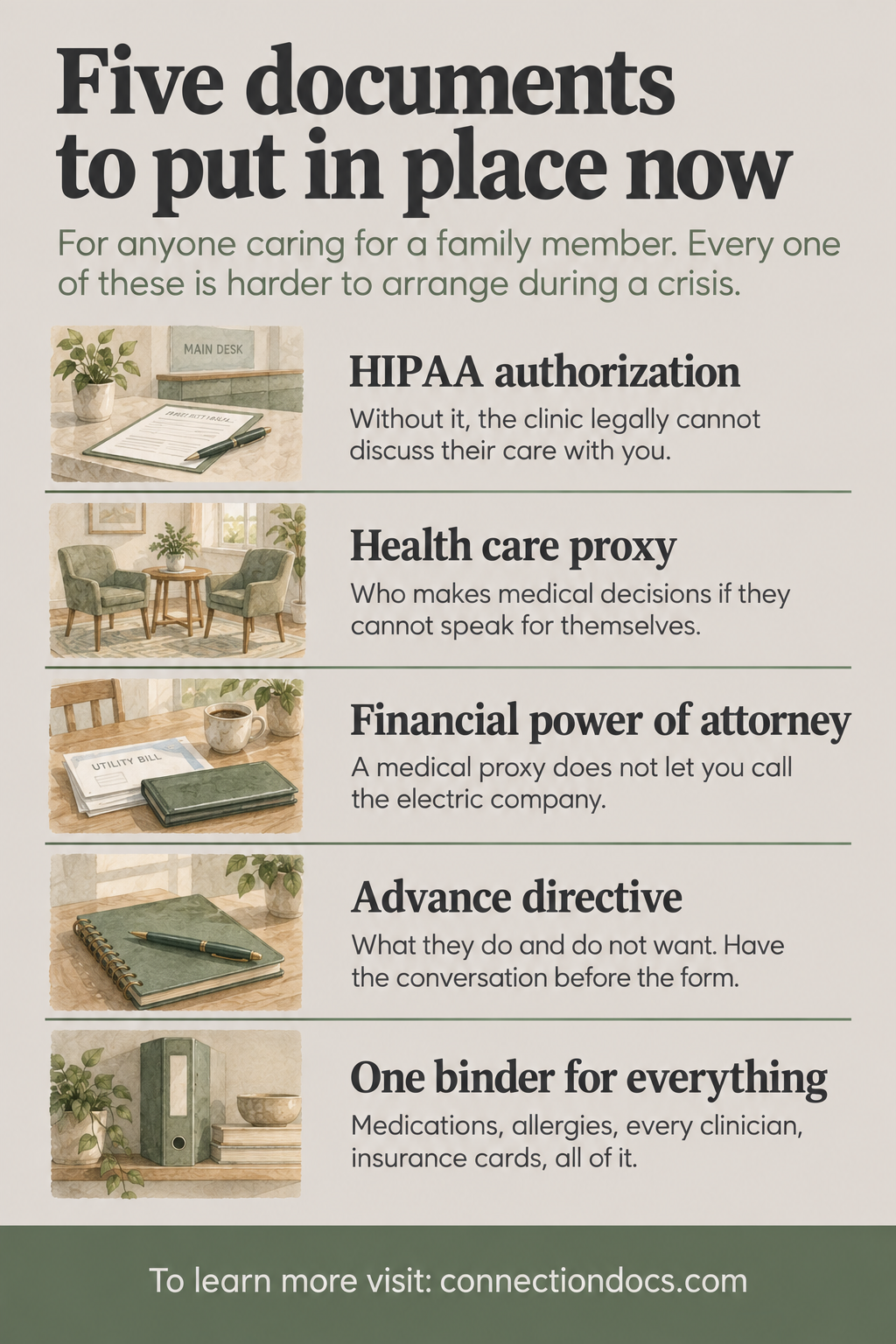
Here is the practical core. Put these in place early, while things are calm, because every one of them is harder to arrange during a crisis.
HIPAA authorization. Without it, a clinic legally cannot discuss your family member’s care with you. Not on the phone, not in the hallway. Most practices have a one page form. Sign it at every office they use, including the lab and the pharmacy.
Health care proxy or medical power of attorney. This names who makes medical decisions if your person cannot speak for themselves. It is separate from the next item, and it is the document families most often regret not having.
Durable power of attorney for finances. Bills, insurance appeals, benefit applications. A medical proxy does not let you call the electric company.
Advance directive or living will. What treatments they do and do not want. Have the conversation before you fill out the form. The form is only a record of a decision you reached together.
One place for everything. A binder, a folder, a shared note on your phone. Medication list with doses and times, allergies, diagnoses, surgeries, every clinician with a phone number, insurance cards, and the documents above. Bring it to every appointment. You will be asked the same twelve questions at every new office, and you will be tired of them by the third.
One more thing, specific to hospital stays. Most states have passed a version of what is called the CARE Act, which lets a hospital patient formally designate a family caregiver in the medical record, requires the hospital to notify that caregiver before discharge, and requires the hospital to provide instruction in the aftercare tasks you will be doing at home. Ask the discharge planner directly whether your state has one and how to be named.
If someone is about to send you home with a wound to pack or an injection to give and nobody has shown you how, stop them and ask. You are allowed to ask. Ask twice if the first explanation goes too fast.
Can you get paid to be a caregiver for a family member?
This is one of the most common questions we hear, and the honest answer is: sometimes, and it depends heavily on where you live. Here are the real pathways.
Medicaid self-directed care. If your family member qualifies for Medicaid long-term care, most states offer some form of self-direction, also called consumer directed services, participant direction, or cash and counseling. These programs let the person receiving care choose and hire their own caregiver, and in many states that caregiver can be an adult child, a sibling, or a trusted friend. Rules about paying spouses vary widely. This is the largest source of paid family caregiving in the country and the first place to look.
Veterans programs. If your family member is a veteran, the VA Program of Comprehensive Assistance for Family Caregivers provides a monthly stipend to an approved primary family caregiver, plus health coverage if you are otherwise uninsured, respite care, and training. It now covers veterans of all service eras. The application is joint, filed on VA Form 10-10CG. Call a caregiver support coordinator at your local VA medical center before you submit anything.
Long-term care insurance. If a policy exists, read it. Some policies pay for in-home care, and a few allow payment to family members.
A personal care agreement. If the money is coming from your family member’s own funds, put it in writing. A simple caregiver contract stating hours, duties, and rate protects everyone, keeps family peace, and matters enormously if Medicaid eligibility is ever reviewed later, since undocumented transfers can look like gifts. Have an elder law attorney glance at it.
A related question we get often: do you need to become a certified caregiver for a family member? For informal care at home, generally no. There is no license required to help your own mother shower. But if you are being paid through a state program, that program may require a background check, basic training, enrollment through a fiscal intermediary, and time sheets. The training is usually only a few hours, and it is worth doing either way, because a great deal of what makes caregiving physically dangerous is technique.
Where to start: call the Eldercare Locator at 1-800-677-1116. It connects you to your local Area Agency on Aging, which knows the programs in your county and can screen you for the National Family Caregiver Support Program. One phone call replaces about six hours of searching.
And to answer the question people ask most often and most hopefully: Medicare does not pay family members to provide personal care. Medicare covers skilled home health services under specific conditions, and it covers hospice, both of which can bring real help into the house. Neither is a paycheck for you.
Protecting your job while you do this
If you are employed, learn the Family and Medical Leave Act before you need it.
FMLA provides eligible employees with up to 12 workweeks of unpaid, job-protected leave in a 12 month period to care for a spouse, child, or parent with a serious health condition. Your health insurance continues during that leave, and you are entitled to return to the same or an equivalent job. You are eligible if you have worked for your employer at least 12 months and at least 1,250 hours in the past year, and your employer has at least 50 employees within 75 miles.
Critically, FMLA leave can often be taken intermittently. A few hours here for an infusion appointment, a day there after a procedure. Many people burn through vacation and then quit, never knowing intermittent leave existed.
Several states also have paid family leave programs that go beyond the federal law, so check your state labor department. And tell your manager earlier than feels comfortable. People generally respond better to information than to a pattern of unexplained absences.
You cannot be the whole care team
The most predictable failure we see is one person quietly absorbing everything while everyone else assumes it is handled.
Break that pattern early, on purpose.
Hold one family meeting. Put every task on a list: medication management, rides to appointments, groceries, insurance calls, bills, laundry, overnight coverage, yard work. Then let people claim specific items. Vague offers of help go nowhere. "Can you take the Thursday appointments" gets a real answer.
Let long-distance family own the things that travel well. Insurance appeals, prescription refills, research, scheduling, and bill paying can all be done from another time zone. Distance is not an excuse, it is a job description.
Then find respite. Respite care is planned, temporary relief, whether that is a few hours from an aide, an adult day program, or a short residential stay. The ARCH National Respite Network has a locator for services near you, and your Area Agency on Aging may have funding for it.
Please hear us on respite. It is not a luxury and it is not abandonment. It is maintenance on the one piece of equipment in this situation that cannot be replaced.
What the research says about your health
We want to say this plainly, because it affects the person you are caring for as much as it affects you.
CDC data show that caregivers consistently report worse health than non-caregivers across most measured indicators, including a higher lifetime prevalence of depression. The 2025 national caregiving report found that caregivers commonly experience emotional stress, physical strain, and loneliness, and that those pressures affect both health and financial stability.
The signs of caregiver burnout are worth knowing before they arrive: exhaustion that sleep does not fix, irritability that surprises you, withdrawal from friends, loss of interest in things you used to enjoy, getting sick more often, and a creeping sense that you are only ever failing someone. If you are nodding along, that is information, not a verdict.
Which brings us to the part of this we care about most.
Staying a person while you are a caregiver
We organize much of our work around four things. They sound simple. They are also, reliably, the first four things to go when someone becomes a caregiver.
Fun
Fun is your connection with yourself. It is the things you like to do for no productive reason at all.
Caregivers give this up first, usually within the first month, usually without noticing. The guitar stays in the case. Friends stop texting because you stopped answering. Six months later you are still doing everything right and you feel like a ghost in your own life.
Protect one thing. Just one. A standing Thursday coffee, a weekly walk with someone who makes you laugh, thirty minutes of the hobby you abandoned. Put it on the calendar with the same seriousness you give an oncology appointment, because it is doing similar work.
Time with friends counts double here. Isolation is one of the most consistent findings in the caregiving research, and it is not solved by being around people. It is solved by being known by people. Tell one friend the truth about how this is actually going.
Food
There is no one perfect diet, for your family member or for you. Anyone who tells you otherwise is selling something.
What we look for instead is whether the basics are holding. Is your person actually eating, and is eating still pleasant for them? Treatment can wreck appetite and change how food tastes. Small, frequent, calorie-dense, and enjoyable beats a nutritionally perfect plan they will not touch. If there is unintended weight loss, ask the care team for a dietitian referral, particularly during cancer treatment, where nutrition genuinely affects how well people tolerate therapy.
Then there is your plate. Caregivers eat standing up, eat the leftovers, eat at ten at night, or forget entirely. Find what works for you rather than what works in theory. That might mean cooking once and eating it four times. It might mean accepting the casserole. When someone asks how they can help, tell them food, and be specific about what you like.
Fitness
We mean functional fitness. Not a program. The ability to do what your life actually requires.
That matters more than usual here, because caregiving is physical work. Transfers, lifting, helping someone up off the floor. Back injuries among family caregivers are common, and they are often what ends caregiving at home. Ask a physical or occupational therapist to show you proper transfer technique and what equipment would help. This is a reasonable request to make of any hospital or home health team, and it is often free.
Beyond that: get your steps, keep some strength work in your week, and go outside. Outside in particular does something indoor exercise does not. If you can bring your family member with you, even for ten minutes of sun in the driveway, you have just covered fitness and connection in one trip.
Family
Fun is mostly about your relationship with yourself. Family is about the people around you, however you define them. Blood relatives, chosen family, the neighbor who has a key.
Something specific happens to a relationship when one person becomes the other’s caregiver, and it is worth naming out loud. The old relationship does not disappear, but it can get buried under logistics. Spouses become nurse and patient. An adult child becomes a manager. Whole weeks go by where every exchange is about pills and appointments.
So protect some time that has no agenda. Watch a game together. Ask about a story from before you were born. Sit in the same room and read separate books. You are not being unproductive. You are preserving the relationship this entire effort is supposed to be in service of.
And do not forget the people at the edges. The kids who have gotten quiet. The sibling who calls and does not know what to say. The spouse whose needs have been on hold. Caregiving pulls a family’s attention toward a single point, and the rest of the household keeps living whether or not anyone is looking.
The thing nobody warns you about
You will feel two things at once, and they will not seem like they belong together.
You will feel love, and you will feel resentment. You will feel devotion, and you will feel trapped. You will grieve someone who is still sitting in the next room.
That last one has a name. Anticipatory grief. It arrives ahead of the loss, and it is one of the most disorienting experiences a person can have, because you do not feel entitled to it yet. The person is right there. How can you be mourning them?
But you are not mourning the person. You are mourning a future. The retirement you had planned. The version of your mother who used to give you advice instead of needing it. The ordinary Tuesday that no longer exists.
Feeling this does not make you disloyal. In our experience, it usually means you are paying attention.
The caregivers who do best over the long run are not the ones who feel only noble things. They are the ones who let themselves feel everything, tell someone the truth about it, and keep going anyway.
What we would want you to carry
Get the documents in order. Call the Area Agency on Aging. Ask whether a paid caregiver program exists in your state. Learn the transfer technique. Take the leave you are entitled to.
And then, with equal seriousness: keep one thing that is yours, eat something you like, go outside, and stay in the relationship rather than only in the role.
The person you are caring for does not only need a caregiver. They need you. Those are not the same thing, and the difference is worth protecting.
You are allowed to need help doing this. Most people do.
If you would like to talk it through
Most of what we do is sit with people at exactly this point, when the diagnosis is new, the decisions are heavy, and everyone is trying to be strong in different directions. Sometimes it helps to have two physicians in the room who are not managing the treatment and have no agenda except helping you think clearly.
If that sounds useful, you are welcome to book a connection call with us at connectiondocs.com/connection-call. No pressure, and no obligation. Just a conversation.
References and Resources
- AARP and National Alliance for Caregiving, Caregiving in the US 2025: https://www.caregiving.org/research/caregiving-in-the-us/
- AARP, New Report Reveals Crisis Point for America’s 63 Million Family Caregivers: https://www.aarp.org/press/releases/2025-07-24-new-report-reveals-crisis-point-for-americas-63-million-family-caregivers.html
- CDC, Caregiving as a Public Health Strategy: https://www.cdc.gov/caregiving/php/public-health-strategy/index.html
- CDC MMWR, Changes in Health Indicators Among Caregivers, United States: https://pmc.ncbi.nlm.nih.gov/articles/PMC11361412/
- Eldercare Locator (1-800-677-1116), find your Area Agency on Aging: https://eldercare.acl.gov/
- Administration for Community Living, National Family Caregiver Support Program: https://acl.gov/programs/support-caregivers/national-family-caregiver-support-program
- ARCH National Respite Network, resources and respite locator: https://archrespite.org/caregiver-resources/
- VA Program of Comprehensive Assistance for Family Caregivers: https://www.va.gov/family-and-caregiver-benefits/health-and-disability/comprehensive-assistance-for-family-caregivers/
- NASHP, Paying Family Caregivers through Medicaid Consumer-Directed Programs: https://nashp.org/paying-family-caregivers-through-medicaid-consumer-directed-programs-state-opportunities-and-innovations/
- U.S. Department of Labor, FMLA Fact Sheet 28: https://www.dol.gov/agencies/whd/fact-sheets/28-fmla
- U.S. Department of Labor, Taking Leave When You or a Family Member Has a Serious Health Condition: https://www.dol.gov/agencies/whd/fact-sheets/28p-taking-leave-when-you-or-family-has-health-condition
- AARP, How the CARE Act Helps Caregivers: https://help.aarp.org/s/article/care-act
- Family Caregiver Alliance, National Center on Caregiving: https://www.caregiver.org/
This article is for general education and is not medical, legal, or financial advice. Benefit programs, eligibility rules, and state laws change, so confirm current details with your care team, your state agency, or a qualified professional.