
Hobbies to Pick Up When Life Slows Down
Sep 15, 2026
There is a particular kind of quiet that arrives after a diagnosis.
It is not the peaceful kind. It is the kind that shows up when the calendar empties out. Work gets handed off. The gym membership goes on hold. The trip gets postponed. Friends are careful about calling because they do not want to intrude. And suddenly there are these long, open hours between appointments, and you have no idea what to put in them.
We hear about it constantly in our work. People describe it almost apologetically, as though boredom were an embarrassing complaint to have in the middle of something serious.
"I know I should be grateful I have the time. But I do not know what to do with myself."
Sometimes the slowdown comes from cancer treatment. Sometimes from a chronic illness that has quietly rewritten what a normal day looks like. Sometimes it is retirement, or recovery from surgery, or caregiving for someone else, or a body that simply will not do what it did five years ago.
Whatever brought you here, the question is the same: what do you do with a life that has more space in it than it used to have?
We want to offer an answer that is bigger than "find a hobby." Because the research on this is more interesting than most people realize, and because the right hobby is not a distraction from your health. Quite often, it is part of it.
What Slowing Down Actually Takes From Us
When we talk with people about what illness has cost them, they rarely start with symptoms.
They talk about the choir they stopped attending. The garden that went to weeds. The Tuesday golf group. The book club they had belonged to for eleven years. The kitchen they used to love standing in.
Illness does not only take health. It takes roles. It takes the small weekly rhythms that told you who you were.
And here is what we have noticed: the medical system is very good at addressing the disease and almost entirely silent on the rest. Nobody hands you a discharge instruction that says "re-enter your own life." Nobody schedules a follow-up to ask whether you still do the things that make you feel like yourself.
So the space fills in with what is loudest. Appointments. Symptom tracking. Medical reading at two in the morning. Scrolling.
And slowly, almost imperceptibly, life starts revolving around the illness instead of around you.
A hobby, it turns out, is one of the simplest ways to interrupt that.
The Research Is Better Than You Would Expect
We are physicians, so we want to be honest with you about what the evidence does and does not show. But the evidence here is genuinely striking.
In 2023, researchers at University College London pooled five long-running studies covering more than 93,000 adults aged 65 and older across 16 countries, and published the results in Nature Medicine. People who had a hobby reported fewer depressive symptoms, better self-rated health, more happiness, and higher life satisfaction. The pattern held in England, Japan, China, the United States, and a dozen European countries. Having a hobby mattered across wildly different cultures and health systems.
Another study from the same research group, published in The BMJ in 2019, followed nearly 6,800 adults over 50 for fourteen years. People who went to museums, concerts, the theater, or galleries even once or twice a year had a meaningfully lower risk of dying during the follow-up period than people who never went. The association held after adjusting for wealth, education, mobility, existing illness, depression, and social engagement.
For people going through cancer treatment specifically, a Cochrane review of 81 trials and more than 5,500 participants found that music interventions had a substantial anxiety-reducing effect, with moderate benefits for depression, pain, fatigue, and hope.
And time outdoors has its own signal. A study of nearly 20,000 adults in Scientific Reports found that spending about 120 minutes a week in nature was associated with significantly better self-reported health and wellbeing. It did not matter whether you got there in one long visit or several short ones.
Now the honest part.
These are observational studies. They show association, not proof of cause. Healthier people find it easier to have hobbies in the first place, and some researchers have argued convincingly that a portion of these findings reflect that reality rather than the reverse. A 2022 analysis looking at purpose in life and mortality found that the relationship weakened considerably once current health was more carefully accounted for.
We tell you that because we do not want to sell you a false promise. Taking up watercolor will not cure anything.
But here is what we keep coming back to. Nobody has ever needed a randomized controlled trial to justify doing something they love. The bar for "should I start painting again" is not the bar for approving a new chemotherapy. If the risk is essentially zero and the potential upside is that your weeks contain something you look forward to, that is enough.
Start With Your Energy, Not With Your Ambition
Here is the most common mistake we see.
Someone decides to take up a hobby, and within about four days they have bought a sewing machine, signed up for a course, and told three people about it. Then a bad treatment week arrives, they cannot touch any of it, and the whole thing becomes one more piece of evidence that they are failing.
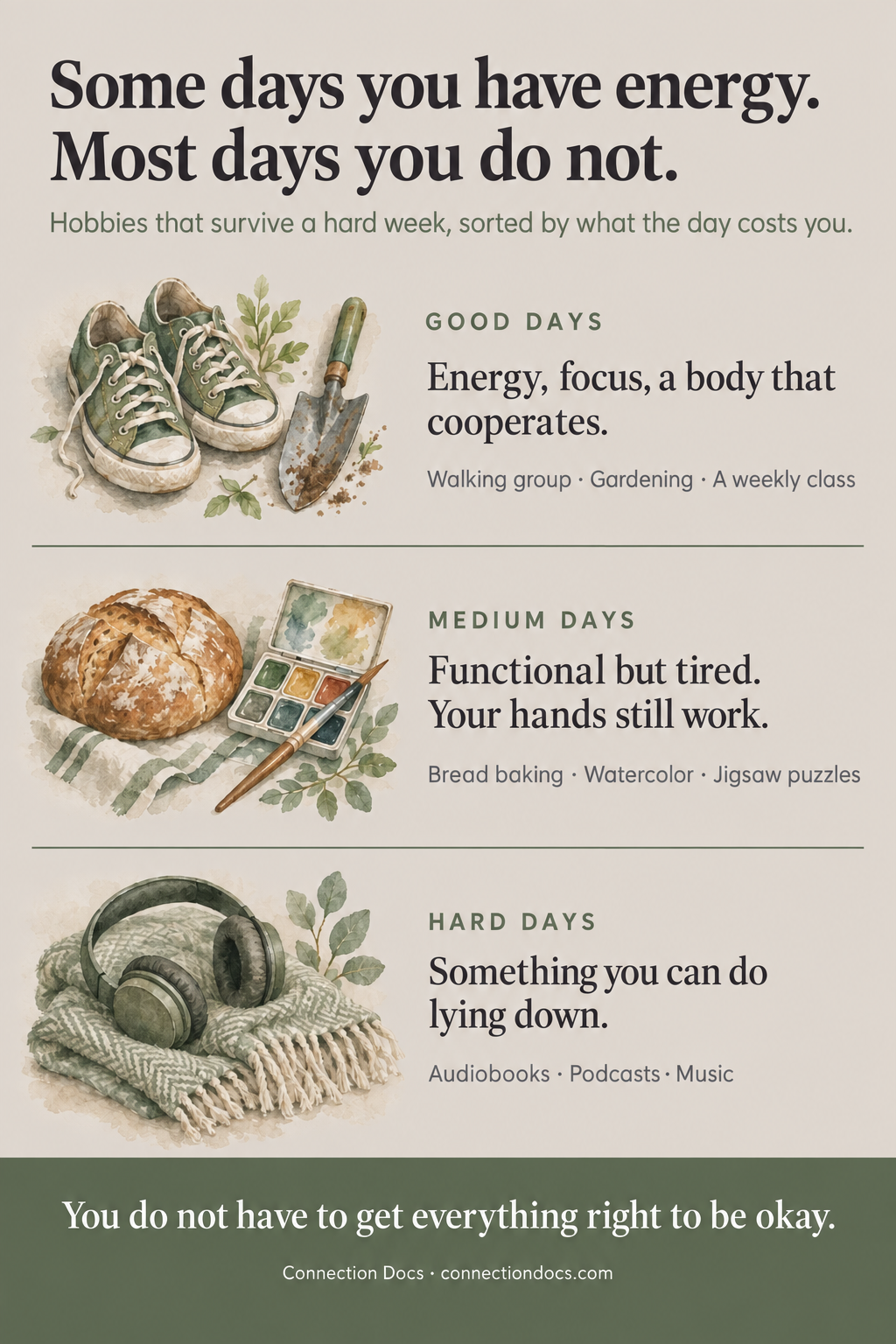
So before you pick anything, sort your days honestly into three categories.
Good days. You have energy, focus, and a body that mostly cooperates. These may be rare right now. That is fine.
Medium days. You are functional but tired. You can do something with your hands, but not something that requires you to leave the house or perform.
Hard days. Nausea, pain, brain fog, grief. On these days the only hobby that works is one you can do lying down, and possibly one you can stop mid-sentence.
Pick at least one hobby for each tier. This single move changes everything, because it means illness can take a day from you without taking the activity from you.
The person who only has a good-day hobby quits. The person who has a hard-day hobby keeps a thread of continuity running through the worst weeks, and that thread is worth more than any single activity.
A reasonable starting set might be a walking group for good days, bread baking or watercolor for medium days, and audiobooks or a podcast for hard days. Same instinct, three different energy costs.
Fun: Hobbies That Reconnect You With Yourself
We think of Fun as the pillar that belongs to you alone. Not what you do for the family. Not what is good for your labs. The thing that is yours.
For a lot of people, this is where the real grief sits, because they cannot remember the last time they did something purely because they wanted to.
Some places to look:
- Something with your hands. Woodworking, pottery, knitting, crochet, model building, jigsaw puzzles, embroidery, leatherwork. There is a reason so many people in treatment gravitate here. Repetitive handwork occupies the part of the mind that otherwise runs scan anxiety on a loop.
- Something creative. Watercolor, sketching, photography, calligraphy, journaling, songwriting, poetry. You do not need talent. You need a Tuesday afternoon and the willingness to make something bad.
- Something you collect or curate. Vinyl records, stamps, vintage maps, houseplants, playlists, family recipes. Collecting gives you a project with no deadline, which is exactly the right shape for an uncertain season.
- Something you learn. A language app, an instrument, chess, astronomy, a free university course online, bird identification. Learning is one of the few activities that reliably makes time feel like it is going somewhere.
- Something you read. Not medical literature. Fiction. Biographies. Poetry. The kind of reading that takes you out of your own story for an hour.
One more thought on this pillar. If you are tempted by an activity and immediately hear yourself say "that is not really me," pause on that. Very often the thing we dismiss fastest is the thing we abandoned decades ago because it was not practical, not profitable, or not what responsible adults do.
That voice is worth arguing with.
Food: Hobbies That Live in the Kitchen
Food is where a hobby and your health overlap most directly, and it is also where people get the most unhelpful advice.
Let us be clear about our position. There is no single perfect diet. Not for cancer, not for autoimmune disease, not for heart disease, not for anyone. What your body needs during treatment is different from what it needs in remission, different from what your neighbor needs, and different from what the internet is shouting at you this month.
Which is exactly why turning food into a hobby rather than a rule set works so well.
Some ideas:
- Bake bread. Sourdough is the obvious one, but a simple no-knead loaf is easier and just as satisfying. The rhythm of it is inherently gentle. Most of the work is waiting.
- Cook one new recipe a week. Not a meal plan. One recipe. Pick a cuisine you have never cooked and work through it slowly over a few months.
- Grow something you can eat. Even a windowsill of herbs counts. Basil, mint, rosemary, and chives all forgive neglect.
- Learn a technique instead of a diet. Knife skills, braising, fermentation, stocks, preserving. Techniques are portable across whatever eating pattern turns out to suit you.
- Build a family recipe archive. Call the relative who makes the thing nobody else can make. Write it down. This is a food hobby and a family hobby at the same time.
A practical note if you are mid-treatment. Taste changes, mouth sores, nausea, and appetite loss are real, and they can make cooking feel cruel rather than pleasurable. On those weeks, the hobby might be smoothies, or simply sitting in the kitchen while someone else cooks and smelling something good. That still counts. Ask your oncology team or a registered dietitian about neutropenic precautions and food safety if your counts are low.
Fitness: Hobbies That Happen to Move You
We are convinced that the best exercise for most people is the exercise they do not think of as exercise.
This matters more than usual when life has slowed down, because formal workouts tend to be the first thing to go and the last thing to come back. A hobby that involves movement sneaks past all of that.
The clinical case for moving is strong. The American College of Sports Medicine's international roundtable concluded that exercise during and after cancer treatment is safe and improves physical function, quality of life, and cancer-related fatigue. The American Cancer Society recommends building toward 150 to 300 minutes of moderate activity per week, with strength work at least twice weekly, while starting slowly and adjusting to your situation.
Notice that those recommendations say nothing about a gym.
Movement hobbies worth considering:
- Gardening. Researchers at the University of Alabama at Birmingham ran a randomized trial called Harvest for Health, pairing older cancer survivors with master gardeners to grow vegetable gardens at home, precisely because gardening bundles physical activity, produce, sunlight, and purpose into one activity.
- Walking with a destination. Not laps. A coffee shop, a trail, a farmers market, a friend's porch. Destination walking is dramatically more sustainable than step counting.
- Birding. It gets you outside, it rewards stillness, it scales to any fitness level, and it gives you a reason to keep going back.
- Swimming or water aerobics. Excellent for joints and for anyone dealing with neuropathy or balance issues. Check with your team first if you have a port, a drain, or a healing incision.
- Pickleball, bowling, golf, or lawn bowls. Social sports with a low impact profile and built-in conversation.
- Tai chi, qigong, or gentle yoga. Well studied for balance and fall prevention, and forgiving on low-energy days.
- Dancing. In a class, in a community hall, or in your own kitchen.
If you have lymphedema, bone metastases, severe anemia, active infection, or recent surgery, please run your plan by your oncology or rehab team before you start. Not because you should not move, but because the right modifications make the difference between a hobby that lasts and an injury that sets you back.
Family: Hobbies That Pull Other People In
If Fun belongs to you, Family is the pillar that belongs to everyone around you. And by family we mean whoever is actually in your corner, related to you or not.
The stakes here are higher than they sound. The 2023 Surgeon General's Advisory on social connection reported that poor social connection is associated with a 29 percent higher risk of heart disease, a 32 percent higher risk of stroke, and a rise in premature mortality risk comparable to well-established behavioral risk factors.
Illness isolates people, and it does it quietly. Friends do not know what to say, so they say less. You do not want to be a burden, so you decline. Six months later the circle has narrowed without anyone deciding it should.
A shared hobby fixes this without anyone having to have a difficult conversation about it, because it gives people something to do together instead of something to discuss.
- A standing game night. Cards, dominoes, board games, trivia. The standing part matters more than the game.
- Genealogy. Deeply absorbing, doable from a chair, and it naturally involves calling relatives and asking them questions.
- Recording family stories. Interview your parents, your siblings, your oldest friend. A phone voice memo is plenty. StoryCorps has free question prompts if you do not know where to start.
- Cooking with a grandchild. Or a niece, or a neighbor's kid. You are teaching and they are helping, and neither of you has to talk about your prognosis.
- A two-person book club. One friend, one book, one phone call a month.
- Volunteering. Even an hour. Being useful is a specific and underrated form of medicine.
- A group class. Ceramics, choir, woodworking, a walking club. The built-in repetition of a weekly class does the relationship-building for you.
One suggestion. If someone has asked "what can I do to help" and you have not known how to answer, this is your answer. Ask them to do the hobby with you. People desperately want a way to be present that is not casseroles and worried texts.
How to Actually Start
Insight rarely changes a life. Small action does.
Choose one thing, not five. The urge to overhaul everything at once is usually anxiety in disguise.
Lower the bar until it is almost embarrassing. Ten minutes. One sketch. One walk to the mailbox and back. The goal in the first month is not progress. It is proving to yourself that the activity still exists in your life.
Put it on the calendar with a specific time. "Sometime this week" reliably becomes never. Thursday at two has a chance.
Buy the cheapest possible version of the equipment. A twelve dollar watercolor set tells you whether you like painting just as well as a two hundred dollar one, and it carries none of the guilt if you stop.
Give it thirty days before you judge it. Almost everything is unsatisfying at first, because you are bad at it. That is not a sign. That is week one.
Let yourself quit. This is the one people need permission for most. If you try three hobbies and abandon two, you did not fail. You ran an experiment and got a result. The only real failure is deciding, after one attempt, that you are not a person who has hobbies anymore.
A Word About the Grief in This
We want to say one more thing, because we would be doing you a disservice if we skipped it.
For many people, picking up a hobby when life has slowed down is not only pleasant. It is complicated.
You may reach for the thing you used to love and find that your hands do not work the way they did. Or that the concentration is not there. Or that the group you used to belong to has moved on. Sometimes a person tries to return to a beloved activity and discovers, painfully, that the version of themselves who did it is gone.
That grief is real and it deserves acknowledgment rather than a pep talk.
But we have also watched, again and again, what happens on the other side of it. Someone who can no longer run becomes a serious birdwatcher. A retired surgeon with tremor discovers pottery, where imperfect is the point. A woman who spent forty years cooking for everyone else takes a photography class and finds out she has an eye.
The activity changes. The aliveness does not have to.
And honestly, that is what all four pillars are for. Fun, Food, Fitness, and Family are not a wellness checklist. They are four different doors into the same room, and the room is a life you are actually participating in rather than one you are waiting out.
So we will ask you the question we ask nearly everyone we sit with.
Not what are you trying to avoid. Not what lowers your risk.
What makes you glad to be alive?
And what is one small thing you could do this week that points in that direction?
Let's Talk
If life has slowed down and you are not sure what to put in the space, or if you are facing a complex diagnosis and want two physicians who will help you think through the whole picture rather than just the next scan, we would love to talk with you.
You can book a Connection Call with us here: https://www.connectiondocs.com/connection-call
No agenda. Just a conversation.
With warmth,
Dr. Alona and Dr. Matt
References and Further Reading
Mak HW, Noguchi T, Bone JK, et al. Hobby engagement and mental wellbeing among people aged 65 years and older in 16 countries. Nature Medicine, 2023. https://www.nature.com/articles/s41591-023-02506-1
Fancourt D, Steptoe A. The art of life and death: 14 year follow-up analyses of associations between arts engagement and mortality in the English Longitudinal Study of Ageing. BMJ, 2019. https://www.bmj.com/content/367/bmj.l6377
Bradt J, Dileo C, Myers-Coffman K, Biondo J. Music interventions for improving psychological and physical outcomes in people with cancer. Cochrane Database of Systematic Reviews, 2021. https://www.cochranelibrary.com/cdsr/doi/10.1002/14651858.CD006911.pub4/full
White MP, Alcock I, Grellier J, et al. Spending at least 120 minutes a week in nature is associated with good health and wellbeing. Scientific Reports, 2019. https://www.nature.com/articles/s41598-019-44097-3
Campbell KL, Winters-Stone KM, Wiskemann J, et al. Exercise guidelines for cancer survivors: consensus statement from international multidisciplinary roundtable. Medicine and Science in Sports and Exercise, 2019. https://pmc.ncbi.nlm.nih.gov/articles/PMC8576825/
American Cancer Society. Physical Activity and the Person with Cancer. https://www.cancer.org/cancer/survivorship/be-healthy-after-treatment/physical-activity-and-the-cancer-patient.html
Demark-Wahnefried W, et al. Harvest for Health, a randomized controlled trial testing a home-based vegetable gardening intervention among older cancer survivors across Alabama. Journal of the Academy of Nutrition and Dietetics, 2022. https://pubmed.ncbi.nlm.nih.gov/35533876/
Office of the U.S. Surgeon General. Our Epidemic of Loneliness and Isolation: The Surgeon General's Advisory on the Healing Effects of Social Connection and Community, 2023. https://www.hhs.gov/sites/default/files/surgeon-general-social-connection-advisory.pdf
Why does purpose in life predict mortality in older adults? A methodological reappraisal of the purpose and mortality literature. medRxiv preprint, 2022. https://www.medrxiv.org/content/10.1101/2022.03.13.22272312v1.full
Harvard Health Publishing. Having a hobby tied to happiness and well-being, 2024. https://www.health.harvard.edu/mind-and-mood/having-a-hobby-tied-to-happiness-and-well-being
This article is for general education and is not a substitute for individual medical advice. Please talk with your own care team before making changes to your activity, diet, or treatment plan.