Healthy Meal Prep Ideas for Low-Energy Weeks
Sep 22, 2026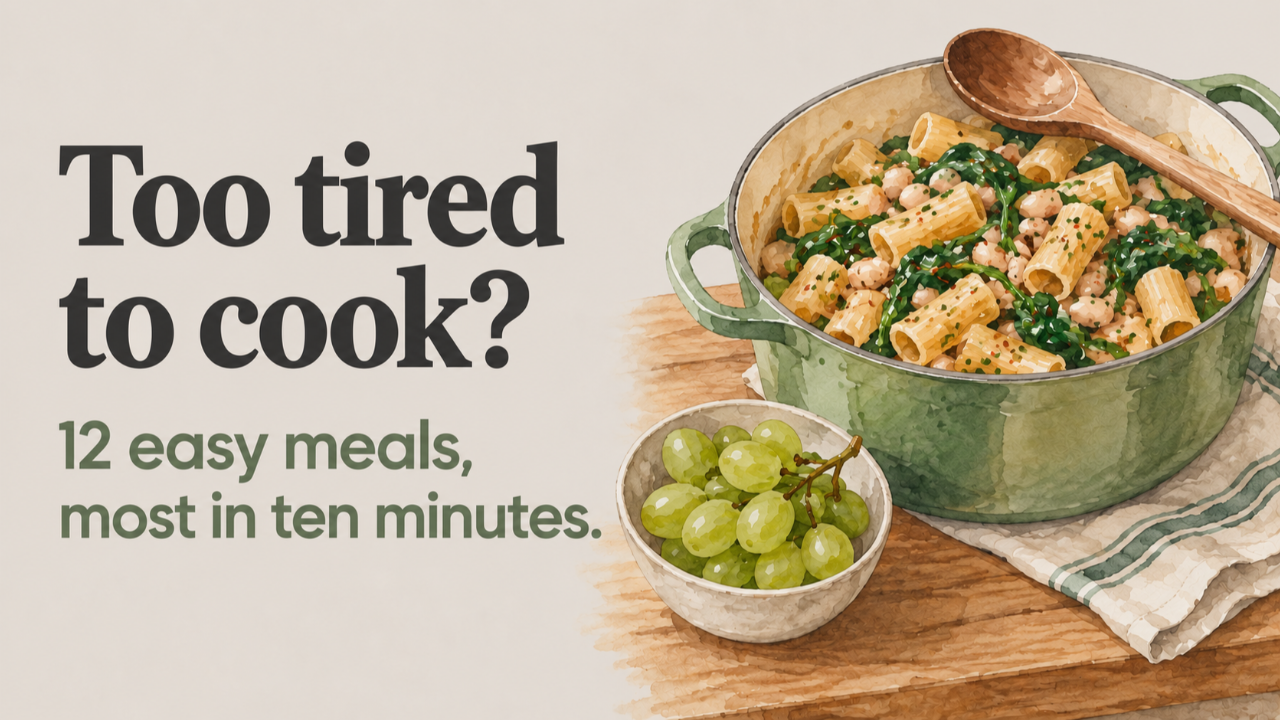
Some weeks, standing at the stove feels like climbing a mountain.
Maybe you are in the middle of chemotherapy or radiation. Maybe an autoimmune flare has knocked the wind out of you, or a new diagnosis has hijacked your sleep and your appetite. Maybe you are simply exhausted from carrying too much for too long. Whatever the cause, the result often looks the same: the refrigerator is full of good intentions, and dinner ends up being crackers eaten over the sink.
If that sounds familiar, please know you are not failing. Fatigue is the most common side effect of cancer treatment, and the National Cancer Institute reports that about 80 percent of people receiving chemotherapy or radiation experience it. It is also a different kind of tired. Unlike ordinary fatigue, cancer-related fatigue is not fully relieved by sleep or rest, and it is often out of proportion to how much you have actually done. People living with many other chronic illnesses know this feeling well.
Most meal prep advice online was written for someone with a free Sunday afternoon, a full tank of energy, and twenty matching glass containers. This post is for everyone else. It is for the weeks when you have fifteen good minutes, not four hours. It is also for anyone who wants to build habits now that make healthy eating easier later, because the best time to set up your kitchen for a hard week is before the hard week arrives.
Why Meal Prep Matters Most When Energy Is Lowest
When energy is scarce, every decision costs something. What should I eat? Do I have what I need? Is it worth the effort? By the time you have answered those questions, the little energy you had may already be spent.
Meal prep makes those decisions ahead of time. In a study of more than 40,000 adults in France, people who planned their meals in advance had better overall diet quality and ate a wider variety of foods than people who did not plan. Planning did not require perfection. It simply meant thinking a few days ahead.
We like to think of meal prep as a gift from your stronger self to your tired self. On a day when you feel a little better, you do one small thing. On a day when you feel depleted, that small thing is waiting for you.
It is also worth saying clearly: there is no single perfect way to eat. Your body, your treatment, your taste buds, your culture, and your budget are different from anyone else's. The ideas below are a menu of options, not a prescription. Take what fits, leave what doesn't, and pay attention to what actually helps you feel better.
Redefine What "Meal Prep" Means
When most people hear "meal prep," they picture five identical lunches lined up on a Sunday. For low-energy weeks, we encourage a gentler definition: meal prep is anything you do today that makes eating easier tomorrow.
That might mean washing a container of grapes. It might mean moving a frozen soup from the freezer to the refrigerator before bed. It might mean asking a neighbor to pick up a rotisserie chicken. All of it counts.
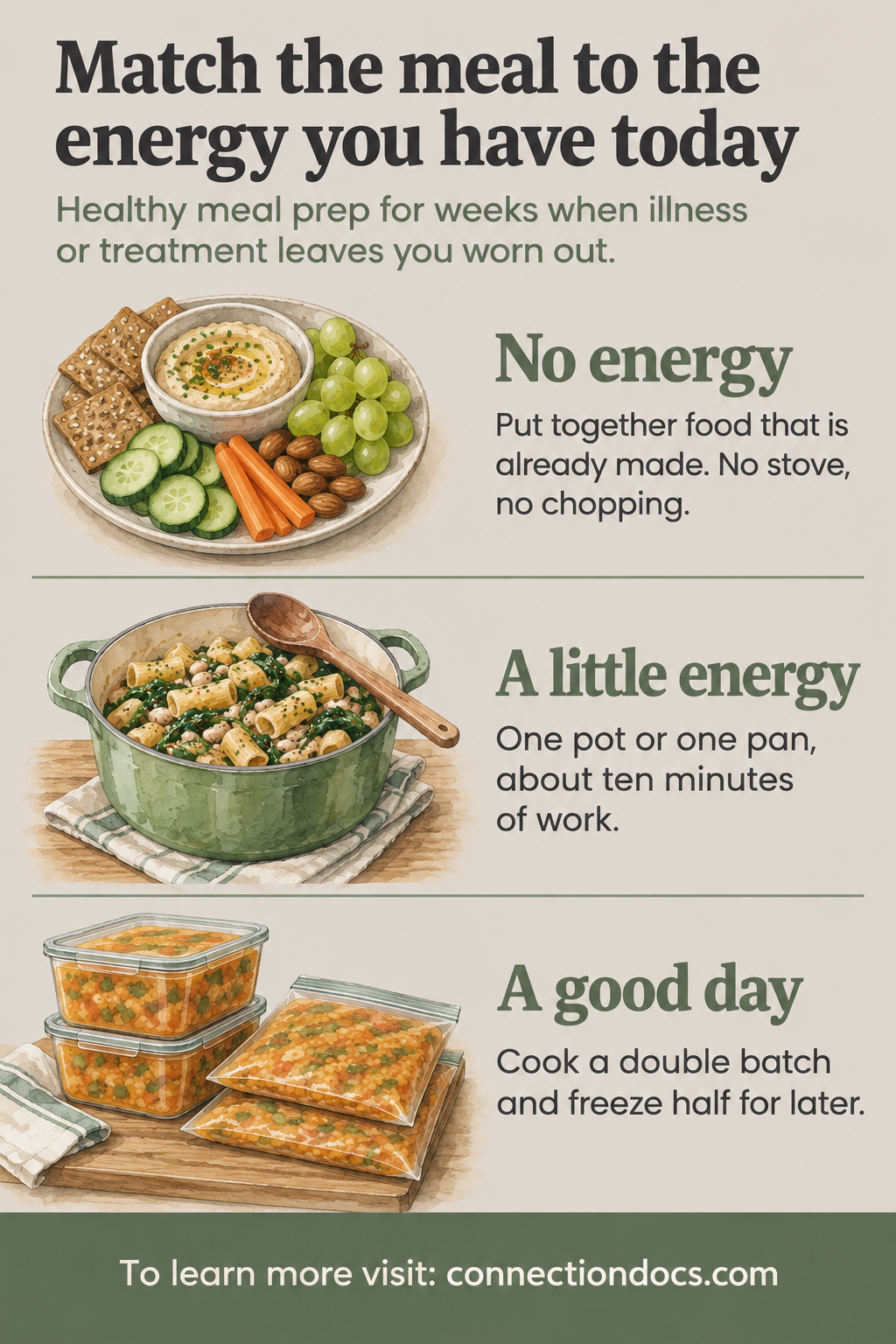
It can help to sort your options by how much energy you have:
- Empty tank: Assemble food that is already ready to eat. No stove, no chopping.
- Low tank: One pot, one pan, or one appliance, with about ten minutes of hands-on time.
- Good day: Cook a double batch and freeze half for the harder days ahead.
When you know which tank you are working with, you can choose a meal that matches it, instead of judging yourself for not doing more.
Stock a Low-Energy Kitchen First
The easiest meal prep happens at the grocery store or in your online cart. Keeping a handful of reliable, low-effort foods on hand means something nourishing is almost always within reach. A few of our favorites:
- Frozen vegetables and fruit. Many people assume fresh is always better, but a two-year study comparing fresh, frozen, and "fresh-stored" produce found frozen fruits and vegetables were generally just as nutritious, and in some comparisons held more vitamins than fresh produce that had sat in the refrigerator for five days.
- Canned or boxed beans and lentils. Rinse them and add them to soups, salads, grain bowls, or eggs.
- Ready-to-eat proteins such as rotisserie chicken, hard-boiled eggs, canned salmon or tuna, baked tofu, or frozen cooked shrimp.
- Microwavable whole grains like brown rice, quinoa, or farro pouches.
- Greek yogurt, cottage cheese, cheese sticks, and hummus.
- Nut butters, nuts, and seeds.
- Broth or bone broth, which becomes a simple soup in minutes.
- Pre-washed greens and pre-cut vegetables. They cost a little more, and during a hard week they are worth it.
Prepared foods are not cheating. Buying pre-chopped onions so that you actually cook dinner is a very good trade.
12 Healthy Meal Prep Ideas for Low-Energy Weeks
Here are easy meal prep ideas organized by the kind of effort they ask of you. Most take ten minutes of hands-on time or less. Think of them as starting points you can adjust to your own tastes, traditions, and any guidance from your care team.
Sheet Pan Dinners: One Pan, Almost No Cleanup
Sheet pan dinners are among the most forgiving meals there are. Everything goes on one pan, the oven does the work, and there is only one thing to wash. Line the pan with parchment and even that gets easier.
- Salmon, sweet potato, and broccoli. Toss cubed sweet potato and frozen broccoli with olive oil and salt and roast for about 15 minutes. Add salmon fillets and roast another 12 to 15 minutes. Leftovers become tomorrow's grain bowl.
- Chicken thighs with chickpeas and whatever vegetables you have. Chicken thighs stay tender even if you lose track of time, and chickpeas turn crisp and satisfying. Finish with a squeeze of lemon.
Crockpot and Slow Cooker Meals
A slow cooker may be the best friend a tired person can have. Crockpot meals let you spend a few minutes in the morning, when many people with fatigue feel their best, and come back to a warm dinner later.
- Lentil and vegetable soup. Add dry lentils, a bag of frozen mixed vegetables, a can of diced tomatoes, broth, and your favorite spices. A few hours later you have several servings of a fiber-rich, protein-rich soup that freezes beautifully.
- Shredded salsa chicken. Place chicken breasts or thighs in the slow cooker with a jar of salsa. When it is done, shred it with two forks. Use it all week in tacos, rice bowls, salads, or wraps.
One Pot Meals
One pot meals keep both effort and dishes to a minimum.
- Pasta with white beans and greens. Cook pasta, and in the last minute toss in a few handfuls of spinach. Drain, then stir in rinsed white beans, olive oil, garlic, and a little Parmesan.
- Simple egg and rice soup. Bring broth to a simmer, add leftover or microwaved rice, then slowly stir in a beaten egg. It is gentle, warming, and often easy to tolerate when your appetite is low.
Freezer Meals for Your Future Self
On a good day, make a double batch of almost anything and freeze half. Healthy freezer meals are the closest thing to a safety net a kitchen can offer.
- Single-serving soup portions. Freeze soup in small containers or freezer bags laid flat. Move one to the refrigerator the night before and it will be ready to reheat.
- Egg muffins or breakfast burritos. Whisk eggs with chopped vegetables and cheese, bake in a muffin tin, cool, and freeze. Or wrap scrambled eggs, beans, and cheese in tortillas. Either reheats in about a minute.
No Cook Meals and "Lazy" Dinner Ideas
There is nothing lazy about honoring your limits. These no cook meals need only assembly, which makes them perfect for empty-tank days and easy meal prep lunch ideas for any week.
- The snack plate dinner. A little cheese, whole grain crackers, hummus, sliced vegetables, fruit, nuts, and a protein like turkey or a hard-boiled egg. Arrange it on a plate you love. It counts as dinner.
- White bean or tuna salad. Mash a can of white beans or tuna with olive oil, lemon, and whatever herbs or chopped vegetables you have. Eat it on toast, in lettuce cups, or with crackers.
High Protein Meal Prep and Snacks
Protein helps you hold on to muscle and strength, which matters a great deal when illness or treatment is pulling in the other direction. Memorial Sloan Kettering's nutrition guidance for people in treatment suggests eating several small meals and snacks through the day instead of three large meals, and reaching for protein-rich foods such as eggs, dairy, beans, nuts, fish, and poultry. When a full meal feels like too much, high protein snacks can fill the gap.
- Yogurt or cottage cheese bowls. Top Greek yogurt or cottage cheese with frozen berries (they thaw into a natural sauce), nuts or seeds, and a drizzle of honey.
- Smoothie packs. On a good day, fill freezer bags with fruit, a handful of spinach, and a spoonful of nut butter or oats. On a hard day, empty one bag into a blender with milk or yogurt. Drinking your nutrition can be easier than chewing it when fatigue or low appetite sets in.
A Word About Food Safety
If you are in cancer treatment or taking medications that lower your immune defenses, food safety deserves extra attention. General guidance from FoodSafety.gov suggests eating refrigerated leftovers within three to four days. For people in cancer treatment, Memorial Sloan Kettering recommends a shorter window of two days, refrigerating food within two hours of cooking, and reheating leftovers to 165°F.
This is one more reason to lean on your freezer. Cook once, eat some now, and freeze the rest in single portions right away. Cool large batches in shallow containers so they chill quickly. Because the right precautions depend on your blood counts and your specific therapy, it is always worth asking your care team what applies to you.
Food: Finding What Works for You
Low-energy weeks are also a chance to get curious about how different foods make you feel. Some people find a big lunch leaves them sluggish, while several small meals keep them steadier. Some feel better with more protein early in the day. Others notice that certain foods sit heavy during treatment while others are soothing.
There is no universal list of "foods for energy" that works for every body. Instead of chasing a perfect list, try keeping simple notes for a week or two. What did I eat? How did I feel an hour later? Over time, you will build your own map. That map is more valuable than any diet book, because it was written by the only expert on your body who lives there full time.
If your focus right now is prevention, the same principle holds. The World Cancer Research Fund's recommendations emphasize a pattern built around whole grains, vegetables, fruit, and beans, rather than any single miracle food. Easy healthy dinners made from those building blocks, repeated week after week, are what add up.
Family: Let Your People Help
For many of us, one of the hardest things in the world is accepting help. We don't want to be a burden. We tell people we are fine.
But the people who love you often feel helpless, and feeding you is one of the most concrete ways they can show up. Memorial Sloan Kettering's patient guidance puts it simply: don't be afraid to let friends and family shop or prepare meals for you.
Specific requests tend to work better than open-ended ones. Instead of waiting for someone to "let me know if you need anything," you might say:
- "Would you be willing to make a double batch of your chili and bring me half?"
- "Could you pick up my grocery order on Thursday?"
- "Would you come over Sunday and help me fill my freezer?"
That last one can become something more than a chore. Cooking together is connection. Research from the University of Oxford found that people who eat with others more often tend to feel happier, more satisfied with life, and more engaged with their communities. The U.S. Surgeon General's advisory on loneliness describes social connection as a meaningful influence on both physical health and longevity. A pot of soup made with a friend on a Sunday afternoon feeds more than your body.
Fitness: A Little Movement Goes a Long Way
It may sound backward, but moving your body is one of the best-studied ways to ease fatigue. An international panel convened by the American College of Sports Medicine reviewed the research and concluded that exercise is generally safe for people with cancer, that everyone should avoid inactivity, and that the right amount of aerobic and strength training can improve fatigue, anxiety, depression, physical function, and quality of life.
On a low-energy week, that does not have to mean a workout. It might mean a slow walk to the mailbox after dinner. A 2022 analysis in the journal Sports Medicine found that even two to five minutes of light walking after eating helped blood sugar rise and fall more gently than sitting.
Meal prep itself can be functional fitness. Standing to rinse vegetables, carrying grocery bags, lifting a pot, reaching into a cabinet: these are the movements of daily life, and practicing them helps keep you capable of daily life. When you can, take your plate outside. Eating in fresh air and sunlight is a small thing that can shift a whole day. As always, check with your care team about the level of activity that is right for you.
Fun: Keep a Little Joy on the Plate
When you are sick or depleted, eating can start to feel like one more medical task. Take your medications. Drink your water. Eat your protein. Somewhere along the way, food stops being a pleasure.
We want to gently push back on that. Food is one of the oldest sources of joy we have. It is memory, culture, comfort, and creativity. Please let yourself enjoy it.
Put on music you love while the soup simmers. Use the good bowl. Buy the fancy strawberries. Make your grandmother's recipe once in a while, even if it is not the "healthiest" thing you could eat. A meal you look forward to is a meal you are more likely to eat, and there is real nourishment in feeling like yourself again.
A Reflective Exercise: Build Your Low-Energy Menu
Set aside ten minutes on a day when you have a little energy. Grab a pen and a notecard, and gently consider these questions:
- When I am exhausted, which foods feel comforting and easy to eat?
- What is one meal I could put together with almost no energy at all?
- What is one meal I could make on a good day and freeze for later?
- Who in my life would be glad to help with food, and what exactly could I ask them for?
- What is one small thing about eating that still brings me joy?
Now write down five meals you could realistically make or assemble during your hardest weeks. Tape the card inside a kitchen cabinet or on the front of your refrigerator. When the tired days come, you won't need to think. You will only need to look.
Please Be Gentle With Yourself
Some weeks, you will do all of this beautifully. Other weeks, dinner will be toast and a banana, and that will have to be enough.
Please don't turn meal prep into one more standard to fall short of. The goal isn't perfection. The goal is to make nourishing yourself a little easier, a little more often, and to let the people around you share the load.
You don't have to figure all of this out alone.
If you are navigating a new diagnosis, a chronic illness, or simply a season of life that has left you running on empty, we would be honored to help you think it through. Sometimes one conversation can make the next steps feel clearer and lighter. Whenever you are ready, you can book a Connection Call with us here.
With care,
Dr. Alona & Dr. Matt
This article is for general education and is not a substitute for individualized medical advice. Please talk with your own care team about nutrition, food safety, and activity during treatment.
References
- National Cancer Institute. Fatigue (PDQ®), Health Professional Version. https://www.cancer.gov/about-cancer/treatment/side-effects/fatigue/fatigue-hp-pdq
- Ducrot P, Méjean C, Aroumougame V, et al. Meal planning is associated with food variety, diet quality and body weight status in a large sample of French adults. International Journal of Behavioral Nutrition and Physical Activity, 2017;14:12. https://pubmed.ncbi.nlm.nih.gov/28153017/
- Li L, Pegg RB, Eitenmiller RR, Chun JY, Kerrihard AL. Selected nutrient analyses of fresh, fresh-stored, and frozen fruits and vegetables. Journal of Food Composition and Analysis, 2017;59:8-17. https://doi.org/10.1016/j.jfca.2017.02.002
- Memorial Sloan Kettering Cancer Center. Eating Well During Your Cancer Treatment. https://www.mskcc.org/cancer-care/patient-education/eating-well-during-your-treatment
- Memorial Sloan Kettering Cancer Center. Food Safety During Cancer Treatment. https://www.mskcc.org/cancer-care/patient-education/food-safety-during-cancer-treatment
- gov. Cold Food Storage Chart. https://www.foodsafety.gov/food-safety-charts/cold-food-storage-charts
- Campbell KL, Winters-Stone KM, Wiskemann J, et al. Exercise Guidelines for Cancer Survivors: Consensus Statement from International Multidisciplinary Roundtable. Medicine & Science in Sports & Exercise, 2019;51(11):2375-2390. https://journals.lww.com/acsm-msse/fulltext/2019/11000/Exercise_Guidelines_for_Cancer_Survivors_.23.aspx
- Buffey AJ, Herring MP, Langley CK, Donnelly AE, Carson BP. The Acute Effects of Interrupting Prolonged Sitting Time in Adults with Standing and Light-Intensity Walking on Biomarkers of Cardiometabolic Health: A Systematic Review and Meta-analysis. Sports Medicine, 2022;52:1765-1787. https://link.springer.com/article/10.1007/s40279-022-01649-4
- Dunbar RIM. Breaking Bread: the Functions of Social Eating. Adaptive Human Behavior and Physiology, 2017;3:198-211. https://link.springer.com/article/10.1007/s40750-017-0061-4
- Office of the U.S. Surgeon General. Our Epidemic of Loneliness and Isolation: The U.S. Surgeon General's Advisory on the Healing Effects of Social Connection and Community, 2023. https://www.hhs.gov/sites/default/files/surgeon-general-social-connection-advisory.pdf
- World Cancer Research Fund / American Institute for Cancer Research. Cancer Prevention Recommendations. https://www.wcrf.org/preventing-cancer/cancer-prevention/our-cancer-prevention-recommendations/