Healthy Lunch Ideas You Can Make in 10 Minutes
Oct 13, 2026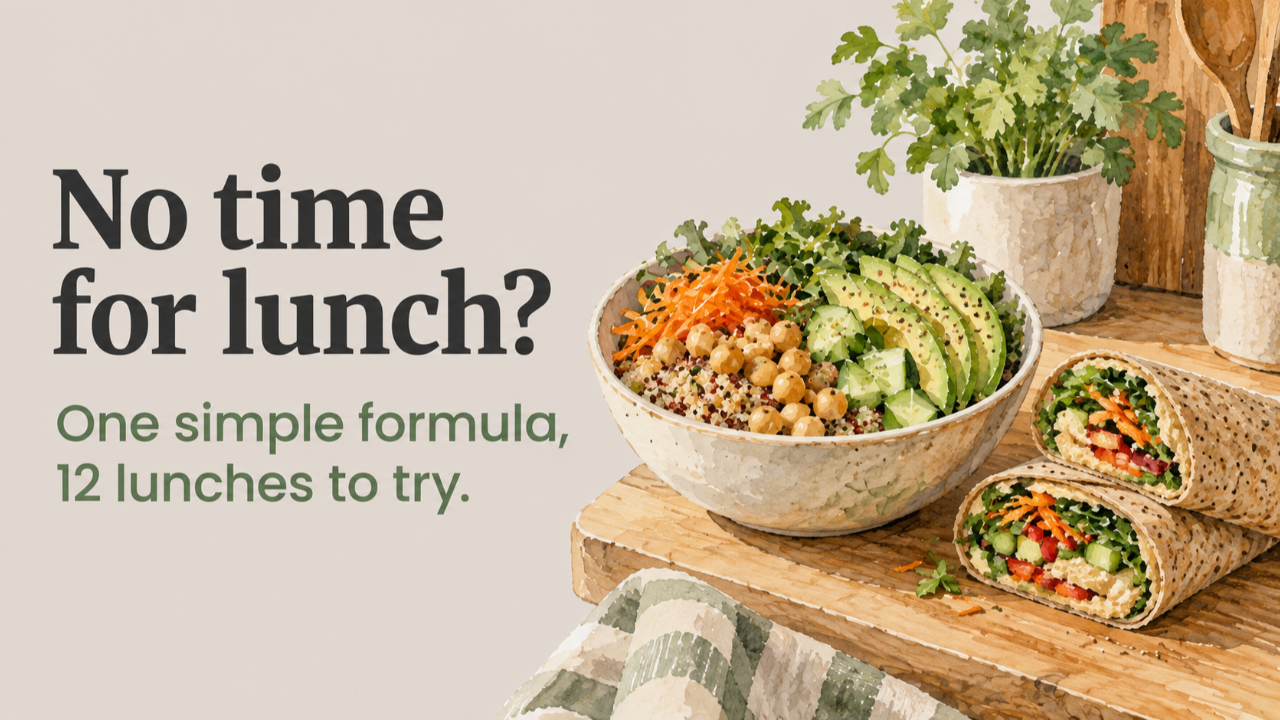
It’s 1:45 in the afternoon. You meant to eat an hour ago. Now you’re standing at the counter eating crackers out of the sleeve, or scrolling for something to have delivered, or deciding you’ll just wait until dinner.
Sound familiar?
Lunch is often the meal that gets skipped, rushed, or handed over to whatever is fastest. And on days when you’re tired from treatment, worn down by a chronic condition, or simply stretched thin, “fastest” usually wins.
We want to make the case that a nourishing lunch doesn’t have to be a production. With a few staples on hand and a simple formula, you can put together a healthy lunch in about 10 minutes. No recipe binder. No oil. No guilt.
Why Lunch Deserves More Credit
Most of us aren’t eating nearly as many plants as our bodies would like. In a large CDC survey, only about 1 in 8 U.S. adults met the recommendations for fruit, and only 1 in 10 met them for vegetables [1].
Fiber tells a similar story. Adults need roughly 25 grams a day (women) to 38 grams a day (men), yet the average American gets about 17 grams, and only about 5 percent of people reach the recommended amount [2].
That gap matters. A major review of 185 studies and 58 clinical trials found that people who ate the most fiber had a 15 to 30 percent lower risk of dying from any cause and from heart disease than those who ate the least, along with less stroke, type 2 diabetes, and colorectal cancer. The biggest benefits showed up at 25 to 29 grams a day [3]. Whole grains tell a similar story: in a large analysis, every additional three servings a day was linked with a 17 percent lower risk of death from any cause [4].
Lunch is one of your best daily chances to close that gap. A single bowl of beans, greens, and whole grains can easily deliver 10 grams of fiber or more.
It also helps to have a plan. When lunch is an afterthought, it’s often ultra-processed. In a carefully controlled NIH study, people ate about 500 more calories a day when offered ultra-processed meals than when offered unprocessed ones, even though the meals were matched for sugar, salt, fiber, and other nutrients [5].
The American Cancer Society and the World Cancer Research Fund both recommend eating patterns built around vegetables, fruits, whole grains, and beans [6, 7]. A whole-food, plant-based lunch puts that advice right on your plate.
And here’s the most important thing: there is no single perfect diet. Every body is different. Some days you’ll want something warm, other days something crunchy and cold. Your job isn’t to eat perfectly. It’s to find what works for you.
The 10-Minute Lunch Formula
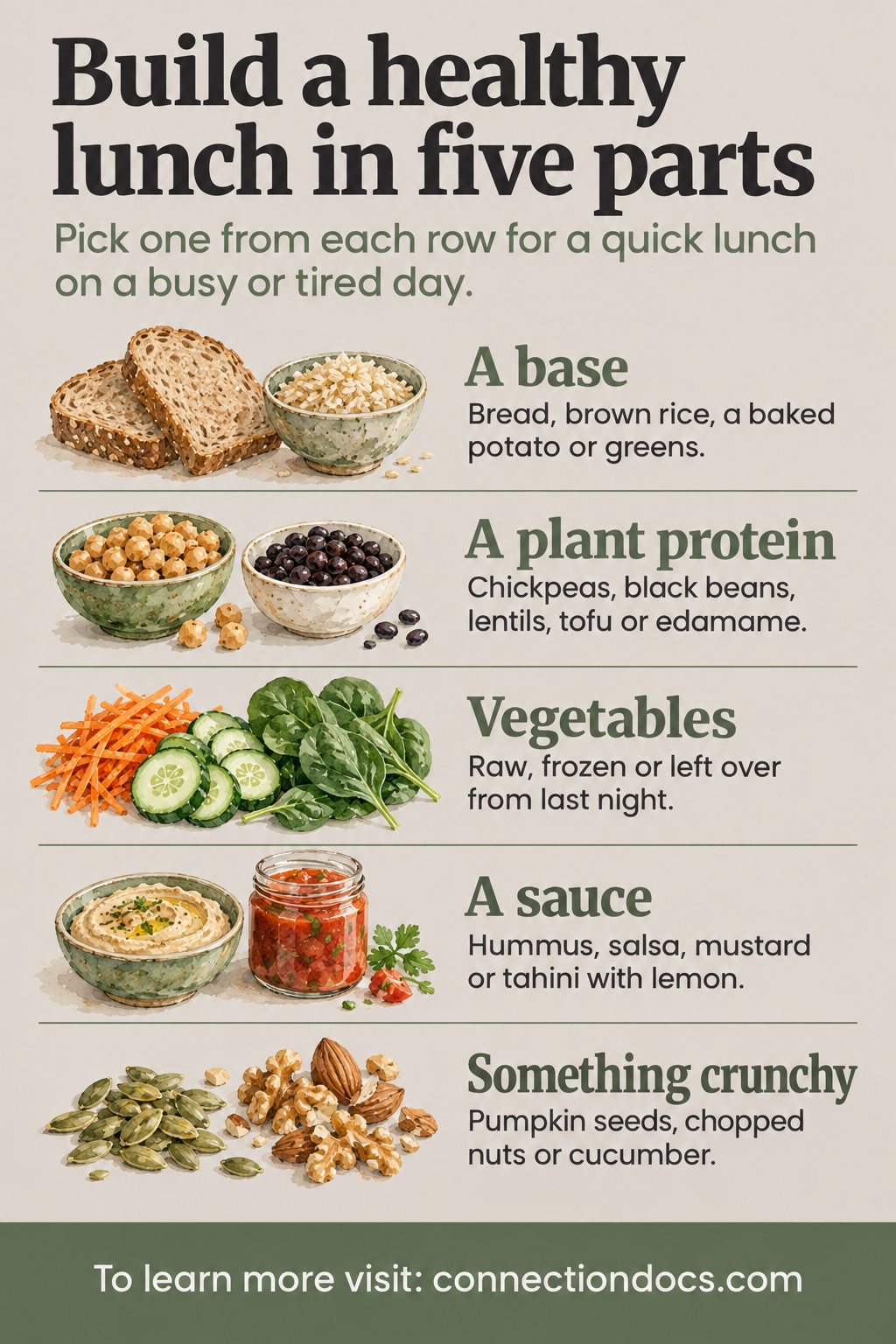
Instead of memorizing recipes, think in building blocks. Choose one from each category, and you have lunch.
- A base: whole-grain bread or wraps, cooked brown rice or quinoa, whole-grain noodles, a baked potato, or a bed of greens.
- A plant protein: chickpeas, black beans, lentils, white beans, edamame, tofu, or tempeh.
- Vegetables: whatever you have. Raw, frozen, or last night’s roasted leftovers. Color counts.
- A sauce: oil-free hummus, salsa, mustard, tahini thinned with lemon juice, miso, or a quick peanut-lime sauce.
- Something crunchy: pumpkin seeds, chopped nuts, cucumber, shredded cabbage, or a few whole-grain crackers.
A quick word about oil: every lunch in this post is oil-free. You don’t need added oil for flavor or for a satisfying meal, because the fats your body needs come packaged in whole foods like nuts, seeds, avocado, tahini, and soy. If you’re avoiding added oil, read the labels on store-bought hummus, wraps, bread, dressings, and microwavable grain pouches, since many contain it. Oil-free versions exist, and homemade hummus (chickpeas, tahini, lemon, garlic, and a splash of water) takes about three minutes in a blender.
Stock Your Kitchen for Quick Healthy Lunches
The secret to a 10-minute lunch is that most of the work happens earlier, at the grocery store. Keep a few of these on hand:
- Canned beans and lentils. Choose no-salt-added when you can. If not, draining and rinsing regular canned beans cuts the sodium by about 41 percent [8].
- Frozen vegetables and fruit. Frozen produce is generally just as nutritious as fresh, and sometimes more so than fresh produce that has been sitting in the fridge for days [9, 10].
- Cooked whole grains. Make a big batch of brown rice, quinoa, or farro on the weekend and keep it in the fridge for the week.
- Flavor builders. Salsa, mustard, tahini, miso, low-sodium soy sauce or tamari, lemons, limes, vinegar, nutritional yeast, and your favorite spice blends.
- Fresh staples that keep. Pre-washed greens, cherry tomatoes, cucumbers, carrots, cabbage, apples, and avocados.
- Firm tofu, frozen edamame, and natural peanut butter.
12 Healthy Lunch Ideas You Can Make in 10 Minutes
Each of these takes about 10 minutes once your grains are cooked and your cans are open. Mix, match, and make them your own.
1. Smashed Chickpea Salad Sandwich
Mash a can of rinsed chickpeas with a fork, then stir in a spoonful of tahini or oil-free hummus, a little mustard, lemon juice, chopped celery, and fresh or dried dill. Pile it onto whole-grain bread with lettuce and tomato, or scoop it into lettuce cups. This chickpea salad sandwich keeps for about three days in the fridge, which makes it a great meal prep lunch idea, too.
2. Lemony Three-Bean Salad
Toss rinsed kidney beans, chickpeas, and white beans with chopped red onion, cucumber, parsley, red wine vinegar, and a squeeze of lemon. Season with salt and pepper. This bean salad is one of our favorite cold lunch ideas because it actually tastes better the next day.
3. Ten-Minute Buddha Bowl
Start with cooked quinoa or brown rice. Add rinsed chickpeas, a handful of greens, shredded carrots, cucumber, and sliced avocado. Finish with tahini whisked with lemon juice, a little garlic, and enough water to make it pourable. A buddha bowl is the lunch formula in its purest form: base, protein, vegetables, sauce, and crunch.
4. Lentil Salad With Cucumber and Herbs
Canned or precooked lentils make this one almost instant. Toss them with diced cucumber, cherry tomatoes, red onion, fresh herbs, lemon juice, and a little Dijon mustard. Serve it over greens or tuck it into a whole-grain pita. Lentil salad is filling, inexpensive, and full of fiber.
5. Hummus Veggie Wrap
Spread a whole-grain wrap with oil-free hummus. Layer on spinach, shredded cabbage, roasted red peppers (choose a jar packed in water, not oil), cucumber, and a sprinkle of sunflower seeds. Roll it tightly and slice it in half. A hummus wrap travels well, which makes it one of the easiest lunch ideas for work.
6. Oil-Free Black Bean Quesadilla
Mash black beans with salsa, cumin, and a squeeze of lime. Spread the mixture over half of a whole-grain or corn tortilla, add a handful of spinach, fold it over, and toast it in a dry nonstick skillet for two to three minutes per side until crisp. No cheese and no oil required. Top with more salsa and sliced avocado.
7. Miso Soup With Tofu and Greens
Heat water with a handful of frozen spinach or chopped bok choy, cubes of tofu, and sliced scallions. Turn off the heat, then stir in a spoonful or two of miso paste, since boiling dulls its flavor. Add leftover rice or a handful of quick-cooking noodles to make it a meal. Miso is salty, so go easy if you’re watching sodium.
8. Peanut Noodle Bowl With Edamame
Boil soba noodles, which cook in about five minutes, and toss in frozen edamame for the last couple of minutes. Meanwhile, whisk natural peanut butter with low-sodium soy sauce or tamari, lime juice, grated ginger, and warm water. Toss everything together with shredded carrots and cucumber. Between the soy and the peanuts, this is one of our go-to high-protein lunch ideas.
9. Sweet Potato and Black Bean Bowl
Pierce a sweet potato a few times with a fork and microwave it for five to seven minutes, until soft. Split it open and top with black beans, corn, salsa, and chopped cilantro. It’s warm, comforting, and gentle on days when your appetite is low.
10. White Bean Toast With Tomato
Mash cannellini beans with lemon juice, a little garlic, salt, and pepper. Spread the mixture on toasted whole-grain bread and top with sliced tomato, fresh basil, and black pepper. Think of it as a fiber-rich, protein-rich cousin of avocado toast.
11. The “Planned-Over” Grain Bowl
Make extra at dinner on purpose. Last night’s roasted vegetables, lentil soup, or bean chili can become today’s lunch over a scoop of brown rice or greens. Planned-overs might be the simplest meal prep lunch idea of all: cook once, eat twice.
12. The No-Cook Snack Plate
Some days, cooking anything feels like too much. On those days, build a plate: oil-free hummus, carrots and snap peas, whole-grain crackers, a handful of nuts, thawed edamame, and some fruit. It still counts as lunch. On a hard day, it might be the best lunch idea of all.
High-Protein Lunch Ideas Without Meat
People often worry about getting enough protein on a plant-based diet. The Academy of Nutrition and Dietetics’ position is that appropriately planned vegetarian and vegan diets are healthful and nutritionally adequate, and that they typically meet or exceed protein needs when you’re eating enough calories overall [11].
Some of the most protein-dense plant foods are also the fastest to prepare: tofu, tempeh, edamame, lentils, beans, and peanut butter. In large studies, people who eat the most beans and lentils have a modestly lower risk of death from any cause [12]. If you’re in active treatment or recovering from surgery, your protein needs may be higher than usual, so it’s worth asking your care team or a registered dietitian what target makes sense for you.
Two more notes:
- Soy is safe. Whole soy foods like tofu, edamame, and soy milk are healthy in normal food amounts. The American Cancer Society calls soy foods healthy and safe, and the American Institute for Cancer Research notes that breast cancer survivors who eat soy foods show no increased risk. Both advise getting soy from whole foods rather than concentrated supplements [13, 14].
- Don’t forget B12. Plant foods don’t naturally contain vitamin B12, so anyone eating a fully plant-based diet needs a reliable source, such as fortified foods or a supplement [15].
If You’re in Treatment: A Few Food Safety Notes
If chemotherapy, a transplant, or another treatment has weakened your immune system, food safety matters more. Federal food safety guidance for people with cancer recommends:
- Skipping raw sprouts, such as alfalfa and bean sprouts. Cooked sprouts are a lower-risk choice.
- Washing fresh produce well, including salad greens.
- Avoiding unpasteurized juice and cider [16, 17].
Interestingly, strict “neutropenic diets” that restrict fresh produce haven’t been shown to prevent infections better than a regular diet with safe food handling [18]. Still, your care team knows your situation best. If they’ve given you specific food rules, follow those first.
If your appetite is low, smaller meals built around calorie-dense whole foods like nut butters, avocado, tahini, and whole grains can help you get enough energy without forcing large portions. The American Cancer Society’s guidance for survivors notes that if you’re losing weight during treatment, the focus should be on getting enough calories and protein [19].
Lunch Through the Four F’s
We think about health through four simple lenses: Food, Fun, Fitness, and Family. Lunch touches all of them.
Food
Find what works for you. Maybe you love a warm bowl. Maybe you need something you can eat with one hand between meetings. Maybe your stomach only tolerates simple foods this week. There’s no perfect diet, only the one that nourishes you and that you can actually keep doing.
Fun
Lunch can be a small daily pleasure rather than one more chore. Try one new ingredient a week. Eat outside when the weather allows. Put on music while you build your bowl. Notice how food tastes when you slow down long enough to enjoy it.
Fitness
A short walk after lunch is one of the easiest ways to add steps to your day. Even 10 minutes outside can change how the afternoon feels. If you can, carry your lunch to a park or a bench and walk on the way there.
Family
Lunch is also an invitation. Pack two lunches and share one with a coworker. Make a weekend lunch with your kids and let everyone build their own bowl. Call a friend while you eat. Food tastes better when it’s shared.
A Short Reflection
Before your next grocery trip, take a few minutes with these questions:
- What does lunch actually look like for me most days?
- What gets in the way: time, energy, appetite, or ideas?
- Which two or three lunches above sound genuinely good to me?
- What would I need to keep on hand to make them easy?
Choose one lunch to try this week. Just one. Put the ingredients on your list. Then notice how you feel that afternoon.
Small Meals, Real Care
None of this needs to be perfect. A lunch made from a can of beans, a handful of greens, and a spoonful of salsa is a meaningful act of care, especially on a day when everything else feels hard.
Ten minutes. A few simple ingredients. A meal that takes care of you.
If you’re living with a new diagnosis or a chronic illness and want help figuring out what eating well looks like for you, we’d love to talk. Our conversations are always virtual, so you can join from your own kitchen table. Book a Connection Call with us and let’s find what works for you.
This article is for general education and is not a substitute for individualized medical or nutrition advice. If you are in active treatment, have kidney disease, take blood thinners, or follow a prescribed diet, please check with your care team before changing how you eat.
References
- Lee SH, et al. Adults meeting fruit and vegetable intake recommendations, United States, 2019. MMWR Morbidity and Mortality Weekly Report. 2022;71(1):1-9. https://www.cdc.gov/mmwr/volumes/71/wr/mm7101a1.htm
- Dahl WJ, Stewart ML. Position of the Academy of Nutrition and Dietetics: health implications of dietary fiber. Journal of the Academy of Nutrition and Dietetics. 2015;115(11):1861-1870. https://doi.org/10.1016/j.jand.2015.09.003
- Reynolds A, et al. Carbohydrate quality and human health: a series of systematic reviews and meta-analyses. The Lancet. 2019;393(10170):434-445. https://doi.org/10.1016/S0140-6736(18)31809-9
- Aune D, et al. Whole grain consumption and risk of cardiovascular disease, cancer, and all cause and cause specific mortality: systematic review and dose-response meta-analysis of prospective studies. BMJ. 2016;353:i2716. https://doi.org/10.1136/bmj.i2716
- Hall KD, et al. Ultra-processed diets cause excess calorie intake and weight gain: an inpatient randomized controlled trial of ad libitum food intake. Cell Metabolism. 2019;30(1):67-77. https://doi.org/10.1016/j.cmet.2019.05.008
- Rock CL, et al. American Cancer Society guideline for diet and physical activity for cancer prevention. CA: A Cancer Journal for Clinicians. 2020;70(4):245-271. https://www.cancer.org/cancer/risk-prevention/diet-physical-activity/acs-guidelines-nutrition-physical-activity-cancer-prevention.html https://doi.org/10.3322/caac.21591
- World Cancer Research Fund. Cancer Prevention Recommendations: Eat a diet rich in wholegrains, vegetables, fruit and beans. https://www.wcrf.org/research-policy/evidence-for-our-recommendations/wholegrains-veg-fruit-beans/
- Duyff RL, Mount JR, Jones JB. Sodium reduction in canned beans after draining, rinsing. Journal of Culinary Science and Technology. 2011;9(2):106-112. https://doi.org/10.1080/15428052.2011.582405
- Li L, et al. Selected nutrient analyses of fresh, fresh-stored, and frozen fruits and vegetables. Journal of Food Composition and Analysis. 2017;59:8-17. https://doi.org/10.1016/j.jfca.2017.02.002
- Bouzari A, Holstege D, Barrett DM. Vitamin retention in eight fruits and vegetables: a comparison of refrigerated and frozen storage. Journal of Agricultural and Food Chemistry. 2015;63(3):957-962. https://doi.org/10.1021/jf5058793
- Melina V, Craig W, Levin S. Position of the Academy of Nutrition and Dietetics: vegetarian diets. Journal of the Academy of Nutrition and Dietetics. 2016;116(12):1970-1980. https://doi.org/10.1016/j.jand.2016.09.025
- Zargarzadeh N, et al. Legume consumption and risk of all-cause and cause-specific mortality: a systematic review and dose-response meta-analysis of prospective studies. Advances in Nutrition. 2023;14(1):64-76. https://doi.org/10.1016/j.advnut.2022.10.009
- American Institute for Cancer Research. Soy. https://www.aicr.org/cancer-prevention/food-facts/soy/
- American Cancer Society. Soy and cancer risk: our expert’s advice. 2025. https://www.cancer.org/cancer/latest-news/soy-and-cancer-risk-our-experts-advice.html
- National Institutes of Health, Office of Dietary Supplements. Vitamin B12: fact sheet for health professionals. https://ods.od.nih.gov/factsheets/VitaminB12-HealthProfessional/
- S. Department of Agriculture and U.S. Food and Drug Administration. Food Safety for People with Cancer (booklet; copy hosted by LSU Health). https://medschool.lsuhsc.edu/lungcancer/docs/Food%20Safety%20Fopr%20People%20with%20Cancer_US%20Bept%20of%20Agriculture%20Food%20adn%20Drug%20admin_booklet.pdf
- USDA Food Safety and Inspection Service. Food Safety: A Need-to-Know Guide for Those at Risk. https://www.fsis.usda.gov/sites/default/files/media_file/2021-04/at-risk-booklet.pdf
- Sonbol MB, et al. Neutropenic diets to prevent cancer infections: updated systematic review and meta-analysis. BMJ Supportive and Palliative Care. 2019;9(4):425-433. https://doi.org/10.1136/bmjspcare-2018-001742
- Rock CL, et al. American Cancer Society nutrition and physical activity guideline for cancer survivors. CA: A Cancer Journal for Clinicians. 2022;72(3):230-262. https://www.cancer.org/cancer/supportive-care/nutrition-activity-with-cancer/acs-nutrition-and-physical-activity-guideline-for-survivors.html https://doi.org/10.3322/caac.21719