Glute Exercises for Stability and Strength: The Muscles That Hold Your Life Up
Sep 11, 2026
There is a moment we watch for on almost every call, and most people have no idea we are watching for it.
It comes when someone says, “Hold on, let me go grab my medication list.” They put both hands on the arms of the chair, rock forward once, sometimes twice, and push.
That push tells us more about the next five years of someone’s life than almost anything on their lab work.
If you arrived here searching for glute exercises, you probably came looking for strength, or shape, or relief from a nagging low back. We want to offer you a different frame, especially if you are reading this in the weeks after a diagnosis that reorganized everything.
Your gluteal muscles are not a cosmetic project. They are the engine of standing up, staying upright, and catching yourself when the floor surprises you. They are the difference between getting out of a chair and being helped out of a chair. And in a season where a great deal has been decided for you, they are one of the few things you still get to build.
What Your Glutes Actually Do
Most people think of the glutes as one muscle. There are three, and they have different jobs.
Gluteus maximus is the big one, and it is the largest muscle in the human body. Its main job is hip extension, which is the motion of driving your thigh backward underneath you. That is what happens every time you stand up, climb a stair, push off a curb, or rise from the toilet.
Gluteus medius and gluteus minimus sit higher and more to the side. Their job is hip abduction and control of the pelvis from side to side. Every time you take a step, you are momentarily standing on one leg, and these muscles are the reason your opposite hip does not drop toward the floor.
That second group is the one almost nobody trains, and it is the one that quietly governs balance. Researchers who study why older adults fall keep landing on the same finding. Work published in the Journal of Neurophysiology found that fatiguing the hip abductors made older adults measurably more vulnerable to sideways balance challenges during walking. A separate study comparing people who had fallen with people who had not found that the gluteal muscles were the most affected muscles of all, with lower muscle quality and weaker hip abduction strength in the fallers.
Why This Matters More After a Diagnosis
Here is something we wish someone explained clearly on day one of treatment.
Cancer and chronic illness do not only affect the organ named in the diagnosis. They affect muscle. Chemotherapy accelerates muscle loss. Steroids, which are part of a great many protocols, cause a specific weakness that shows up first in the hips and thighs. Androgen deprivation therapy and aromatase inhibitors change the hormonal environment that maintains muscle. Add fatigue, add nausea, add weeks of sitting in infusion chairs and waiting rooms, and the math works against you fast.
This is not a small cosmetic issue. Low skeletal muscle mass has been repeatedly associated with more treatment toxicity and worse outcomes across many cancer types. One meta-analysis of 48 studies found low muscle mass predicted dose limiting toxicity in oncology patients. Chemotherapy is dosed to the body, and a body with less muscle handles that dose differently.
We are not telling you this to frighten you. We are telling you because it reframes what a set of glute bridges actually is. It is not vanity. It is not optional wellness. It is part of the physical scaffolding that helps you tolerate the treatment that is trying to save your life.
And there is a second reason, one that matters even more to most of the people we work with. Falls. More than one in four adults over 65 falls each year, and roughly 319,000 older Americans are hospitalized for hip fractures annually. If you are on treatment, if your bone density has taken a hit, if neuropathy has changed what your feet can feel, that risk is not theoretical. The muscles that prevent a fall from happening in the first place are the ones on the sides of your hips.
If You Are Reading This to Stay Well
Some of you found this page not because of a diagnosis but because you are trying to avoid one. Good. The evidence is on your side.
The American Cancer Society links regular physical activity to lower risk of several cancers, including breast, colon, and endometrial cancer, and recommends 150 to 300 minutes of moderate intensity activity each week. A pooled analysis of more than 750,000 adults found that meeting those amounts was associated with lower risk across seven cancer types.
The Physical Activity Guidelines for Americans add the part people skip: muscle strengthening on two or more days a week covering all the major muscle groups, plus balance training for older adults. Roughly 80 percent of American adults are not meeting both components, and strength is usually the half that gets abandoned. Training your hips is the most efficient way to honor it, because that is where the largest muscles live.
Four Questions That Tell You Where You Stand
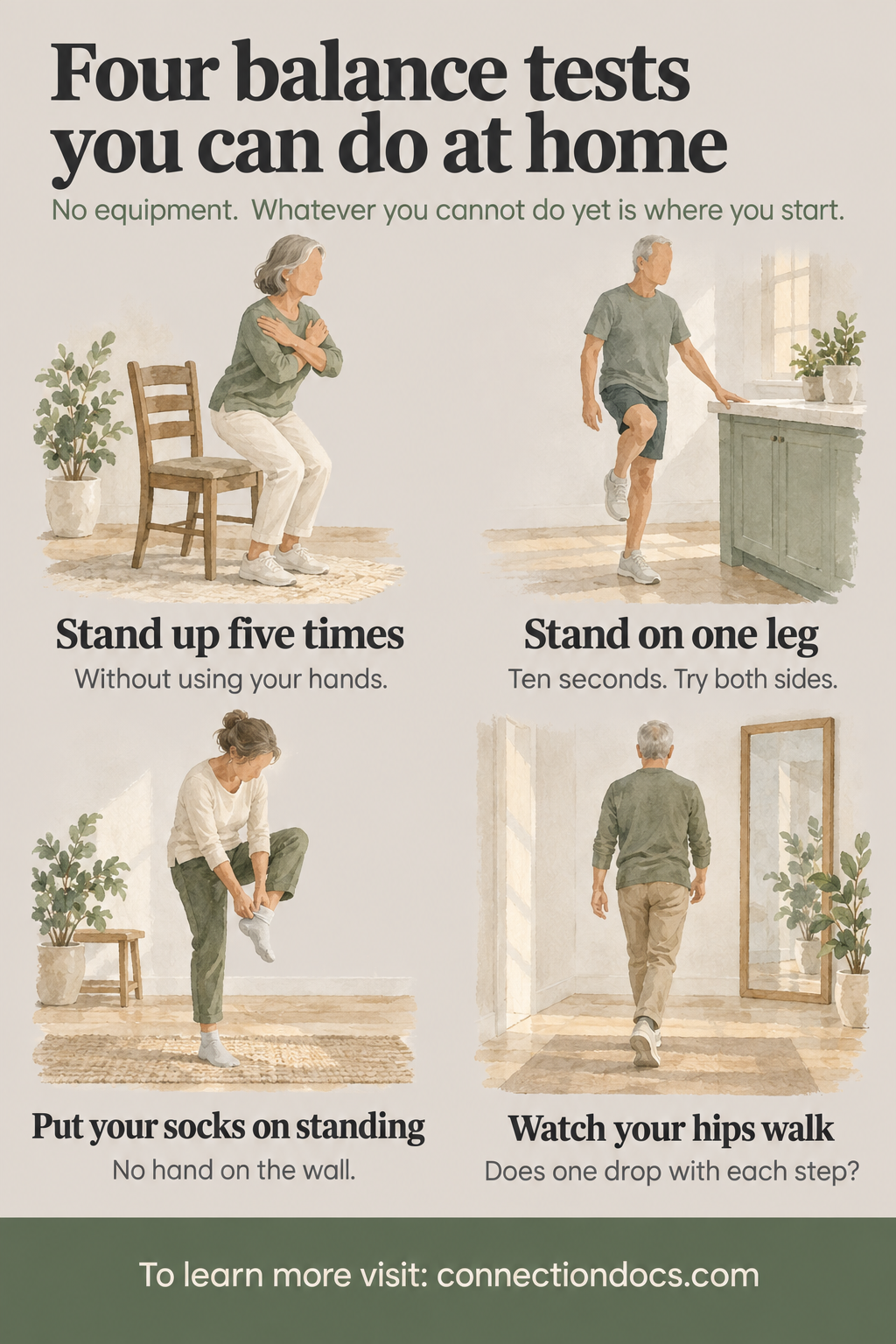
Before the exercises, get an honest baseline. None of these require equipment. Do them near a counter or a sturdy chair.
- Can you stand up from a standard chair without using your hands? Try it five times in a row. If you need the armrests, your hip extensors are asking for help.
- Can you stand on one leg for ten seconds without grabbing something? Try both sides. Most people are noticeably worse on one.
- Can you put on socks standing up? This is a real world test of single leg hip control that almost nobody thinks of as a test.
- Watch yourself walk past a window or a mirror. Does one hip drop noticeably with each step? Does your torso sway side to side? That is often the gluteus medius quietly asking for attention.
Phase One: Glute Activation Exercises
After illness, surgery, or a long stretch of sitting, the problem is often not only that the muscle is weak. It is that the brain has stopped recruiting it well. Other muscles take over. The low back and hamstrings start doing work the glutes should be doing, which is one common reason hip weakness shows up as back pain.
Start here. These can be done on a bed if the floor is not accessible.
Glute Bridge
Lie on your back, knees bent, feet flat and about hip width apart, heels close enough that you can just brush them with your fingertips. Press through your heels and lift your hips until your body makes a straight line from knees to shoulders. Squeeze at the top for two seconds. Lower slowly.
Two or three sets of 10 to 15. If you feel it mostly in your hamstrings, walk your feet slightly closer to you. If you feel it in your low back, you are arching instead of extending your hips, so lift a little less far and tuck your pelvis slightly.
Side Lying Hip Abduction
Lie on your side, bottom knee bent for stability, top leg straight and in line with your body. Lift the top leg about 12 inches, leading with the heel rather than the toe. Lower with control.
Two sets of 12 each side. This is your gluteus medius, the muscle the falls research keeps pointing to.
Clamshell
Same side lying position, both knees bent to about 45 degrees, feet stacked. Keeping your feet together, open the top knee like a clamshell. Do not let your hips roll backward.
Two sets of 15 each side. Add a light resistance band above the knees once it feels easy.
Sit to Stand
The most functional exercise on this list. Sit toward the front of a sturdy chair, feet flat, arms crossed over your chest. Lean forward slightly, press through your heels, and stand. Sit down slowly, taking three full seconds on the way down.
Three sets of 5 to 10. If you cannot do it without hands yet, start with a higher surface, or use two fingertips on the armrest instead of full hands, then wean off.
Phase Two: Glute Exercises for Stability
This is the phase most programs skip, and it is the one that transfers to real life. Walking is a single leg activity. Stairs are a single leg activity. Catching yourself on an uneven sidewalk is a single leg activity.
Hold a counter or chair back with one or two fingers for these. Fingertip support is not cheating. It is how you build confidence honestly.
Standing Hip Abduction
Stand tall, hand on the counter. Lift one leg out to the side about 12 inches, keeping your torso upright and your toes pointing forward rather than turning out. The work is happening in the standing leg as much as the moving one.
Two sets of 12 each side.
Step Ups
A systematic review of gluteus maximus activation across common exercises found that step ups and their variations produced the highest gluteal activation of all the exercises studied, above deadlifts, hip thrusts, lunges, and squats.
Use a low step, four to six inches to start. Step up leading with one leg, drive through that heel, and step down slowly with control. The slow descent is where the strength is built.
Two sets of 8 each side. Raise the step height before you add weight.
Single Leg Glute Bridge
From the bridge position, extend one leg straight out. Lift your hips using only the planted leg. Keep your pelvis level, meaning the free side does not sag toward the floor.
Two sets of 6 to 10 each side. This is harder than it sounds, and the level pelvis is the whole point.
Lateral Band Walk
Place a loop band above your knees. Sink into a quarter squat and take ten slow steps sideways, keeping tension on the band the entire time, then ten back the other way.
Two rounds. You will feel this on the outside of the hips, which is exactly the tissue the balance research is talking about.
Balance Practice
Stand on one leg near a counter for 10 to 30 seconds per side. When that becomes easy, try it with your eyes closed, still near the counter. Then try tandem stance, one foot directly in front of the other, heel to toe.
Phase Three: Glute Strengthening With Load
When the phase two exercises feel manageable, adding resistance is what actually builds tissue. Muscle responds to progressive challenge. It does not respond much to doing the same easy thing forever.
Goblet Squat
Hold a dumbbell or a kettlebell at chest height. Feet a little wider than hip width. Sit back and down as far as you comfortably can, then drive through your heels to stand. Two or three sets of 8 to 12.
Hip Hinge and Romanian Deadlift
Stand with a weight in each hand. Push your hips backward while keeping a long spine, letting the weights travel down the front of your thighs. Go until you feel a stretch in the hamstrings, then drive your hips forward to stand. Two or three sets of 8 to 10.
Hip Thrust
A loaded bridge with your upper back supported on a couch or bench. Research comparing exercises found the barbell hip thrust produced higher gluteus maximus activation than the back squat, because the load is heaviest at the point where the glute is strongest. Start with a single dumbbell across your hips. Two or three sets of 10.
Split Squat
One foot forward, one foot back, and lower straight down rather than forward. Hold a counter for balance at first. Two sets of 8 each side.
Single Leg Deadlift
The most demanding balance and glute combination here. Stand on one leg, hinge forward at the hip while the other leg reaches back, and keep the hips level. Start with no weight and a fingertip on the wall. Two sets of 6 each side.
How to Build a Week That You Will Actually Do
The best program is the one that still exists in six weeks. Here is a structure that fits inside a real life.
- Two non consecutive days a week of glute and lower body strength work, 20 to 30 minutes each. Monday and Thursday works well for most people.
- Pick four to six exercises. Two or three sets each. Stop two or three repetitions short of total failure, which means you finish the set knowing you had a few left.
- Sixty seconds of balance practice on the other days. While the coffee brews. While you brush your teeth.
- Walking on most days, as much as your energy allows. Steps count. They have always counted.
- Add difficulty roughly every two weeks, by adding a repetition, adding a little weight, raising the step, or slowing the lowering phase. Any of those is progress.
If you are in active treatment, some weeks the honest answer is two sets of bridges on the bed. That is not failure. That is maintenance, and maintenance during treatment is a genuine win. The published exercise consensus for cancer survivors generally suggests resistance training two or more times a week at moderate intensity, and it also makes clear that avoiding inactivity altogether is the primary goal.
The Food Half of the Equation
Muscle is built from protein, and you cannot train tissue you are not feeding. This is where the food pillar meets the fitness pillar.
There is no single correct diet, and we will not pretend otherwise. What works for a person with a stoma is not what works for someone with mouth sores from radiation, and neither of those looks like what works for a healthy 45 year old trying to prevent disease. You have to find what your body and your life can actually sustain.
What is reasonably consistent is this: older adults and people in treatment generally need more protein than standard minimums suggest, not less, and spreading it across meals works better than loading it all into dinner. If chewing is hard, protein can come from eggs, yogurt, blended soups, cottage cheese, or a shake. If appetite is gone, smaller and more frequent is better than heroic and impossible.
Before You Start, Check on These
Exercise is safe for the large majority of people, including people undergoing cancer treatment. Still, a few situations call for a conversation with your team first.
- Bone metastases or significant osteoporosis, which may change the loads and movements that are appropriate for you.
- Recent surgery, especially abdominal, pelvic, or orthopedic.
- Peripheral neuropathy that affects your footing, which makes supported and seated versions the smarter starting point.
- Very low blood counts, active infection, or a new cardiac symptom.
- New or worsening pain with any specific movement, which is information rather than something to push through.
A physical therapist is the right professional here, and most people with a cancer or chronic illness diagnosis qualify for a referral. Ask for one. Two or three sessions to learn the movements correctly will pay you back for years.
Where Fun and Family Come In
The people we have worked with who stay strong over years are rarely the most disciplined. They are the ones who attached the work to something they actually care about.
One woman did her step ups because her granddaughter’s recital was upstairs in a building with no elevator. A man in his seventies did his bridges every morning because he wanted to be the grandfather who got down on the floor and got back up without help. Another walked because her neighbor walked, and the conversation was the point while the steps were the byproduct.
That is the connection piece, and it is not decoration. Do this with someone if you can. Text a friend when it is done. Put the band next to the couch where you sit anyway. Make the balance practice happen while you wait for the kettle. Take the walk outside, where the light and the air do something for you that a treadmill never will.
Fun is your connection with yourself and the things you actually enjoy. Family is the people around you. Fitness gets a whole lot more durable when it is wrapped inside both.
What We Are Really Training For
Nobody comes to the end of their life grateful for their gluteus medius.
But people do come to the end grateful that they could still get down on the floor with a grandchild. That they could still climb the stairs to the room where everyone was gathered. That they could step into a boat, walk a beach, carry a bag, stand for the length of a wedding ceremony, move through their own house without calculating the risk of every threshold.
Strength is not the point. Strength is what makes the point possible.
If you have just been handed a diagnosis, you are being asked to accept an enormous amount that you did not choose. This is one of the places where that reverses. Nobody has to give you permission. Nothing has to be approved. You can lie down on your bed tonight, bend your knees, press through your heels, and lift your hips ten times.
That is not nothing. That is the beginning of building a body you can keep living your life inside of.
Sources and Further Reading
- The effects of hip abductor fatigue on gait instability in older adults. Journal of Neurophysiology, 2025.
- Gluteal muscle composition differentiates fallers from non-fallers in community dwelling older adults. BMC Geriatrics.
- Gluteus Maximus Activation during Common Strength and Hypertrophy Exercises: A Systematic Review. Journal of Sports Science and Medicine, 2020.
- Facts About Older Adult Falls. Centers for Disease Control and Prevention.
- Physical Activity Guidelines for Americans, 2nd edition. U.S. Department of Health and Human Services, 2018.
- Exercise Guidelines for Cancer Survivors: Consensus Statement from International Multidisciplinary Roundtable. American College of Sports Medicine, 2019.
- American Cancer Society Guideline for Diet and Physical Activity for Cancer Prevention. American Cancer Society, 2020.
- Study: Getting Enough Exercise Lowers Risk of 7 Cancers. American Cancer Society.
- Low skeletal muscle mass is a predictor of treatment related toxicity in oncologic patients: a meta-analysis. Clinical Nutrition, 2021.
- Skeletal Muscle Mass Change During Chemotherapy: A Systematic Review and Meta-analysis. Anticancer Research, 2020.
- Hip Abductor Strength Predicts Injurious Falls in Older Adults. Geelong Osteoporosis Study.
- STEADI: Older Adult Fall Prevention resources. Centers for Disease Control and Prevention.
If any of this landed, and you would like to think it through with two physicians who will actually sit with your whole situation rather than one organ system, we would be glad to talk.
You can book a Connection Call with us here: https://www.connectiondocs.com/connection-call.
No agenda. Just a conversation about what a strong, well lived life looks like from where you are standing right now.
Dr. Alona & Dr. Matt are board-certified Internal Medicine physicians who help people navigate complex, high-stakes medical decisions during serious and life-altering illness. This article is for general education and is not a substitute for individual medical advice. Please talk with your own clinicians before beginning a new exercise program.