
20 Easy to Digest Foods for Rough Stomach Days
Sep 09, 2026
There is a specific kind of exhaustion that comes from being at odds with your own stomach.
Most of the people we work with can describe it exactly. The morning after an infusion. The third day of a flare. The week a new medication started. You wake up and, before a single conscious thought, your body has already sent the message: not today.
Then, almost immediately, a second message arrives, usually from someone who loves you. You have to eat something.
Both messages are true. That is exactly what makes these days so hard.
We are two board-certified Internal Medicine physicians, married to each other, and much of our work happens in the space between those two truths. One of the most common questions we hear is not about survival statistics or treatment options. It is smaller and far more immediate. What can I actually eat today?
This article is our answer. Twenty foods that tend to be gentle when your digestive system has run out of patience. But first, a few words, because the list on its own will not help you the way we hope this article can.
Food Is One of Four Things, and None of Them Work Alone
We build most of our conversations around four words: Fun, Food, Fitness, and Family. They are not a program. They are the four places where aliveness tends to live, and the four places that quietly go missing when illness takes over the calendar. On a rough stomach day, all four show up at the table.
Food is the obvious one. Fitness is the slow walk to the mailbox, or sitting upright after you eat instead of lying flat. Family is whoever brings you the toast, or the friend who sits with you while you eat four crackers and does not comment on the four crackers.
And Fun is the one almost everyone forgets. Fun is your relationship with yourself, the part of you that still has preferences and still remembers what you like. When eating becomes a purely medical act, something in you goes quiet. Part of our goal on a rough stomach day is to keep that part of you awake, even if all it gets to say today is that you would rather have the peaches than the pears.
What "Easy to Digest" Actually Means
Easy to digest is not a mystical category. It usually comes down to four practical traits.
- Low in fiber. Less residue means less work for an irritated gut, which is why low fiber and soft food diets are so often recommended after surgery, during flares, and through treatment.
- Low in fat. Fat slows how quickly the stomach empties, and when you are nauseated, a slow stomach is a miserable stomach. This is why greasy food so reliably makes things worse.
- Mild in flavor and low in acid. Strong spice and high acid irritate an already inflamed lining or a sore mouth.
- Soft, moist, and simple in texture. Less chewing, less grinding, less effort all the way down.
You may have grown up with the BRAT diet: bananas, rice, applesauce, and toast. Most clinicians no longer treat it as the standard. The American Academy of Pediatrics moved away from recommending it because it is too low in protein, fat, and nutrients to actually help the gut recover. Think of bland food as a bridge, not a destination. You use it to get across a bad week, then you walk off the other side.
The other thing worth saying plainly: there is no single perfect diet and no single perfect list. Two people with the same diagnosis on the same regimen will tolerate completely different things. One of you will live on ginger and find yogurt unbearable. The other will find the exact opposite. Your job is not to follow a list correctly. It is to run small, low-stakes experiments and pay attention to what your own body tells you.
Foods That Start the Day Off Gently
1. Clear Broth
When nothing solid sounds possible, warm broth is often the first thing that stays down. It delivers fluid and sodium at once, which matters enormously if you have been vomiting or dealing with diarrhea. Sip it from a mug rather than a bowl, which feels less like a meal and more like a drink.
2. Ginger
Ginger has the longest history and some of the most studied evidence of any food remedy for nausea. The research is genuinely mixed, but several systematic reviews of chemotherapy-induced nausea and vomiting have found benefit, particularly for acute vomiting at doses around one gram per day or less. Ginger tea, ginger chews, or fresh root steeped in hot water are all reasonable starting points. If you are in active treatment or on blood thinners, ask your team before using concentrated ginger supplements.
Gentle Starches That Tend to Stay Down
3. White Rice
Plain white rice is close to the definition of an easy to digest food. It is low in fiber, low in fat, low in odor, and neutral enough to eat when everything else smells wrong. Cook it soft, almost to the texture of congee. Brown rice is the better grain on a normal day, but here the extra fiber works against you.
4. Plain Toast
White bread, lightly toasted, no butter yet. The dryness is part of why it helps. Many people find that keeping toast or crackers at the bedside and eating a piece before sitting up in the morning meaningfully blunts early nausea.
5. Saltine Crackers and Plain Pretzels
Dry, salty, bland, and portable. Salted crackers replace some of the sodium lost through vomiting and give you something to take with medications that should not be swallowed on an empty stomach. Keep them in the car, in your bag, and by your bed.
6. Oatmeal or Cream of Wheat
One of the easiest breakfast foods to tolerate. Cooked cereals are soft, warm, and mild, and oatmeal provides soluble fiber, which is better tolerated than the insoluble kind and can help firm up loose stools. Make it with water or lactose-free milk if dairy has been a problem, and skip the nuts, dried fruit, and seeds for now.
7. Plain Pasta or Egg Noodles
Refined pasta cooked soft, with nothing on it but a little olive oil or broth, gives you real calories at a time when calories are hard to come by. Save the tomato sauce for a better week, since the acid can sting a sore mouth.
8. Peeled Potatoes, Boiled or Mashed
Potatoes are filling, potassium-rich, and forgiving. Peel them, because most of the fiber is in the skin, and boil or steam rather than roast. Mash them with broth instead of cream and butter so the fat stays low enough for your stomach to empty normally.
Soft Fruits That Are Kind to Your Stomach
9. Bananas
A ripe banana is soft, sweet, mild, and one of the better potassium sources you can eat when you have lost fluids. The pectin also helps add form to loose stools. And it requires no preparation at all, which on a bad day is its own argument.
10. Applesauce
Unsweetened applesauce gives you the pectin and gentle sweetness of an apple without the skin, the crunch, or the work. It also tastes fine straight from the refrigerator, which matters more than you would expect. Cold foods give off far less aroma, and aroma is often the real enemy.
11. Canned Peaches or Pears Packed in Juice
Soft, peeled, low acid, and ready in a second. Choose fruit packed in juice rather than heavy syrup. Chilled, they feel almost like a treat, and there is something quietly restorative about eating a food that still tastes good rather than merely tolerable.
12. Cantaloupe and Honeydew
Melon is mostly water, low in fat, low in acid compared to citrus, and the coolness soothes a sore mouth. It is an excellent way to take in fluid when you cannot face another glass of anything. Ask someone to cut it up ahead so it is ready when a window of appetite opens.
Well-Cooked Vegetables
13. Carrots, Cooked Until Soft
Raw vegetables are a genuine challenge for an irritated gut. Cooked carrots are a different story. Boiling or steaming until they are truly soft breaks down the fiber structure, so you get real nutrition in a form your system can handle. Puree them into soup if chewing feels like too much.
14. Butternut Squash or Peeled Sweet Potato
Both are naturally sweet, soft when cooked, and far more nutrient-dense than white starches. Peel them, cook them thoroughly, and mash them with a little broth. These are what we suggest when someone has been living on crackers for four days.
Gentle Proteins
15. Eggs, Scrambled or Soft Boiled
Eggs are one of the most useful foods on this list. Soft, mild, quick, and high in quality protein in a very small volume, which is exactly what you need when your appetite has shrunk. Scramble them soft with a splash of water rather than a lot of butter or cheese.
16. Poached or Baked Skinless Chicken or Turkey
Lean poultry, cooked simply and kept moist, is well tolerated by most people. Poach it in broth rather than frying or roasting it hard, then shred it into soup. Season lightly, because heavy spice is usually what causes trouble, not the meat itself.
17. Mild White Fish
Cod, tilapia, sole, and similar white fish are low in fat, soft, and quick to cook. Bake or steam them with a little lemon if acid is not an issue. Fish carries a stronger aroma than chicken, so if smells are your trigger, have someone else cook it.
18. Silken Tofu
Silken tofu is soft, essentially flavorless, and easy to blend into soups or smoothies for protein that requires no chewing. It is an underrated option for people who cannot face animal protein during treatment, which is common once taste changes set in.
19. Smooth Nut Butter
A thin layer of smooth peanut or almond butter on toast turns a low-calorie snack into something that sustains you. Smooth is the key word, since chunky versions bring back the texture you are avoiding. Keep the portion small, because nut butters are high in fat.
20. Plain Yogurt or Kefir
Plain, unsweetened yogurt and kefir are cool, soft, protein-rich, and easy to eat in small amounts throughout the day. The live cultures help some people digest lactose, though not everyone tolerates dairy during treatment. If dairy is a problem, lactose-free and non-dairy cultured options work the same way. Skip the versions loaded with added sugar.
How You Eat Matters as Much as What You Eat
We have watched people follow a perfect food list and still have a miserable day, simply because of how the eating was structured. A few adjustments help.
- Eat small and often. Six to eight small meals and snacks across the day is far easier to tolerate than three real meals, and an empty stomach usually makes nausea worse.
- Go cold or room temperature. Hot food releases much more aroma, and aroma drives nausea. Chilled applesauce, cold melon, and popsicles beat a steaming plate.
- Separate liquids from solids. Drinking a lot with a meal fills the stomach fast. Sip fluids steadily between meals instead.
- Stay upright after eating. Sitting up for about an hour after a meal helps, and lying flat right away tends to make reflux and nausea worse.
- Eat on the good hours, not the good days. Most people have a window, often mid-morning or early evening, when things settle. Put your most nutritious food there.
- Let someone else cook. This is a medical recommendation, not a courtesy. Standing over food you are about to eat is one of the fastest ways to lose your appetite for it.
What Tends to Make Rough Days Rougher
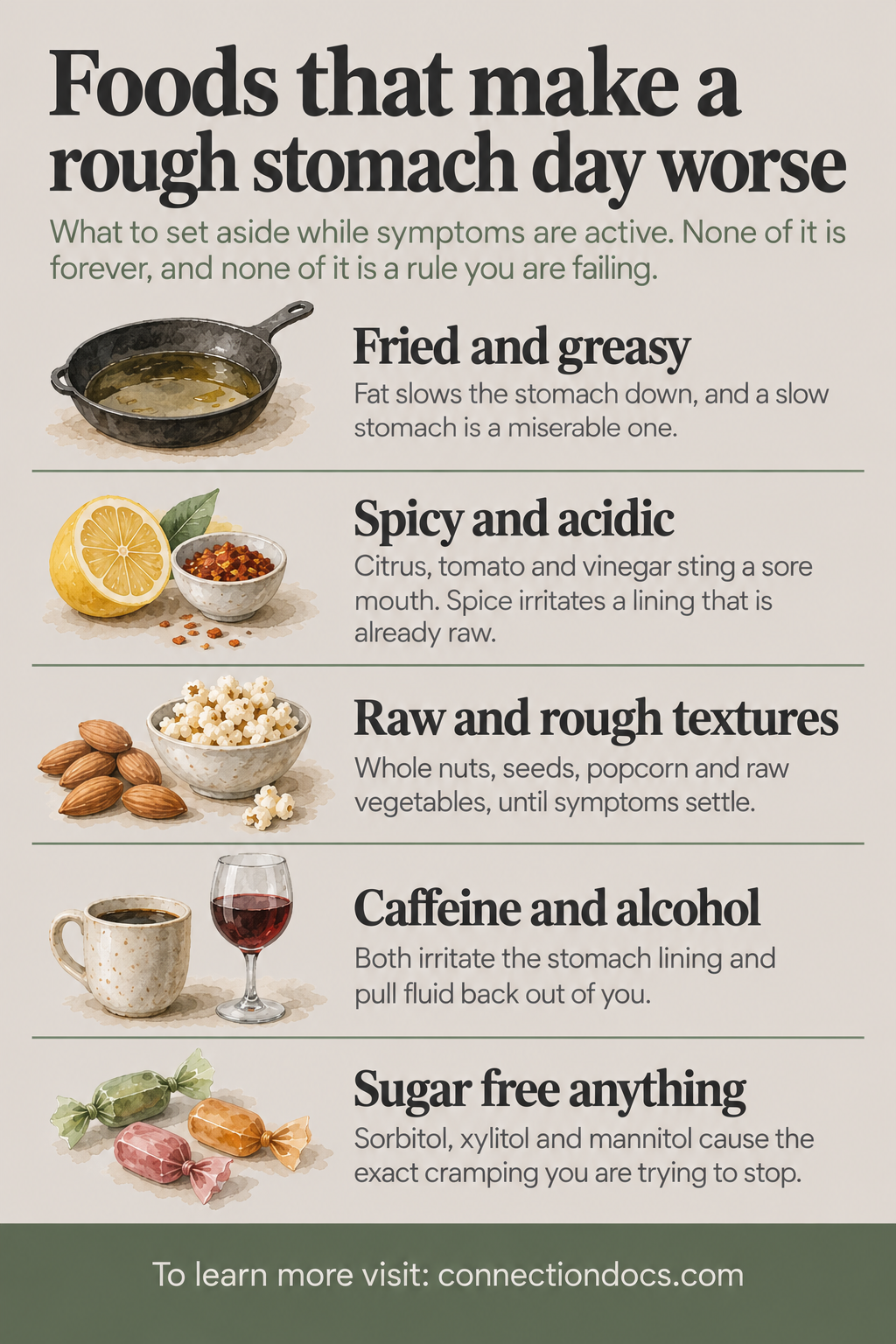
Just as useful is the short list of what to set aside for now.
- Fried and greasy foods, and anything heavy with cream, cheese, or butter.
- Very spicy food, and for some people, highly acidic food such as citrus, tomato, and vinegar.
- Raw vegetables, whole nuts and seeds, and popcorn while symptoms are active.
- Caffeine and alcohol, both of which irritate the stomach lining and pull fluid out of you.
- Sugar alcohols such as sorbitol, xylitol, and mannitol, found in many sugar-free candies and diet drinks. They are a frequent and very overlooked cause of cramping and diarrhea.
- Your favorite food, on your worst day. If you eat a food you love while deeply nauseated, your brain can build an aversion that lasts for years. Protect the foods that matter by not spending them on bad days.
If you are on active treatment, ask your pharmacist about grapefruit and about any supplements you take, since both can interact with specific medications.
Do Not Let Protein Quietly Disappear
Here is where the Fitness piece enters, and it enters through the kitchen.
When eating is hard, protein is usually the first thing to fall away, because protein foods feel heaviest and smell strongest. But muscle is not a cosmetic concern during serious illness. Muscle mass is tied to how well you tolerate treatment, how well you recover from surgery, and how independent you stay through all of it.
European clinical nutrition guidelines recommend that adults with cancer aim for more than one gram of protein per kilogram of body weight per day, and up to one and a half grams where possible. For someone weighing 154 pounds, that is roughly 70 to 105 grams a day. On a rough stomach day, nobody hits that. But knowing the target changes what you reach for in the small windows when you can eat.
Eggs, yogurt, silken tofu, shredded chicken, and a spoonful of nut butter are on this list for exactly that reason. If your intake has been low for more than a few days, ask for a referral to an oncology or clinical dietitian. That referral is one of the most underused resources in medicine.
On the movement side, keep it small and functional. A short walk outside. Sitting upright in a real chair for meals instead of eating in bed. Gentle movement helps gut motility, appetite, and mood, and it does not require you to feel well first.
The Table Is Not Only About Food
Researchers at Oxford, University College London, Harvard, and Gallup studied more than 150,000 people across 142 countries for the 2025 World Happiness Report and found that how often people share meals with others predicted wellbeing about as strongly as income or employment status. That held across every age, culture, and region. Which means what happens at your table is not only caloric.
So on a rough stomach day, we suggest two things.
From the Family side: let people sit with you. You do not have to eat what they are eating, or eat much at all. Ask someone to bring their dinner and sit near you while you work through half a cup of applesauce. The connection is doing something real, whether or not you finish the bowl.
From the Fun side: keep asking yourself what you actually want, even when the honest answer is nothing. Preference is a form of aliveness. Would you rather have the peaches or the pears? Cold or warm? In the kitchen or on the porch? Tiny questions, and also practice at staying in contact with yourself during a season that pulls you away from yourself constantly.
The goal on these days is not a perfect diet. It is to take in enough to keep going, lose as little muscle as possible, and stay connected to the people and the preferences that make the rest of it worth doing.
When to Stop Managing This at Home and Call
Contact your medical team, or seek urgent care, if you have any of the following.
- You cannot keep fluids down for 24 hours, or you are vomiting more than a few times a day.
- Signs of dehydration: very dark urine, urinating much less than usual, dizziness on standing, a dry mouth you cannot resolve, or confusion.
- Blood in your vomit, or vomit that looks like coffee grounds.
- Black, tarry, or bloody stools.
- Severe or worsening abdominal pain, a rigid abdomen, or a swollen belly.
- Fever, especially if you are on chemotherapy or otherwise immunocompromised, where fever is an emergency and not a wait-and-see situation.
- Unintentional weight loss, or several days where you have barely eaten at all.
Nausea and vomiting during cancer treatment are very often controllable with the right medications at the right times. If yours are not controlled, that is information your team needs. Do not white-knuckle it and then report that you are fine at your next appointment.
One Last Thing
If today is one of those days, we hope you find something here your body will accept. Start with two crackers and a few sips of broth. That counts. It is not failure and it is not giving up. It is a reasonable response to a hard day.
And if you are reading this while trying to figure out something much larger than lunch, a new diagnosis, a treatment decision, a conversation with your family that you do not know how to start, we would be glad to talk with you.
You can book a Connection Call with us at https://www.connectiondocs.com/connection-call. No agenda and no pressure. Just a conversation with two physicians who believe that people navigating these decisions deserve more time and more honesty than most systems are built to give.
This article is for general education and is not a substitute for individual medical advice. Please talk with your own physician, oncology team, or registered dietitian about your situation, especially if you are in active treatment or managing a condition such as diabetes, kidney disease, or inflammatory bowel disease, where recommendations may differ.
References and Further Reading
American Cancer Society: Managing Nausea and Vomiting at Home. https://www.cancer.org/cancer/managing-cancer/side-effects/eating-problems/nausea-and-vomiting/managing.html
Memorial Sloan Kettering Cancer Center: Eating Well During Your Cancer Treatment. https://www.mskcc.org/pdf/cancer-care/patient-education/eating-well-during-your-treatment
Dana-Farber Cancer Institute: Managing Cancer Side Effects with Nutrition. https://www.dana-farber.org/patient-family/support-services/nutrition/managing-cancer-side-effects
UCSF Health: Nutrition Plans for Cancer Patients Undergoing Treatment. https://www.ucsfhealth.org/health-articles/nutrition-plans-for-cancer-patients-undergoing-treatment
UT Health San Antonio MD Anderson: Dietary Management for Chemotherapy-Induced Nausea and Vomiting. https://cancer.uthscsa.edu/news-and-stories/dietary-management-chemotherapy-induced-nausea-and
Johns Hopkins Medicine: Nutritional Management of Nausea and Vomiting While Undergoing Cancer Treatment. https://cancer-matters.blogs.hopkinsmedicine.org/2023/03/20/nutritional-management-of-nausea-and-vomiting-while-undergoing-cancer-treatment/
Effects of Ginger Intake on Chemotherapy-Induced Nausea and Vomiting: A Systematic Review of Randomized Clinical Trials (Nutrients, 2022). https://pubmed.ncbi.nlm.nih.gov/36501010/
Efficacy of Ginger in Ameliorating Chemotherapy-Induced Nausea and Vomiting: A Systematic Review Update and Meta-Analysis (Journal of the Academy of Nutrition and Dietetics, 2019). https://pubmed.ncbi.nlm.nih.gov/31519467/
Ginger for Treating Nausea and Vomiting: An Overview of Systematic Reviews and Meta-Analyses. https://pubmed.ncbi.nlm.nih.gov/38072785/
ESPEN Practical Guideline: Clinical Nutrition in Cancer. https://www.espen.org/files/ESPEN-Guidelines/ESPEN-practical-guideline-clinical-nutrition-in-cancer.pdf
ACG Clinical Guideline: Management of Irritable Bowel Syndrome. https://journals.lww.com/ajg/fulltext/2021/01000/acg_clinical_guideline__management_of_irritable.11.aspx
Systematic Review and Meta-Analysis: Efficacy of Peppermint Oil in Irritable Bowel Syndrome (Alimentary Pharmacology and Therapeutics, 2022). https://onlinelibrary.wiley.com/doi/abs/10.1111/apt.17179
World Happiness Report 2025: Sharing Meals with Others. https://www.worldhappiness.report/ed/2025/sharing-meals-with-others-how-sharing-meals-supports-happiness-and-social-connections/
University of Oxford: Social Eating Connects Communities. https://www.ox.ac.uk/news/2017-03-16-social-eating-connects-communities
Breastcancer.org: Eating When You Have Nausea and Vomiting. https://www.breastcancer.org/managing-life/diet-nutrition/healthy-eating-during-treatment/eating-with-side-effects/nausea-vomiting